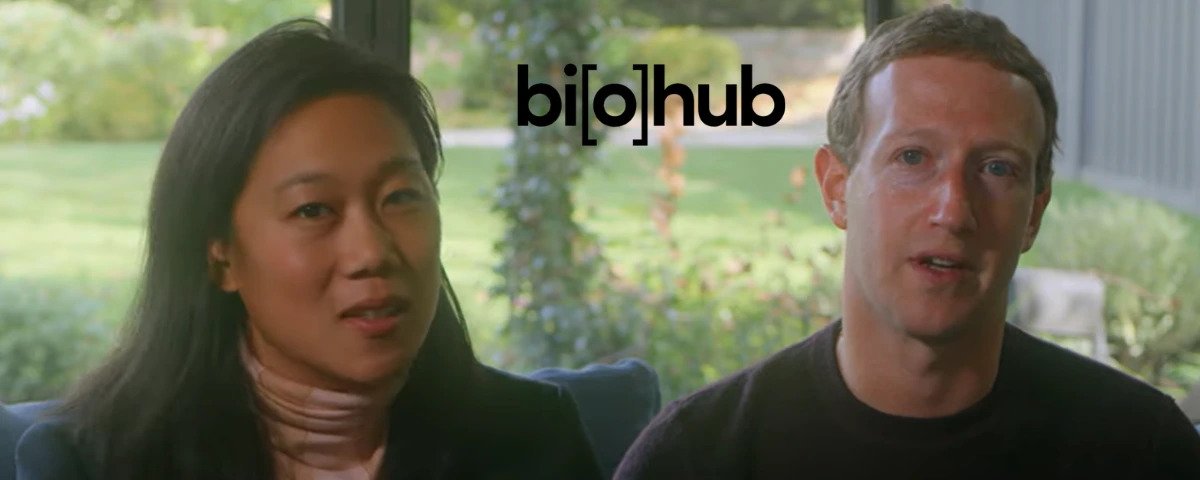
The US government, Google DeepMind, Meta and AI drug-discovery company Isomorphic Labs are joining nonprofit Biohub to generate data for predictive AI models of biology, bringing the total investment to $1.8 billion, said Biohub in a statement.
Founded by Mark Zuckerberg and his wife Priscilla Chan, Biohub is a nonprofit research institute that combines frontier AI and biology to accelerate scientific research.
The $1.8 billion investment combines funding, data, computation and new measurement technology. Biohub has committed $500 million, while the US Department of Energy (DOE) will invest more than $500 million over five years.
The National Institutes of Health will coordinate datasets, repositories and knowledge bases developed through more than $500 million in prior federal investment.
Google DeepMind, Isomorphic Labs and Meta are collectively investing $300 million in the Virtual Biology Initiative- development of technologies and multimodal datasets needed to build predictive models of life.
Also Read: DeepMind and Isomorphic Labs Pitch “Bioresilience” Plan to Keep AI Out of Bioweapon Hands
The DOE will support fundamental cell research through data collection, AI analytics, measurement and imaging, modeling and computation, using resources including exascale supercomputing, X-ray and neutron scattering, cryo-electron microscopy and tomography, and autonomous laboratories.
The NIH will bring together existing biomedical datasets, national data infrastructure and research programs to build resources for the scientific community. Biohub will work with NIH to standardize these datasets for AI model training.
NVIDIA will provide accelerated computing infrastructure, domain-specific software and technical expertise, while Renaissance Philanthropy will help expand funding for data generation.
Demis Hassabis, co-founder and CEO of Google DeepMind, expressed his excitement about the partnership in a post on X.
The most important thing we can apply AI to is improving medicine and human health – very excited about this partnership with the CZI and the Virtual Biology Initiative!
— Demis Hassabis (@demishassabis) October 7, 2026
The collaboration aims to generate large-scale biological data for predictive AI models and advance the development of a “virtual cell.” “An accurate predictive model of biology could dramatically accelerate scientific discovery by enabling scientists to perform experiments digitally,” said Alex Rives, Biohub Head of Science.
Also Read: Trump Unveils Voluntary AI Safety Accord with Google, OpenAI, Anthropic, Meta, xAI and Nvidia