Ant Ling, a team within inclusionAI, Ant Group’s Artificial General Intelligence (AGI) initiative, has released LingSante-3.1-flash, an open-weight medical AI model.
The open-weight medical Mixture-of-Experts (MoE) language model is designed for complex medical reasoning, professional healthcare communication, evidence-based deep research, long-horizon medical tasks and professional behavior alignment.
Built on the architecture of Ling-3.1-flash, LingSante-3.1-flash has 560 billion total parameters, activates 25 billion parameters per token and supports a 1-million-token context window, according to the company.
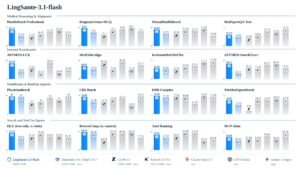
According to the company, the model leads on HealthBench Professional (65.72), HLE (text-only, with tools: 72.22) and BrowseComp (with context: 94.10), outperforming GPT-6 Astra, Claude Opus 5.5 and Gemini 4 Argon on all three benchmarks.
LingSante-3.1-flash demonstrates strong performance on benchmarks for medical professional behavior, ranking second overall behind only GPT-6 Astra, the company added.
The model is designed to handle medical tasks involving incomplete health information, diverse patient scenarios and the need to verify evidence across multiple sources.
Its training combines medical-mixed pretraining, mid-training, supervised fine-tuning, task-specific reinforcement learning and multi-teacher on-policy distillation. Medical data provide domain knowledge and clinically grounded training examples, while general data help maintain broader capabilities such as reasoning, coding, search and tool use.
“Real-world medical tasks present challenges that go beyond general intelligence, including incomplete health information, substantial patient heterogeneity, and strict operational and compliance requirements,” the company stated.
LingSante-3.1-flash lies on the performance–cost Pareto frontier of the InclusionMed medical AI benchmark.
Its previous healthcare release was Ling-3.0-flash-Sante, with 124 billion total and 5.1 billion active parameters per token.
However, the company cautioned that the model is intended for research and evaluation and is not a medical device. Its outputs may be incorrect and incomplete and requires human verification. The company said the model should not independently diagnose, prescribe, determine treatment or make clinical triage decisions.
Also Read: Zuckerberg’s Biohub Teams with Google, US Government in $1.8B Push for AI biological data