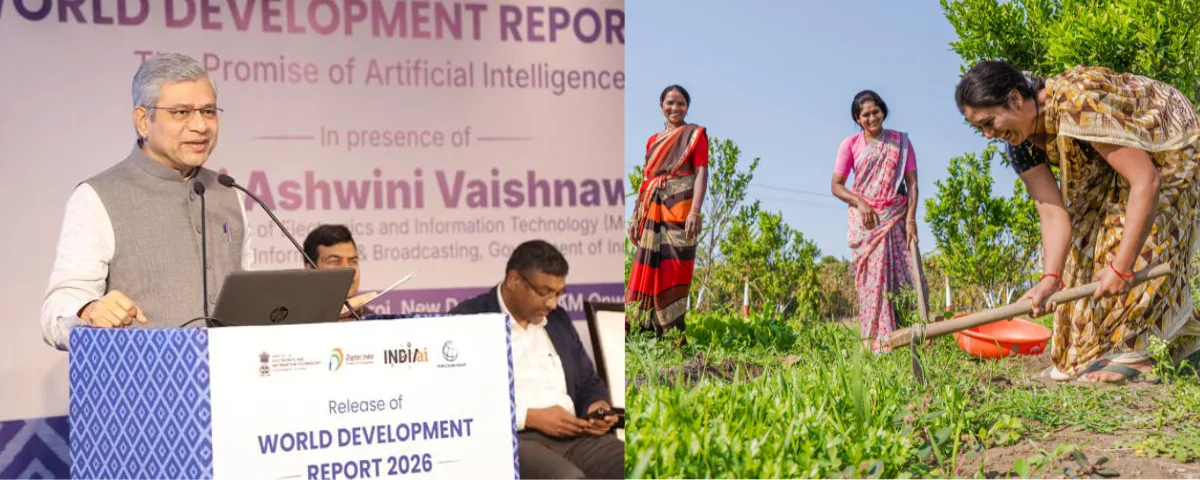
India’s Union Electronics and IT Minister Ashwini Vaishnaw said artificial intelligence is changing the lives of ordinary people in the country citing examples of farmers getting better yields with smarter tools, at the launch of World Bank Group’s (WBG) World Development Report 2026: The Promise of Artificial Intelligence in New Delhi on Thursday.
Launching the World Development Report 2026, Union Minister Vaishnaw stressed on the democratization of AI in order to ensure its benefits reach every citizen, institution and enterprises.
“AI is changing the lives of ordinary people. In Baramati, sugarcane yields rose by 40 per cent with 30 per cent less water and fertiliser, for farmers who have never used a computer simply through voice on a phone. In healthcare, TB detection has increased by 35 per cent. Examples like these can change lives across the Global South and the world,” said Ashwini Vaishnaw. The minister also cited examples of agristack used by half a million farmers in Gujarat.
➜ Union Minister @AshwiniVaishnaw launches World Bank Group’s ‘World Development Report 2026: The Promise of Artificial Intelligence’ in New Delhi
➜ Report sets out a framework for developing economies to harness AI for development through adoption, adaptation and advancement
➜ #IndiaAIMission, @GoI_MeitY and the World Bank Group jointly host the India launch
➜ Policymakers, development experts and technology leaders deliberate on scaling AI for inclusive development
➜ High-level panel and State #AI Showcase examine how India can move from isolated AI pilots to evidence-based scale-up across sectors
Read here for more details: https://t.co/A2guRW8LW9
— PIB India (@PIB_India) October 8, 2026
According to Press Information Bureau, the WBG’s World Development Report 2026: The Promise of Artificial Intelligence asks developing countries to be optimistic yet pragmatic in their approach towards AI, focusing more on adapting AI tools as per local context than spending billions on building advanced systems and infrastructure.
The report also notes that the risk of job disruption due to AI is less imminent in developing countries.
Also Read: India’s AI Agriculture Dream: A Thousand Miles Between Policies and Farmlands
On this occasion, Dr. Michael Kremer, Chief Economist and Senior Vice President, WBG delivered a keynote lecture “From AI Pilots to Scale: The Promise of AI in India”, Illustrating India’s AI-based monsoon forecasting system. He also lauded Indian Meteorological Department (IMD) and Ministry of Agriculture for correctly predicting the unusual monsoon in 2025 and then combining multiple AI models, including open-access models, and delivering the forecasts to millions of farmers through text, voice and AI-powered advisories.
“India’s huge strides in AI is not just addressing its own problems but broader development challenges for the world,” he said. Illustrating examples from weather advisory for farmers and EdTech solutions in Andhra Pradesh, he said, “For the scale up of AI solutions, we need a full stack approach – not just elements of the software but humans and institutional elements that come along with it.”
Also Read: India Faces Limited AI Job Risks, Productivity Gains Could Outpace Losses: Goldman Sachs