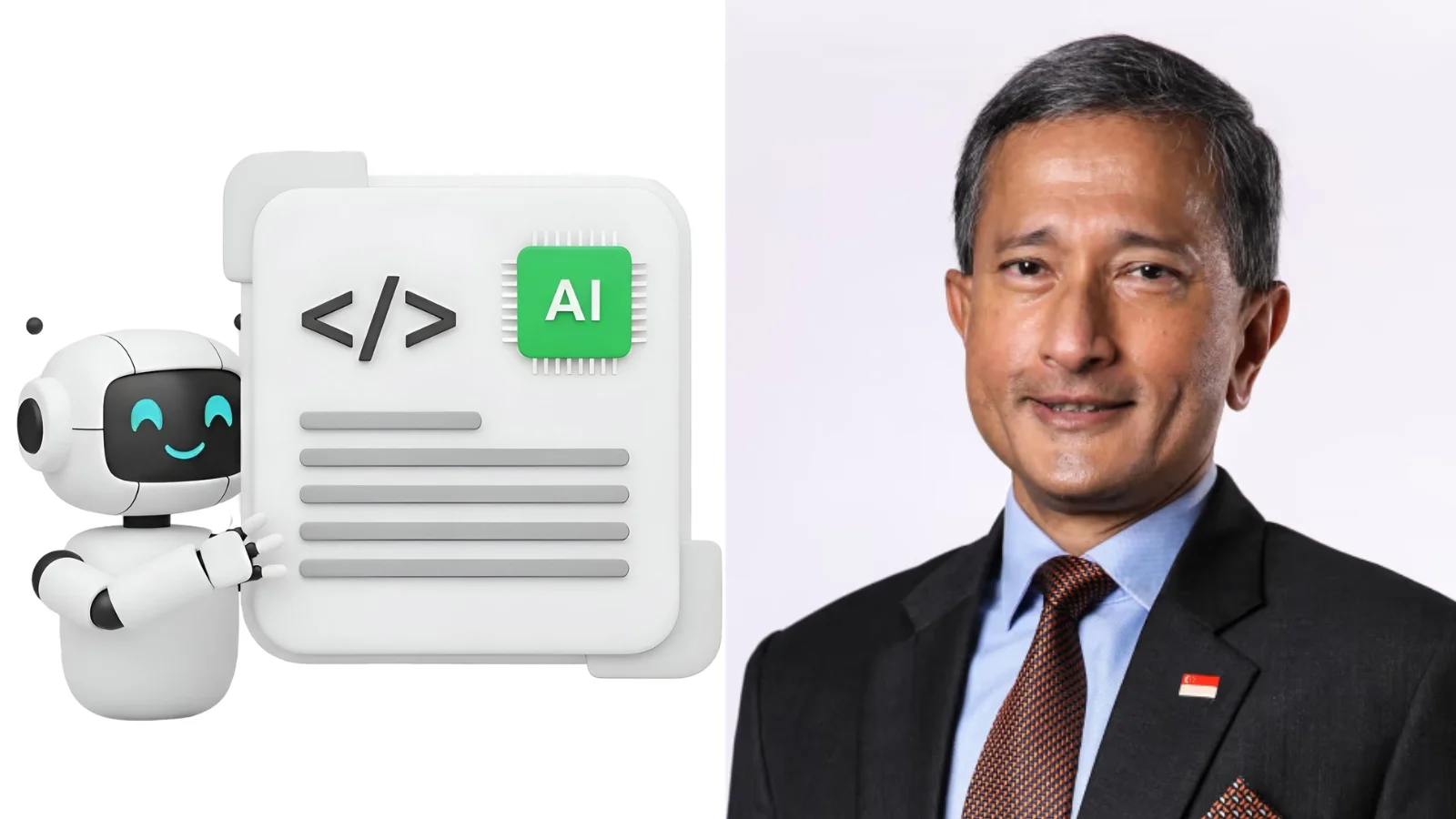
Singapore Foreign Minister Vivian Balakrishnan has built a custom “second brain” AI agent designed for “diplomatic work”. Originally built as a NanoClaw agent on a Raspberry Pi, he has now tested it in Claude Duet as a server-free cloud agent that can remain always-on, using a private GitHub-based knowledge base ordered by source authority.
In a post on GitHub, Singapore Foreign Minister Vivian Balakrishnan said that he has been running the “second brain” on Raspberry Pi for the past nine months but due to the requirement of a dedicated hardware, he decided to built it on Claude Duet- a pro-active AI agent from Anthropic that helps users monitor connected tools and works in background.
Explaining the need for a customized second diplomat brain, Balakrishnan says that unlike regular AI chatbots that responds from vast training data and open web, the AI agent designed by him responds through a three layer setup, where the information-official speeches, transcripts, statements and treaties- is curated and is checkable and has an order of authority.
My “second brain for a diplomat” has run as a NanoClaw agent on a Raspberry Pi. Could it also live in an always-on cloud agent? I rebuilt it in Claude Duet: a curated wiki, one skill, an order of authority, no servers. Full recipe and prompts:
https://t.co/zJ19TfvgTe
— Vivian Balakrishnan (@VivianBala) November 21, 2026
“The principal’s own framing comes first, the curated knowledge base second, the web third. The model’s own background knowledge is never used as evidence, and any disagreement between layers is shown, never hidden,” said Balakrishan.
According to Balakrishnan, the AI system is built around a private GitHub repository that serves as its sole memory store. A short “primer” distilled from the minister’s own speeches sits at the top of a strict evidence hierarchy and below it is a curated wiki of Markdown pages drawn from official speeches, statements, and source documents.
The minister says web search is used only to fill gaps and must be cited. Model background knowledge is never treated as evidence. Conflicts between layers are explicitly surfaced, with the higher-authority source prevailing.
“Together, the wiki and the source documents work as a context compiler. For each question the agent compiles a short brief from the primer, the relevant wiki pages and the raw passages they cite, checks it, then answers from that brief and the web alone. The curated sources are the input, the brief is the compiled output, and the model’s own memory is never part of either,” said Balakrishnan.
Balakrishnan’s blueprint is not a finished government system. He presents the Duet version as an experiment, and he is clear that sensitive material has no place in a cloud-hosted agent. It can read, compile and summarize, but only the record counts as evidence. For governments across the Global South, including India’s, the lesson may lie less in the tool than in that discipline.
Also Read: Meet PMX AI: Malaysia’s Prime Minister Anwar Ibrahim Debuts an AI Avatar