US President Donald Trump has released a voluntary agreement with six major technology companies that sets out a framework for addressing the risks associated with increasingly capable artificial intelligence systems.
President Trump has also changed the name Artificial Intelligence to Superintelligence in the U.S. through an executive order, citing that the new term “more appropriately captures the promise, potential and and rapidly advancing capabilities of these technologies.”
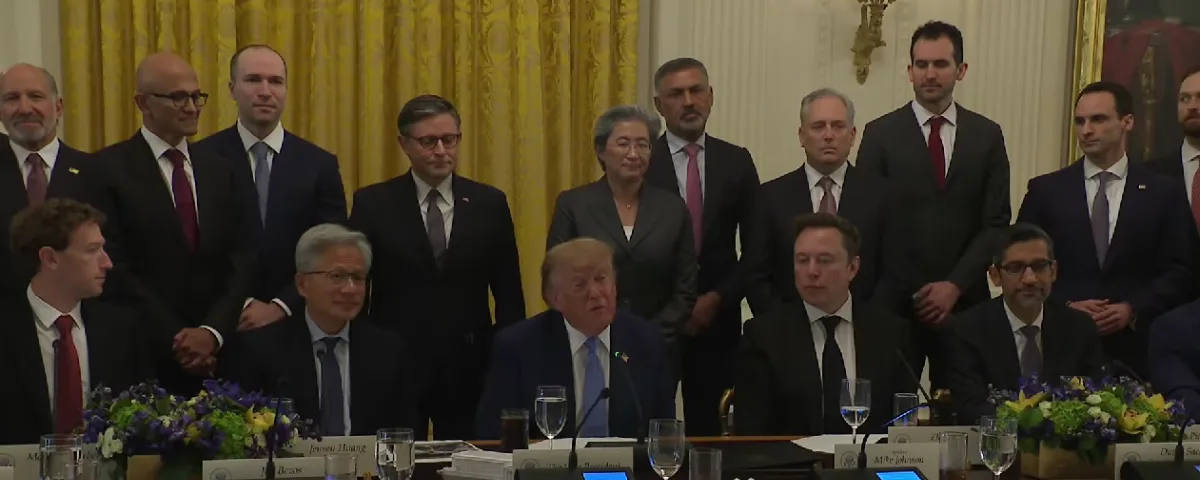
The developments come as Trump hosted AI and Tech leaders like Elon Musk, Mark Zuckerberg, Sundar Pichai, Dario Amodei, Jensen Huang, Lisa Su among others at a White House dinner event on Tuesday.
President Trump referred to the AI/Tech meet as “an extraordinary gathering” of the minds that are “building America’s golden age”.
The meeting came as some tech executives and experts have called for tighter oversight of AI, raising concerns about the potential risks it poses to humanity.
The White House Accord on Super Intelligence: Joint Commitment on Frontier Responsibilities was published by Trump on Truth Social after he had described it as a “morally binding” commitment. The document does not create enforceable legal duties, but mentions that some of its provisions could later be incorporated into legislation or regulations.
The accord was signed by the president and executives from Google, Anthropic, Meta, OpenAI, xAI and Nvidia. The signatories are Google CEO Sundar Pichai, Anthropic CEO Dario Amodei, Meta CEO Mark Zuckerberg, OpenAI president Greg Brockman, xAI CEO Elon Musk and Nvidia CEO Jensen Huang.
The agreement proposes multiple layers of oversight for the development and deployment of advanced AI systems rather than relying on a single safety mechanism.
Under the accord, companies are encouraged to use independent auditors or external assessors to evaluate whether their AI safeguards and monitoring systems are working as intended. The companies would also establish independent board committees to oversee AI controls.
Another layer includes monitoring AI models throughout training and deployment. According to the agreement the proposed checks would cover capabilities and alignment, with particular attention to areas including cybersecurity, biosecurity and chemical threats. The accord also calls for safeguards against models accessing or interfering with technical systems in unintended ways.
Companies would additionally maintain internal teams responsible for testing whether their controls, monitoring and detection mechanisms continue to function effectively.
The White House document says the voluntary measures could eventually be codified through legislation or regulation. The companies have also agreed to meet periodically to develop standards and best practices to improve the safety of their systems.
In a post on X Google CEO Sundar Pichai said the accord is a step towards promoting safe development while delivering the economic and scientific benefits of the technology.
Great to meet today with @POTUS, @JDVance, @SpeakerJohnson and Administration + tech leaders. Important conversation and we signed today the White House Accord on Super Intelligence.
As I shared today, Google has invested hundreds of billions in the last two years alone, with… pic.twitter.com/04EirBfyUX
— Sundar Pichai (@sundarpichai) September 30, 2026
While speaking to press Anthropic CEO Dario Amodei said AI could deliver incredible benefits, including advances in machines but also emphasized that “the technology has very real risks”.
Meanwhile Trump has ordered federal agencies to use the terms “Super intelligence” and “SI” instead of “Artificial intelligence” and “AI” in official communications, describing the technology as part of a new era of advanced intelligence.
“The terminology used by the federal government should reflect the transformative capabilities of these technologies and the limitless opportunities they create for the American people,” read an excerpt from executive order signed by the president.
“Accordingly, the term “Super Intelligence” more appropriately captures the promise, potential, and rapidly advancing capabilities of these technologies. It is therefore the policy of my administration that, to the maximum extent permitted by law, the executive branch shall use the terms “Super Intelligence” and “SI” in place of “Artificial Intelligence” and “AI” and will not acknowledge the usage of “Artificial Intelligence” and “AI” in any applicable setting,” it further mentioned.
However the order does not require previously issued regulations, presidential actions contracts, grants or historical documents to be changed.
David Sacks, the chair of the President’s Council of Advisors on Science and Technology has praised the step taken by the US President for releasing White House Accord on Super Intelligence.
Only President Trump could convene all the leaders of the top companies developing chips, data centers and frontier models for Super Intelligence. This new Industrial Revolution has already created a million new jobs and is spurring a bigger infrastructure build-out than the… pic.twitter.com/tih4YNXmYt
— David Sacks (@DavidSacks) September 29, 2026
In a post on X he said, “I was honored to witness history as the leaders of the frontier lab companies signed the White House Accord on Super Intelligence, accepting responsibility for the safe development of their products and imposing new internal controls and external audits. This is far better than waiting years for some international agreement that would probably never happen. President Trump continues to ensure that U.S. remains the technology leader while putting Americans first.”
Also Read: Trump Announces ‘AI Force,’ Plans to Appoint AI Czar; Suggests Renaming Artificial Intelligence