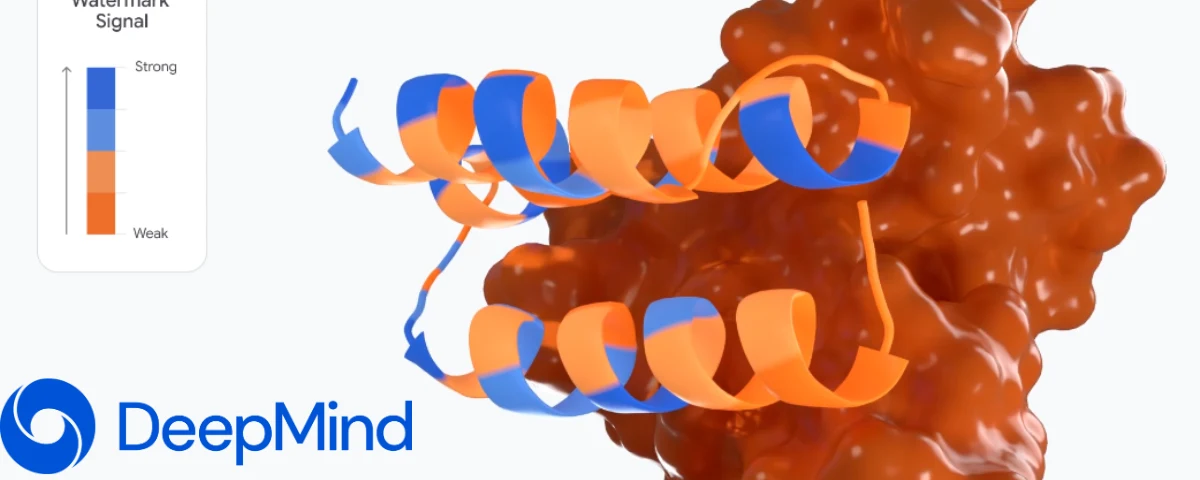
Google announced that it has successfully watermarked AI-designed proteins under ‘SynthID Bio’, while preserving their biological function, in order to identify the artificially made proteins.
In a post on X, Google Deepmind’s Vice President Pushmeet Kohli announced the launch of SynthID Bio watermark for AI designed proteins claiming Google is the first company to watermark AI in biomedical sciences.
“With SynthID Bio, we achieved effective watermarking while preserving biological activity. We developed techniques to watermark both protein sequences as well as predictions of their three-dimensional protein structures,” said Kohli in a post on X.
— Pushmeet Kohli (@pushmeet) September 30, 2026
Explaining the process of watermarking AI designed proteins, Google said the SynthID Bio creates reliable signal for detection by adapting its approach on the type of data and subtly guiding the choice of amino acids for sequences and adjusting atomic coordinates for predicted 3D structures.
“In experiments, these adjustments did not compromise the protein’s biological function, which is essential to effectively treat disease and advance scientific research. We verified our approach for watermarking protein binders, i.e. molecules built to selectively latch onto other proteins, by using our binder design method AlphaProteo alongside a SynthID Bio-enabled version of ProteinMPNN, the commonly used protein sequence generation method,” read a statement from Google Deepmind.
Kohli also said that Google is offering SynthID bio to researchers at Hie Lab at Stanford University and Arc Institute to watermark the genome of an Evo 2-designed bacteriophage.
Google claims that watermarking AI-designed proteins can help against AI designs that can bypass traditional DNA synthesis screening and also pose risk polluting public database and mislead researchers.
“Generative AI could advance how we develop effective disease treatments, but it also has the potential to be misused. For instance, AI-generated proteins could circumvent biosecurity screening measures used by gene synthesis companies, as well as threaten to pollute shared scientific databases,” said Kohli.
Also Read: Google DeepMind Launches AlphaGenome Atlas for 9 Billion DNA Variants