“Happy Rogue AI Day”: Inside the Absurdist Protest at OpenAI Office
“As Playful as Humanity, As AI Can Never Be”– why these activists chose comedy, not rage, to warn about Rogue AI.
In-depth, narrative-driven stories that put people at the center of the AI revolution. Our features go beyond headlines to explore the human experiences behind artificial intelligence — from workers navigating displacement to communities reshaping their futures. Long-form journalism that asks not just what happened, but what it means.

“As Playful as Humanity, As AI Can Never Be”– why these activists chose comedy, not rage, to warn about Rogue AI.

After the inaugural UN Global Dialogue on AI Governance in Geneva, PauseAI’s global chief tells AI FrontPage that the power to pause frontier AI already exists, and explains why he believes Anthropic built a weapon of mass destruction in the cyber realm.

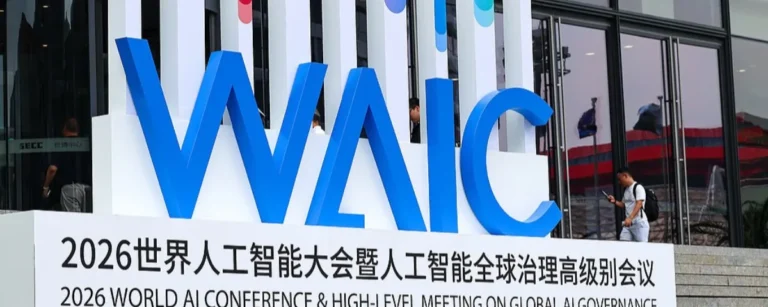
The World Artificial Intelligence Conference in Shanghai closed with 20.36 billion yuan in intended procurement deals, a new intergovernmental AI body signed by 29 countries, and Xi Jinping’s first in-person address a coordinated pitch to the Global South weeks after Washington launched its own AI alliance.

According to a new Concordia AI report, China is shifting its AI safety focus beyond AI-generated content toward governing increasingly autonomous AI systems and the risks they pose to cybersecurity, society, and critical sectors.

India has 591 million gamers, most of them outside the metros — and platforms like STAN now lean on AI to keep tens of thousands of live voice rooms safe. In an exclusive interview, STAN CEO Parth Chadha explains why AI sits at the core of the platform, where it still falls short on moderation, and how it is helping small-town creators earn.

While watermarking is viewed as a safeguard for tracing AI-generated content, research presented at ICML 2026 shows that building watermarks that are secure, robust and stealthy at the same time remains a fundamental challenge.

Alibaba’s internal ban on Anthropic’s Claude Code has evolved into a broader dispute spanning security concerns, regulatory scrutiny, user privacy, and allegations of large-scale AI model distillation between two of the industry’s biggest players.

An AI FrontPage analysis of all 536 spotlight-tier papers at ICML 2026 — the world’s premier machine learning conference — found 40 researchers educated at Indian institutions, including 14 whose papers earned the coveted Oral designation given to just 0.7% of nearly 24,000 submissions.

“A country is not sovereign because it owns every technology it uses. It is sovereign when it is not dependent on a single provider, a single geography or a single political decision”, says Amitabh Kant in an exclusive interview with AI FrontPage.

UNESCO’s toolkit brings together global case studies on AI in the justice sector, examining how courts are using the technology while highlighting legal, ethical and human rights concerns raised by its deployment.