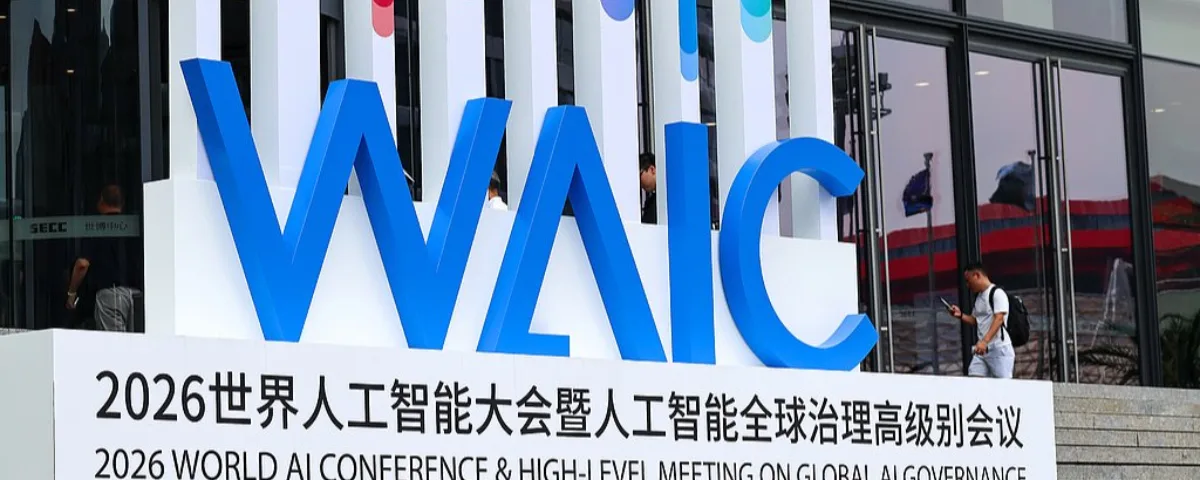
Be it President Xi Jinping announcing World AI Cooperation Organization (WAICO) with 28 other countries or Kimi K3 open-weight models showing frontier capabilities or over 1000 AI/Tech companies displaying latest advancements, the World Artificial Intelligence Conference (WAIC) 2026 Shanghai gave a glimpse of China’s might to the world.
WAIC 2026 was held between July 17-20 in Shanghai concluded on Monday, generating a record 20.36 billion yuan ($3 billion) in intended procurement deals, a 25 percent year-on year increase, the China Daily reported.
WAIC 2026 saw President Xi Jinping’s first in-person appearance at the annual conference as he claimed China was ready to be the answer to the global south in AI. Batting for open-source AI, Xi said AI development should not be a “solo performance” by a single country but a “symphony of international cooperation”.
Jinping’s maiden speech at WAIC 2026 coincided with the launch of Kimi K3, the world’s first 3T open-weight AI model by Chinese startup Moonshot AI. Kimi K3 recorded at par or even better frontier capabilities than Claude Fable and GPT 5.0 in coding and other domains.
At the WAIC 2026, some of the major initiatives signed included 32 key Shanghai AI projects with a total investment exceeding 40.9 billion yuan. China Unicom also launched its “UniAI connecting Shanghai with AI” project investing over 25 billion yuan in intelligent computing infrastructure in the city along with strategic financial agreements supporting new enterprises.
Around 1,117 companies presented 4,486 exhibits, including 351 making their global debut at the conference. China’s neurotech company BrainCo debuted a Brain-Controlled Robot AI Platform that allows humans to command a robot through neural signals at the World Artificial Intelligence (WAIC) 2026 conference in Shanghai.
Several flagship innovations highlighted China’s advances in artificial intelligence and computing. Chinese developers unveiled Kimi K3, an open-weight AI model with 2.8 trillion parameters. The debut of the Dawning 8000 (Dengfeng), China’s first domestically built 100,000- card AI supercomputing cluster, marked a milestone in the country’s computing infrastructure. Huawei also launched the Atlas 950 SuperPoD, featuring 1,024 Ascend AI processors to support next generation foundation models. While AI-powered pharmacy robots and proactive companion robot Bubbo 1 showcased how advanced AI is rapidly moving from laboratories into everyday life.
Meanwhile the conference hosted 158 forums which brought together leading academics and industry experts, along with pitch sessions for 180 startups. The event featured 11 recipients of the Turing award Nobel Prize and Fields Medal laureates. Also at the conference 2026 International Embodied Intelligence Competition was launched and Shanghai Mayor Gong Zheng officially unveiled the Shanghai Institute for Physical AI and Robotics.
Youth participation emerged as one of the defining features of the conference. More than 40 dedicated events drew 1,030 young AI talents globally.
President Xi Jinping attended the opening ceremony of the 2026 World AI Conference and High-Level Meeting on Global AI Governance in Shanghai and delivered the keynote address.
President Xi noted that today, the world has entered an unprecedented period of active innovation on… pic.twitter.com/pGn8kIhsbi
— Mao Ning 毛宁 (@SpoxCHN_MaoNing) July 17, 2026
The signing of an agreement by twenty nine countries including China, Russia, South Africa, Pakistan, Indonesia and Kazakhstan for establishing the World Artificial Intelligence Cooperation Organization (WAICO) was one of the major highlights of the 2026 WAIC conference.
The move by China comes weeks after the US invited 35 nations to sign ‘Declaration on AI Opportunity’ under Pax Silica initiative to secure the supply chain for semiconductors, AI and rare earth elements.
According to the Chinese government, the purpose behind setting up WAICO is to promote international cooperation and global governance on AI, ensure that AI is beneficial, safe and fair, thereby promoting its healthy and orderly development to benefit all humanity.
WAICO will be an intergovernmental organization which will uphold the purposes of the UN Charter, the principles of consultation, joint contribution, shared benefits, and will focus on a people-centered approach.
Apart from WAICO, the Chinese President also announced providing 5,000 opportunities in AI training and seminar programs to developing nations and growing international AI application cooperation centers with ASEAN, the League of Arab States, the African Union, the Community of Latin American.
China Global Television Network mentioned that on the policy front, China’s National Development and Reform Commission (NDRC) along with other government agencies released two key initiatives: the Action plan for artificial intelligence cooperation and development and China Intelligence, Global Benefits (2026), a collection of case studies highlighting the country’s AI achievements.
The Action plan outlined eight practical initiatives covering high quality data supply, inclusive computing power, open-source ecosystems, AI safety governance and ethical development. The document also mentioned about the MAZU intelligent weather early warning system. It is marked as the world’s first nationwide AI solution in response to the “UN early warnings for All initiative”, which is expected to be deployed in 30 countries.
The accompanying casebook showcased the country’s vision of “AI for Good” through examples of AI applications in more than 20 countries. Covering sectors including agriculture, manufacturing, energy, scientific research, healthcare and disaster prevention, highlighting how China’s “A+” strategy is delivering practical benefits beyond its borders.
“For many, the 2026 World Artificial Intelligence Conference (#WAIC), being held in Shanghai on July 17-20, represents an important platform for bringing countries together to address shared challenges, strengthen cooperation and ensure that more nations can participate in shaping the future of AI,” tweeted CAI Run Head of Mission of the People’s Republic of China to the European Union.
As artificial intelligence (#AI) rapidly reshapes economies and societies, global attention is shifting beyond technological breakthroughs to how AI can be developed responsibly and inclusively.
For many, the 2026 World Artificial Intelligence Conference (#WAIC), being held in… pic.twitter.com/W7W3EELTH3
— CAI Run 蔡润 (@AmbCaiRun) July 20, 2026
Under the theme “Intelligent Partners, Shared Future,” the conference emphasised that while AI is reshaping economies, industries and scientific research, it also presents growing challenges related to technological ethics, data security and regulatory systems.
The conference called for strengthening international cooperation in AI, discussion and resolution of major issues and challenges faced by the people in the current technological era, and placing international cooperation in AI capacity building at the forefront of global AI governance.
It stressed the importance of addressing prominent issues such as uneven resource distribution and unequal power allocation, ensuring that countries in the Global South benefit equally from AI development, contributing to the implementation of the UN 2030 Agenda for Sustainable Development, and ensuring that AI benefits all of humanity.
The conference was attended by more than 100 countries and international organizations including UN Secretary-General António Guterres . At the conference he urged governments and technology companies to work together to ensure artificial intelligence (AI) benefits all countries.
AI risks pushing the world towards even greater inequalities, deeper divides in income, opportunity & security, & greater gaps between North & South.
We cannot let that happen.
We must ensure that artificial intelligence becomes a force for greater inclusion & shared progress.
— António Guterres (@antonioguterres) July 17, 2026
“AI risks pushing the world towards even greater inequalities, deeper divides in income, opportunity & security, & greater gaps between North & South. We cannot let that happen. We must ensure that artificial intelligence becomes a force for greater inclusion & shared progress,” António Guterres tweeted.
Xi’s speech at the conference appeared to reflect China’s opposition to the US government’s export controls on frontier AI models. He referred to the recent decision by the U.S. government to put export control over Anthropic’s Frontier AI model Claude Fable and Claude Mythos over national security concerns.
Also Read: China To Answer The Call of Global South: Xi Jinping Bats for a New World Order on AI
Xi urged countries to take a people-centered approach and develop AI for the positive and for good. “In China’s view, all countries should take a people-centered approach and develop AI for the positive and for good. We should ensure that AI is an important driver for shared prosperity and common security. We should join hands to build a just and equitable system for global AI governance,” he said.
What Shanghai made visible was not simply a conference, but the shape of a contest. Within weeks of Washington assembling 35 countries around Pax Silica supply-chain pact, Beijing had signed up 29 for an intergovernmental body of its own, wrapped in the language of consultation, shared benefit and a people-centred approach.
The Global South is the ground on which that contest will be fought, and the currency is not chips but access to training slots, open weights, cooperation centres, early-warning systems deployed in countries that could not build them alone.
Also Read: Why is Indium Phosphide Crucial for AI Chips and Why China Wants Supreme Control?