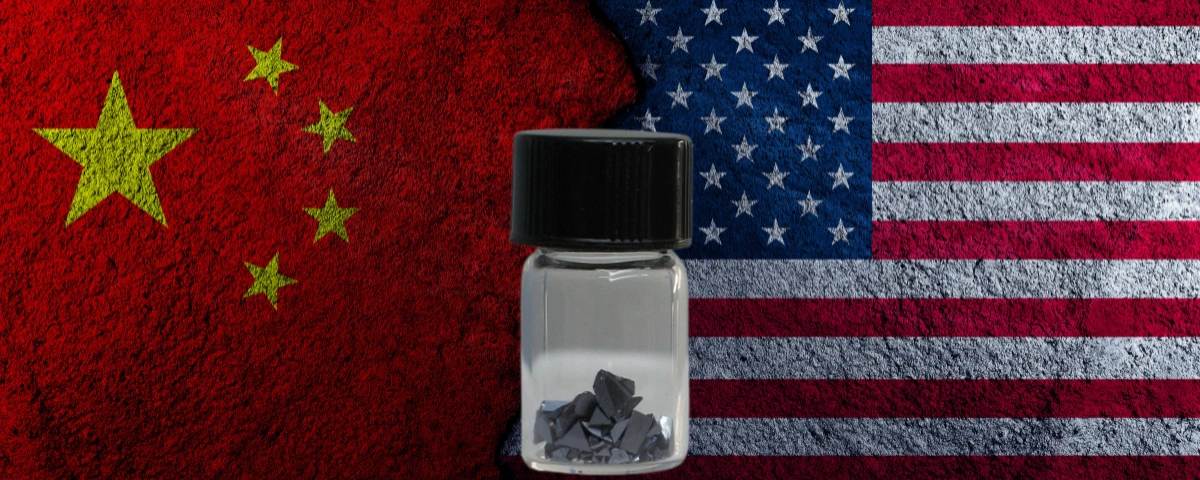
On June 19, as French President Emmanuel Macron hosted G7 leaders in Paris, a new critical minerals alliance was set up, in order to curb the countries’ reliance on China for supplies of metals and minerals vital to defence, technology and renewable energy.
The alliance was a result of China’s increasing control over supply of rare earth and critical minerals/metals including Indium, rare metal extract of Zinc, that is used in manufacturing Indium Phosphide, a binary semiconductor composed of metal indium and non-metal phosphorus.
Indium Phosphide (InP) serves as a critical hardware enabler for high-speed AI data centers and advanced optical chips. The Chinese government had put Indium Phosphide under export control in February 2025 creating a chokehold on its supply to other countries.
While there is no export ban on indium, recent reports by Reuters suggest China’s increasing control over its export as the country manufactures 70% of world’s total indium. Chinese officials are now probing companies seeking export of indium including asking information regarding their end users and where they are based.
Ever since China restricted indium phosphide substrates under export control last year, the average cost of a 6-inch InP wafer has jumped 250% to about US$5,000, putting severe cost restraints on the U.S. AI industry.
To address the same issue, Coherent CEO Jim Anderson was part of U.S. President Trump’s recent delegation to Beijing wherein the topic was discussed with Chinese top brasses regarding delay in export licenses of InP. Recently, the U.S. Department of Commerce’s CHIPS program announced a letter of intent for $50 million funding to Coherent for the expansion of their Texas based first high volume 6-inch Indium Phosphide semiconductor manufacturing facility.
In this article, we will explain what Indium Phosphide is, why it is important for the AI industry and why China wants complete dominance over it through supply of Indium.
What is Indium Phosphide?
Indium Phosphide is a phosphide of indium, a rare, shiny silver colored metal that is a byproduct of zinc refining used mainly for LCD displays, touch screens and solar panels in the form of indium tin oxide.
Indium Phosphide is a man-made, binary compound semi-conductor formed by a chemical reaction at 400 degree celsius of white phosphorus and indium iodide. It can also be formed by a direct combination of purified elements at high pressure or by thermal decomposition of trialkyl indium compound and phosphine.
Indium Phosphide acts as a semiconductor with its electrical conductivity modified by ‘doping’ (adding impurities) to its crystal structure. Indium Phosphide is a hazardous material that can cause cancer.
What makes Indium Phosphide Unique?
The dependence of Indium Phosphide can be understood from its physical feature of being a photonics material. Indium Phosphide has a direct bandgap of 1.34eV which means the compound can efficiently emit and absorb light, which silicon fundamentally cannot since its an indirect bandgap material. Its bandgap makes it ideal for fiber-optic communication as the 1550 and 1310 nm wavelengths ensure glass fiber has the lowest loss.
It also has very high electron velocity / electron mobility, so InP transistors switch faster than silicon ones at high frequencies, useful for millimeter-wave and radar electronics. And it tolerates higher temperatures and power densities than silicon or GaAs.
To explain it in simple terms, even a multi-trillion dollar silicon chip making company like NVIDIA is dependent on indium phosphide as silicon chips are fundamentally incapable of generating light efficiently.
It is here that indium phosphide fills in the gap by acting as the foundation material for optical networking and photonics, allowing thousands of GPUs to communicate at the speed of light.
How Does Indium Phosphide go from Metal to Chips?
First, the indium metal is refined from zinc residues, which is then combined with phosphorus and grown into a single-crystal boule through Vertical Gradient Freeze (VGF) or Vertical Bridgman (VB) method, or Liquid-Encapsulated Czochralski (LEC).
The crystal boule of Inp is fragile due to the volatile nature of phosphorus making it harder for firms to manufacture it at a large scale. The crystal boule is then sliced and polished into wafers with a standard size of 150 mm (6 inches).
The wafers are then sold as semi-insulating and semi-conducting, to be fabricated into lasers, photodetectors, modulators, or photonic integrated circuits (PICs), then diced into chips.
Use Cases of Indium Phosphide
Indium Phosphide had mainly three applications–high speed optoelectronics, optical communication and photovolatile optical. However, it’s the use of InP in AI data center optical interconnects that is currently causing the panic market buy.
As AI clusters scale to tens of thousands of GPUs, the bottleneck stops being compute and becomes moving data between chips and racks fast enough without melting the power budget. InP-based optical chips are the key enabling technology because they transmit data at extremely high speeds while consuming less power than alternatives. In practical terms: the next generation of AI buildouts depends on InP photonics, and there’s no drop-in substitute at the performance frontier.
Why China Wants Supreme Control over Indium Phosphide?
China controls over 70% supply of Indium, a rare metal that is a byproduct of zinc refining. Other major producers of Indium are South Korea, Canada, Peru, Japan, France, Belgium and Russia.
However, when it comes to Indium Phosphide wafer making business, it is controlled by a handful of non-Chinese companies like Japan’s Sumitomo Electric, U.S. based AXT and Japan’s JX Metals.
However, since China controls the export of the fundamental ingredient of Indium Phosphide, it practically creates a bottleneck for U.S. based companies especially NVIDIA and Coherent.
The Indium Phosphide Wafer market is projected to grow at a rate of 12.89% to reach $472.42 million by 2032, driven by its increasing demand in data centers and AI chips. By controlling the raw material supply, China wants to keep its leg on the jugular vein of the AI chip making industry.
Also Read: China’s Indium Phosphide Curbs Threaten U.S. AI Data Centre Expansion