China’s neurotech company BrainCo has unveiled a Brain-Controlled Robot AI Platform that allows humans to command a robot through neural signals at the World Artificial Intelligence (WAIC) 2026 conference in Shanghai.
With Neuro-embodied AI as its underlying framework, the platform uses AI algorithms to decode signals picked by EEG headset, into motor or control intent which then converts into commands for the robot.
According to the company the system translates brain signals into robotic commands in under 200 milliseconds, marking a step forward in integrating brain computer interfaces with embodied AI.
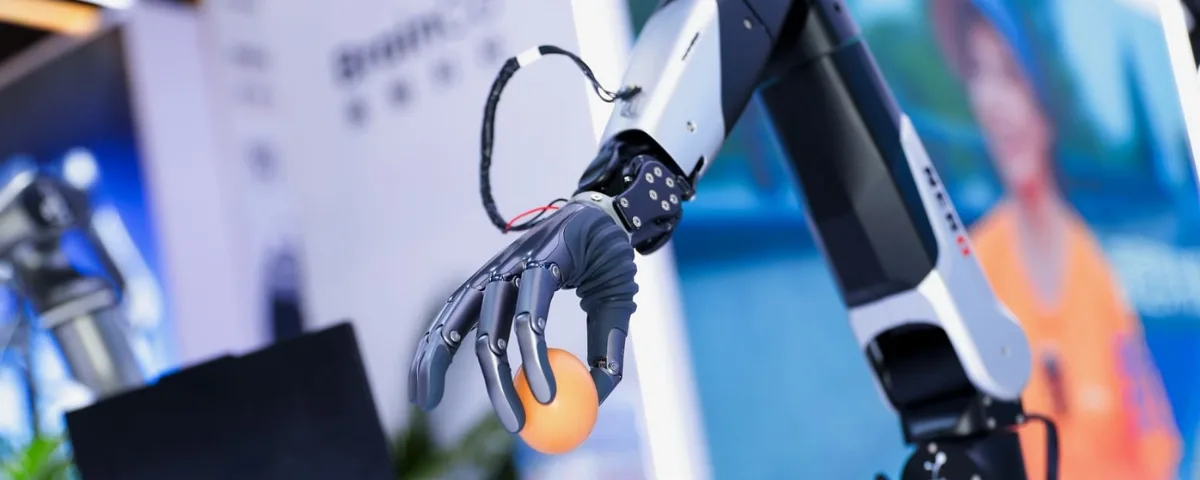
At the WAIC 2026, BrainCo demonstrated a user wearing a lightweight electroencephalography (EEG) headset successfully directed a robotic arm to perform precision tasks such as grabbing a cup or or picking up an apple without speaking, pressing buttons or making any physical movements.
“The technology works in three steps: The user puts on an EEG headset that picks up the wearer’s brain signals, AI algorithms decode those signals to identify motor or control intent, then that intent gets converted into commands for the robot. The entire process takes under 200 milliseconds,” the company mentioned.
The company highlighted that the platform is designed to work with a wide range of commercially available robots, from humanoid machines to robotic arms and four-legged robotic dogs, enabling it to slot into robotics R&D pipelines without needing proprietary hardware.
“A decade of BCI research has given us the ability to decode what a person intends to do and translate that into machine action,” said Nyx He, partner and senior vice president, BrainCo.
“By integrating brain-computer interfaces, AI, and embodied AI, we believe it will define the next chapter of human-machine collaboration,” he added.
Meanwhile BrainCo also unveiled its embodied AI data collection solution, a platform designed to address one of embodied AI’s most persistent gaps which are the lack of high-quality, real-world training data to teach robots complex, dexterous tasks.
“Teaching a robot to perform a complex physical task, such as folding laundry, assembling components and handling fragile objects requires enormous amounts of high-quality training data. Collecting that data has been one of the field’s most persistent technical challenges,” the company informed.
WAIC 2026 is bringing together more than 1,100 companies and over 3,000 exhibits, with more than 300 AI products making their global debuts, as per the latest official data.
Also Read: China To Answer The Call of Global South: Xi Jinping Bats for a New World Order on AI