As governments worldwide race to advance artificial intelligence (AI) capabilities while introducing new AI regulations, most rules under the European Union’s AI Act came into force on August 2, 2026. The Act entered into force on August 1, 2024, and, according to the Council of the European Union, aims to ensure that AI systems are developed and used responsibly.
“As the world’s first law regulating AI, the EU’s rules could set a global standard in AI regulation, just as the General Data Protection Regulation (GDPR) has done for data privacy, promoting ethical, safe, and trustworthy artificial intelligence worldwide,” the Council of the European Union said.
On July 20, the European Commission published transparency guidelines to help providers and deployers comply with the AI Act’s obligations before most rules took effect on August 2.
On June 29, 2026, the Council of the European Union gave its final green light to Regulation (EU) 2026/1744 under the Omnibus VII legislative package.
Effective from July 27, the amendments delayed compliance deadlines for certain high-risk AI systems and banned AI systems used to generate non-consensual intimate content and child sexual abuse material.
The AI Act also establishes penalties for violations of its rules. Fines are based on a percentage of a company’s global turnover from the previous year or a fixed amount, whichever is higher. “SMEs and start-ups face proportionate fines,” the Council said.
The AI Act follows a risk-based approach, classifying AI systems into four risk levels.
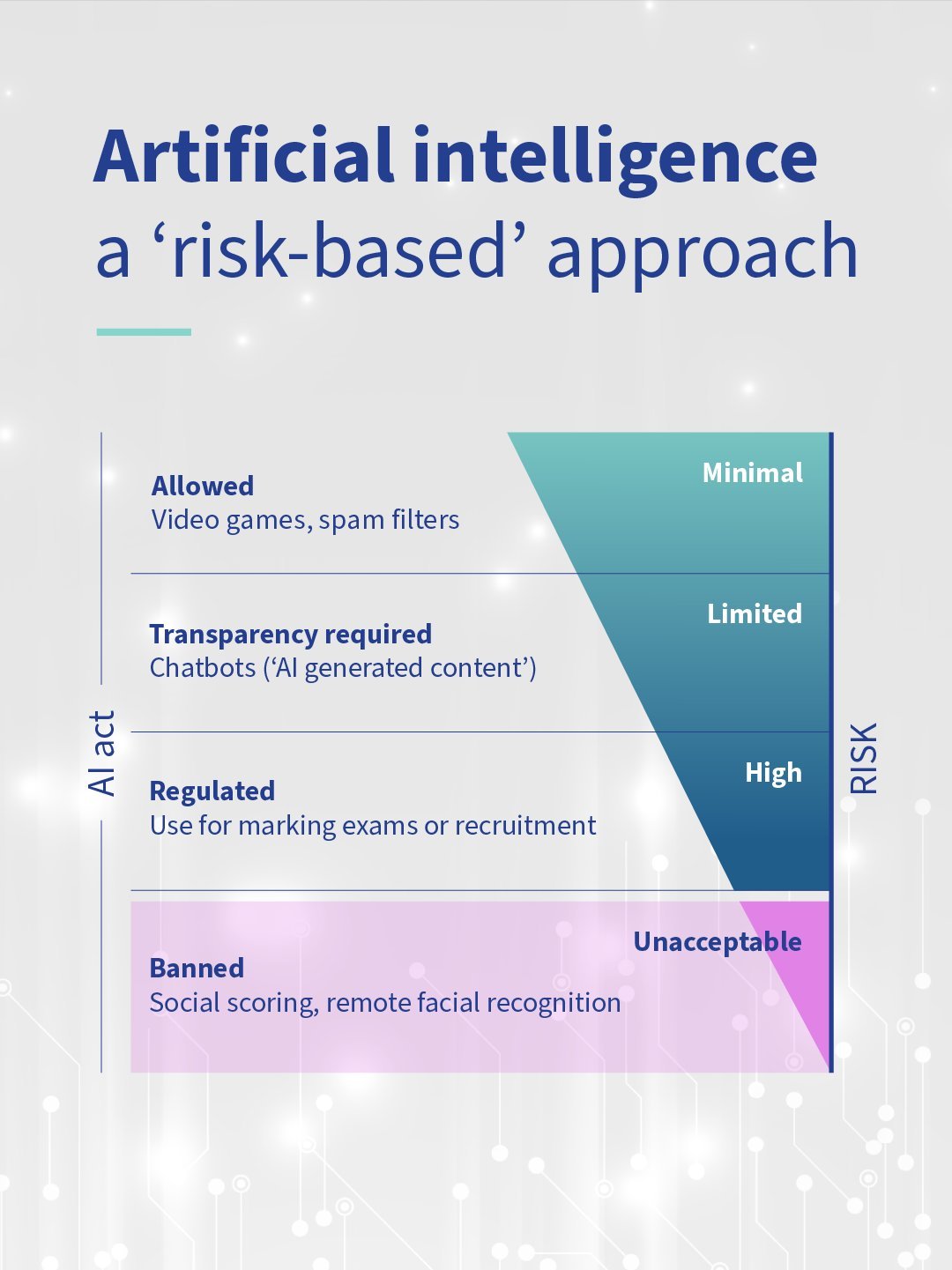
Minimal or no-risk: AI systems such as AI-powered games and spam filters are not regulated under the Act.
Limited-risk: AI systems, including chatbots and AI-generated content tools, are subject to transparency obligations, such as informing users that content was generated by AI.
High-risk: AI systems, including those used in disease diagnosis, autonomous driving and certain biometric identification applications, must meet strict requirements, including testing, transparency and human oversight.
Unacceptable-risk: AI systems that threaten people’s safety, rights or livelihoods are prohibited in the EU. These include cognitive behavioural manipulation, predictive policing, emotion recognition in workplaces and educational institutions, and social scoring.
The Act also covers general-purpose AI (GPAI) models, such as those used for text generation and image recognition. Models posing systemic risks are subject to stricter requirements, while those without systemic risks face limited transparency obligations.
To ensure proper enforcement, the AI Act establishes an AI Office within the European Commission, a scientific panel of independent experts, an AI Board comprising representatives of member states, and an advisory forum to provide technical expertise.
The Council said the AI Act aims not only to strengthen the enforcement of laws protecting fundamental rights and safety but also to promote investment and innovation in AI and facilitate the development of a single market for AI applications.
The AI Act is in line with the European Union’s broader AI strategy, including the AI Continent Action Plan to strengthen AI innovation, infrastructure and competitiveness.
Also Read: India-EU Join Forces on Frontier AI Models to Challenge U.S. Dominance