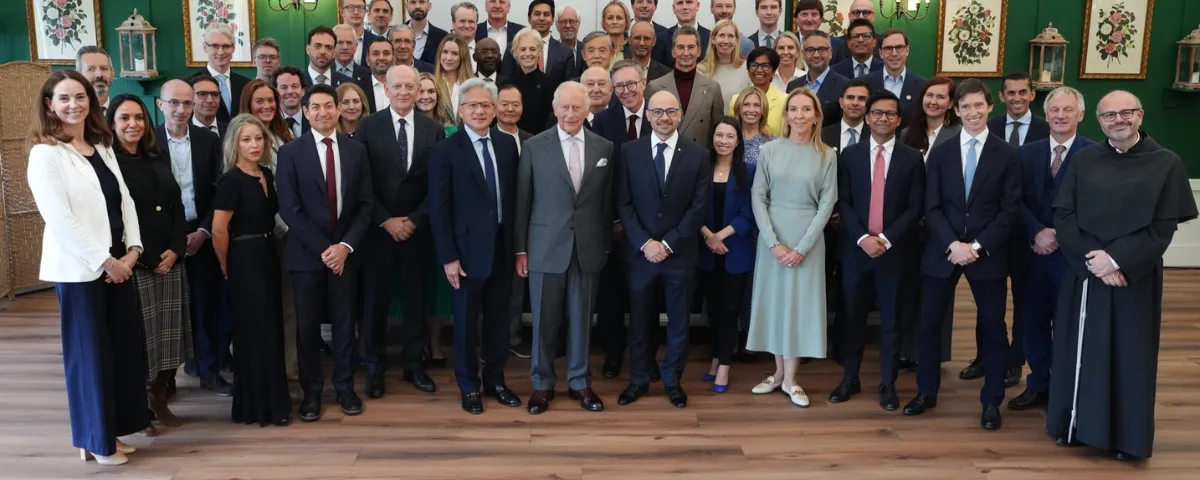
Calling for stronger safeguards and international cooperation in the development of artificial intelligence, UK King Charles met representatives of AI industry at AI summit in Scotland Thursday to discuss need for a shared set of principles for the evolving technology.
NVIDIA CEO Jensen Huang, Google Deepmind CEO Demis Hassabis and UK AI Minister Kanishka Narayan were among the several delegates who interacted with King Charles at the AI Summit in Scotland.
“AI is already showing its immense capacity to improve and save life – for example, in the field of life sciences and medicine. Yet, those who have created these technologies are now increasingly warning that AI risks developing darker capacities – perhaps even to take life,” King Charles said.
Building on the message he delivered at the UK AI safety summit in Bletchley in 2023, King Charles posed two key questions to those working on AI: “How can we harness the benefits of AI, with safety at its heart? and “How can we build international cooperation and consensus to achieve this, so no Nation is left behind – but the human race is left in place?”
“I really am enormously grateful for the presence in this room of many of our greatest technological minds, and indeed, for the thoughtful stewardship demonstrated by those gathered here today as you consider the fundamental principles that should – and must – guide the… pic.twitter.com/raxMvdTZvT
— The Royal Family (@RoyalFamily) September 17, 2026
According to UK’s Royal Family, King Charles had convened the summit at Dumfries House in Ayrshire to discuss how the tech can be used to benefit society as he stressed that AI has the potential to improve and save life, particularly in life sciences and medicine.
He said the rapid development of AI must be considered within the wider systems on which humanity depends, stressing the importance of maintaining a balance between technological progress, humanity and the natural world.
“The decisions taken at this formative time will shape the world inherited by future generations. And so, the task before you is not merely to advance technology, but to ensure that it remains firmly in the service of humanity, community and the natural world,” King Charles said.
Jensen Huang, chief executive of Nvidia, was among the top industry leaders present at the summit.
Huang told the room that safety was “paramount”, saying companies should hold back a product and “keep engineering” it if it was not safe enough. The Nvidia CEO also stressed the importance of open models, which gives users direct access to the underlying software, saying they can help people “ensure that people and countries are not left behind”. He further added that these systems must be protected to allow “researchers, universities, startups and countries” to build applications “none of us would have imagined alone”.
Meanwhile, Demis Hassabis, CEO of Google DeepMind said artificial general intelligence systems that could match or surpass humans across multiple tasks was probably only a few short years away and have an impact “ten times that of the industrial revolution”.
He acknowledged that the chance of something going wrong was definitely non zero but called for a sensible middle way, arguing that humanity could address the risks if given enough time and space to mitigate them collectively.
UK AI minister Kanishka Narayan was also present at the summit. In a video on X, he delivered a message to the global AI leaders who attended the summit saying, “In recent days some of the global AI leaders building advanced AI systems have issued a warning about the risks posed by them. I urge them to not ignore these warnings and build AI systems that are safe and secure for the British public.”
It was a privilege to join His Majesty The King at Dumfries House today, as he convened AI leaders, civil society and others to discuss how AI can be developed and deployed in ways that are safe and benefit society. https://t.co/NKkkUHqjAh pic.twitter.com/wzHx1rHHY6
— Kanishka Narayan MP (@KanishkaNarayan) September 17, 2026
He further highlighted that Britain needs to test the most advanced AI systems, understand the risks, level up its defences in cybersecurity and critical national infrastructure. Kanishka stressed that the country needs to build sovereign capabilities which should be shaped by British values.
OpenAI chief financial officer Sarah Friar and Anthropic’s chief global affairs officer Tino Cuellar also attended the summit.
The recent incidents involving OpenAI and Anthropic models have raised questions over safety safeguards, cybersecurity risks and how advanced AI should be developed and controlled.
Recently, AI safety researcher Jacob Coxon announced his exit from Anthropic, warning that AI companies are gambling with people’s lives by racing towards superintelligent AI.
Following Coxon’s tweet, concerns have grown over the potential risks posed by the rapid development of artificial intelligence. It has also intensified the political heat in the U.S. as several governors, senators, lawmakers, senior congressmen and congresswomen expressed their shock and concern.
Also Read: UK AI Politics Heats Up Over Frontier Model Access, Superintelligence Ban Bill