The European Commission on Monday published guidelines to help providers and deployers of artificial intelligence systems comply with the transparency obligations under the EU AI Act, which take effect on August 2, 2026.
The Commission said the transparency obligations are intended to help people recognize when they are interacting with AI or when content has been generated or altered by AI, reducing the risk of deception and manipulation.
The guidelines explain key concepts under the AI Act‘s transparency obligations, which are set out in Article 50 of the legislation, including directly interactive AI systems, synthetic content, deepfakes and AI-generated text on matters of public interest.
“On 2 August 2026, the majority of rules laid down in the AI Act start to apply, including the enforcement powers of the Commission and of national market surveillance authorities,” the Commission said.
It added AI systems placed on the market before August will have to comply with the marking and detection obligations from December 2, 2026.
Under the AI Act, providers must design AI systems to inform users when they are directly interacting with AI and add machine-readable marks to enable the detection of AI-generated or manipulated content. Deployers must inform users when they are exposed to deepfakes, AI-generated content on matters of public interest without human review or editorial control, and emotion recognition or biometric categorization systems.
The guidlines explain exemptions, such as standard spelling and grammar correction, and explain how providers and deployers can demonstrate compliance, including through adherence to the voluntary Code of Practice on Transparency of AI-generated Content or through other equivalently adequate means.
The Commission is also introducing a range of tools to help organizations understand their AI Act obligations, including the Code of Practice on Transparency of AI-generated Content and the AI Act Service Desk.
“With today’s guidelines, the Commission supports the smooth and effective application of the AI Act to make AI systems interacting with people such as chatbots and AI agents and AI content more transparent and trustworthy,” said Henna Virkkunen, Executive Vice-President for Tech Sovereignty, Security and Democracy.
She added that these guidelines support providers and deployers in meeting their obligations under the AI Act, while helping citizens know when they are interacting with AI.
The guidelines to help providers & deployers of AI systems meet the EU AI Act’s transparency obligations have been published.
The transparency obligations will help people recognise when they are interacting with #AI or when content has been generated or altered by AI. https://t.co/xCOmQ1mLDL pic.twitter.com/a9Aeb7XnQi
— Henna Virkkunen (@HennaVirkkunen) July 21, 2026
The transparency obligations form part of the AI Act, which the European Commission describes as the world’s first comprehensive legal framework on artificial intelligence.
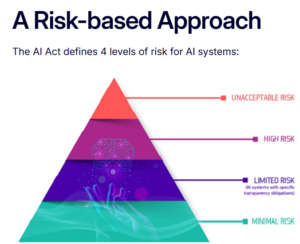
The Act adopts a risk-based approach and is part of a broader package of policy measures that also includes the AI Continent Action Plan, the AI Innovation Package and AI Factories.
Separately, the EU AI Office this month published a report on findings from more than 100 experts on how the European Union can enhance its competitiveness, sovereignty and security in frontier AI.
According to the report, experts said the next one to two years could be decisive for Europe to strengthen its position in frontier AI. The report informs the European Frontier AI Initiative and notes that it reflects expert findings rather than the official position of the European Commission.
Canadian AI researcher and computer scientist Yoshua Bengio drew attention to the report on X, highlighting its recommendations for strengthening Europe’s position in frontier AI.
The EU AI Office has put out a new report, with input from 100 experts, outlining how the European Union can enhance its competitiveness, sovereignty and security in frontier AI. https://t.co/Omte8SjMke
— Yoshua Bengio (@Yoshua_Bengio) July 20, 2026
Also Read: Google, Apple Challenge EU AI Assistant Rules, Cite Privacy and Security Risks