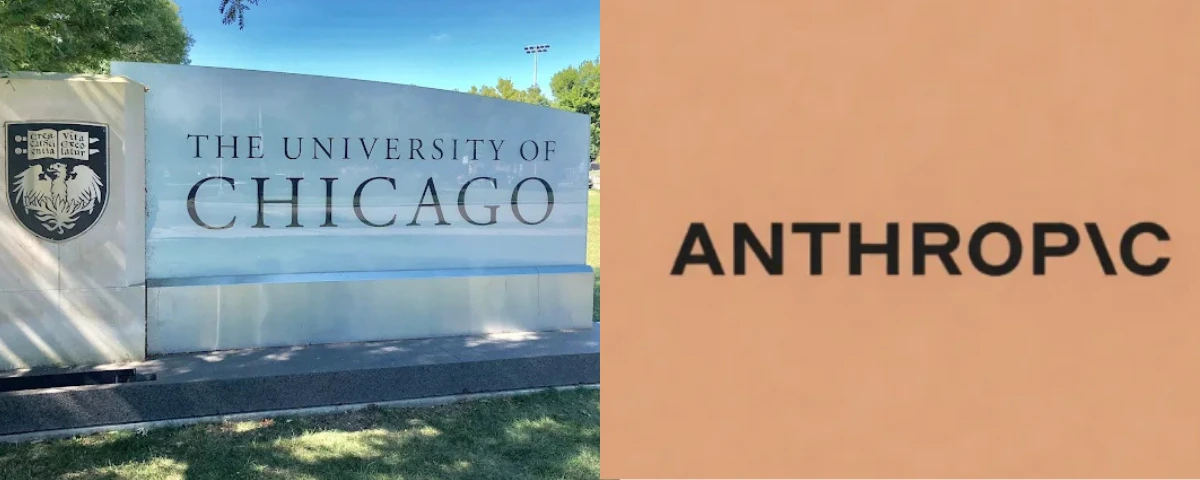
The University of Chicago has partnered with Anthropic to provide access to Claude Enterprise, including Claude Chat, Cowork and Code, for all academics and staff starting in July, and for all students before the fall term.
The users will be granted access to the newest versions of Anthropic’s tools along with improved integration with university resources and tools and stronger data protection than is available with private accounts.
“This is a time of rapid change due to the advent of AI, and the university has been thoughtful in navigating it. Indeed, there is inspiration to be drawn from our faculty’s report on AI and education that calls on us to be skeptical, ethical, and ambitious when it comes to AI, while remaining grounded in the habits of mind and standards of judgment that define this university,” said Paul Alivisatos, president of the university.
In a letter to the university the president said that in some cases AI tools can give better results while in other cases previous approaches may work better or new policies may be needed to prevent misuse. However, he stressed that the priority is making these tools available in a way that respects and protects every individual who is part of the university.
He further highlighted that the adoption of AI tools and systems for the workplace will balance important priorities.
The president expressed that the university will seek ways to relieve burdensome and repetitive activities, reduce friction in routine tasks, strengthen service to students and faculty, and create more capacity for the forms of judgment, care, and coordination that each of you brings to your endeavors.
He said faculty and instructors are developing classroom practices and policies to help students navigate the opportunities and challenges presented by artificial intelligence, adding that the framework will prepare students to meet the opportunities of a changing world.
Giving some details about the framework the president said, “You can understand more about how your faculty are thinking about helping you to learn by reading about a recent series of workshops sponsored by the Center for Teaching and Learning. Policies vary by course, and you are required to follow them closely; but the sum across your full curriculum will give you diverse learning experiences with and without AI assistance.”
The president pointed out that the motive behind giving access to AI tools is that scholars across disciplines can harness them to enhance their work.
“We will continue to deepen support for research with AI that requires specialized AI tools, including by providing access to different tools beyond those we have secured with this agreement,” he stated.
The university aims is to enable access for faculty and staff in early July, for those who wish to participate. Students will have access after faculty and instructors closest to pedagogy have had the opportunity to do more specific planning that takes this expanded access into account. Also, it plans to appoint a faculty committee for AI and academic life to advise on AI implementation over the next year.
However, the announcement by the university has been criticized by some of the students and professors on social media platform X.
Some members of the university community expressed skepticism about the announcement on X.
“As a next step in the University of Chicago’s overall approach to AI, the University is selling itself out to Anthropic and abolishing its core mission of research, education and independent thought,” said Pavel Gregoric, a senior research fellow at the Institute of Philosophy in Zagreb Croatia.
As a next step in the University of Chicago’s overall approach to AI, the University is selling itself out to Anthropic and abolishing its core mission of research, education and independent thought. pic.twitter.com/pzwzXmsNey
— Pavel Gregoric (@pavelgregoric) June 3, 2026
The announcement comes as universities continue to debate how generative AI should be used in teaching, research and assessment.
Recent studies have revealed that students across several universities are becoming dependent on the use of generative artificial intelligence for their assignments and other research related work. AI tools like ChatGPT are becoming more common in academic settings.
A study titled “Generative AI Use and Misuse Call for Assessment Reform in Higher Education” analyzed responses from more than 95,000 undergraduate students across 20 major public research-intensive universities in the United States. It revealed that 37.1% students reported using generative AI tools almost monthly while 9.3% admitted to using it for cheating.
“This junk is being pushed by trustees, and, because trustees are major donors, presidents probably feel obliged to them. But the first one who just flat out says no and loses their office because of it will be a legend in their own time,” tweeted V. Joshua Adams, a professor at the University of Louisville.
This junk is being pushed by trustees, and, because trustees are major donors, presidents probably feel obliged to them. But the first one who just flat out says no and loses their office because of it will be a legend in their own time. https://t.co/XE8xzpmYzv
— V. Joshua Adams (@vjoshuaadams) June 3, 2026
A few days back California-based UC Berkeley School of Law announced a strict AI policy that will prohibit AI use for coursework and examinations, while allowing limited AI use only for identifying research sources.
The policy states that future lawyers may need to use AI fluently, but its use must be accompanied by cognitive skills needed to strategically deploy the technology, critically assess its work product, and uphold ethical obligations to clients and the legal system.
While the University of Chicago is expanding access to AI tools across campus, UC Berkeley School of Law has adopted a more restrictive approach, highlighting the different ways institutions are responding to generative AI.
Universities across the world are trying to expose students and faculty to AI tools but at the same time they are also grappling with the misuse of AI.
Also Read: Australia’s Classroom AI Crisis: Cheating, Learning Loss and No Easy Fix