Classroom AI Crisis: A landmark study has found that artificial intelligence is already disrupting classrooms across Australia’s and warns that if left unaddressed, the damage to student learning will only intensify.
A new study titled “AI Use in Schools: Taking Action Now” by Australian education research group Learning First has warned that the negative impact of Artificial Intelligence (AI) on student learning is increasing. The study has argued that supporters of AI perceive risk to education as a future problem which can be managed, but this perception is both misplaced and dangerous.
“New evidence from teachers and school leaders shows that AI is already being used in schools in a variety of ways, and that the ‘risks’ of AI to education are no longer problems that might come to pass in the future, but realities that schools are dealing with today,” the study revealed.
The researchers surveyed 3,377 teachers and 766 school leaders, which is a total of 4,143 educators across government, independent and Catholic schools in New South Wales, Australia.
What the Data Shows
The study found that around half of secondary teachers reported students using AI for schoolwork. More specifically, 56% of senior secondary teachers and 43% of lower secondary teachers confirmed student AI use with the problem most acute in the final years of schooling where results carry the greatest weight.
Among these teachers, nearly three-quarters said students use AI to complete assessments, despite more than 80% of secondary teachers stating that restrictions on using AI were already in place.
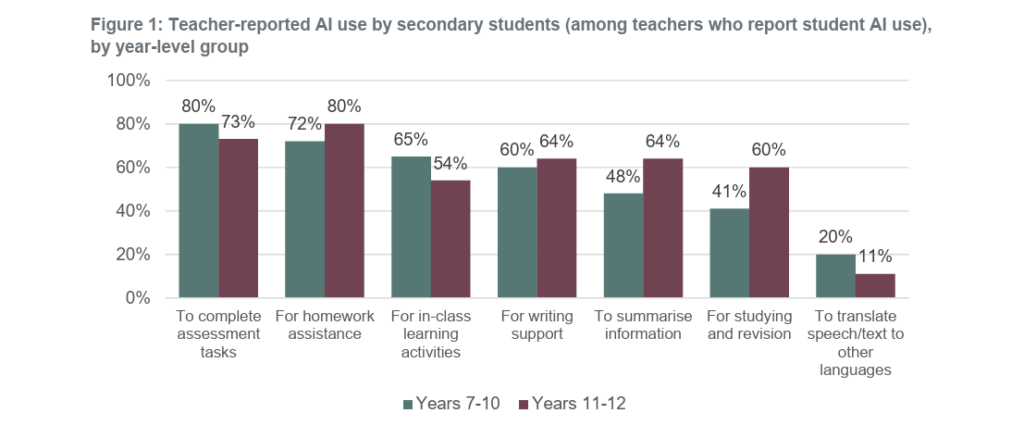
Most alarmingly, one in five senior secondary teachers said that all or almost all of their students used AI to complete their most recent main assessment task, even where it was banned.
“About half of secondary teachers are worried they do not know how to prevent AI-related student plagiarism or cheating and almost 80% of teachers and school leaders from primary and secondary schools whose students use AI for schoolwork are concerned about its future impact on education,” the study informed.
Only one in five schools has set any guidelines on whether and how students can use AI for assessment.
The Thinking Problem
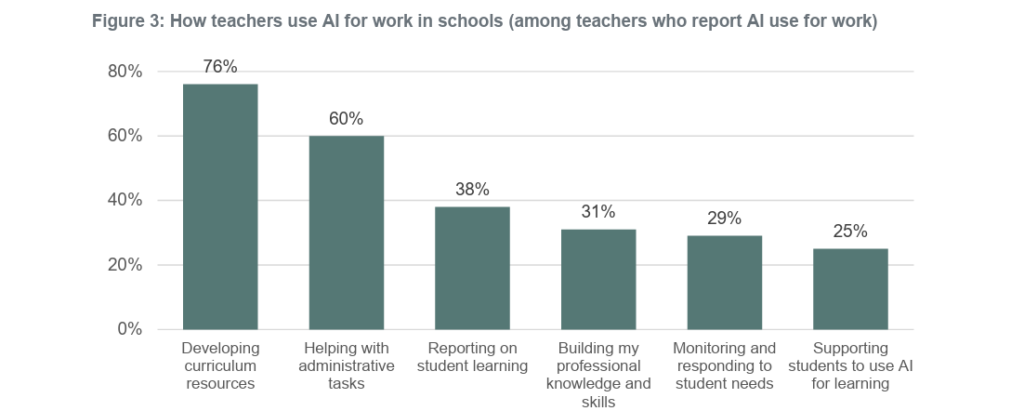
It further highlighted that three-quarters of teachers and school leaders have used AI for work, and about three-quarters of these teachers have used it to develop curriculum resources. The study raised concern about the widespread and less visible use of AI. Many teachers said they cannot tell how often or in what ways their students are using AI, meaning the true scale of the problem is likely even larger than the data suggests.
“School leaders and teachers say that students are using AI not as a cognitive partner for learning but as a surrogate to which they can delegate their thinking, a phenomenon known as cognitive outsourcing,” the study stated, adding that Emeritus Professor Paul Kirschner describes cognitive outsourcing as ‘handing over the thinking itself’ to AI.
Researchers warn this is not simply a cheating problem. It is a learning problem. When students outsource thinking to AI, they may produce polished work but retain nothing. The Organisation for Economic Co-operation and Development (OECD) calls this the “mirage of false mastery.” Researchers describe it as a “performance paradox” where output improves while actual learning declines. The Brookings Institution has gone further, describing the growing sophistication of AI tools as “an existential danger to learning itself.”
Teachers and AI: A Double-Edged Problem
The study mentioned that the challenge AI poses to education is not only limited to student use. Even educators are increasingly using general-purpose AI to develop curriculum resources, yet these tools are not trained exclusively on content that reflects the evidence on how students learn best.
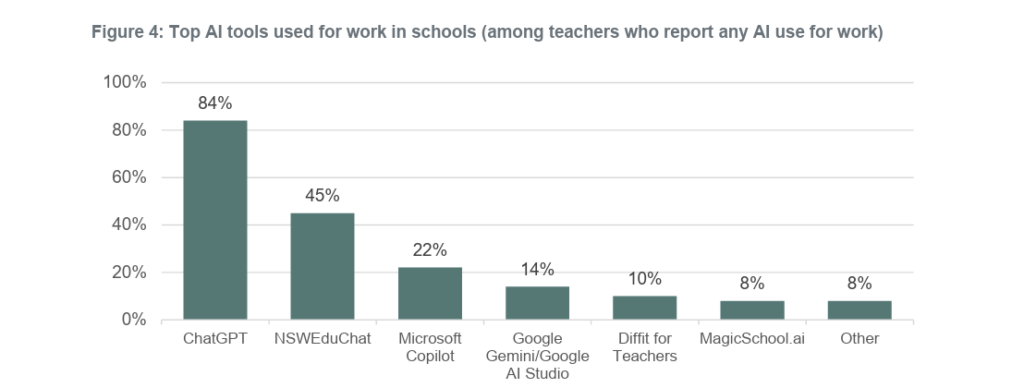
Of teachers who use AI for work, 84% use ChatGPT, which is a general-purpose tool with no built-in instructional goals, no learning theory, and no pedagogical intent.
“For instance, general-purpose AI typically design ‘activity-first’ lessons, a superficial approach in which student activities, rather than the knowledge and related skills to be learnt, drive instruction. As a result, AI can harm effective teaching,” the study stated.
The study also warned that plagiarism detection software, used by over one third of secondary teachers, is largely ineffective. Emeritus Professor Dylan Wiliam stated that accurate AI detection may be “in principle, impossible,” adding that students can simply feed AI-generated work through detectors themselves and paraphrase accordingly.
A Cautionary Tale from South Korea
The report pointed to South Korea as a cautionary tale for education systems. The country planned to make AI-supported textbooks mandatory across all schools by 2028 but the initiative collapsed due to lack of teacher preparation, parental concern over digital overload, and political instability. By mid-2025, a newly elected government moved to phase out the programme entirely.
Conclusion
The study warned that if left unaddressed, the risks AI currently poses to teaching, learning and assessment will intensify. “Once realised at scale, these harms will undermine excellence and equity in education,” it said.
The study further suggested that effective AI governance depends on coordinated leadership at every level of the education system and not a single teacher, school leader, network or system leader can carry this work alone.
Also Read: Over a Third US Students Use Gen AI, 9.3% Admit Cheating: Study