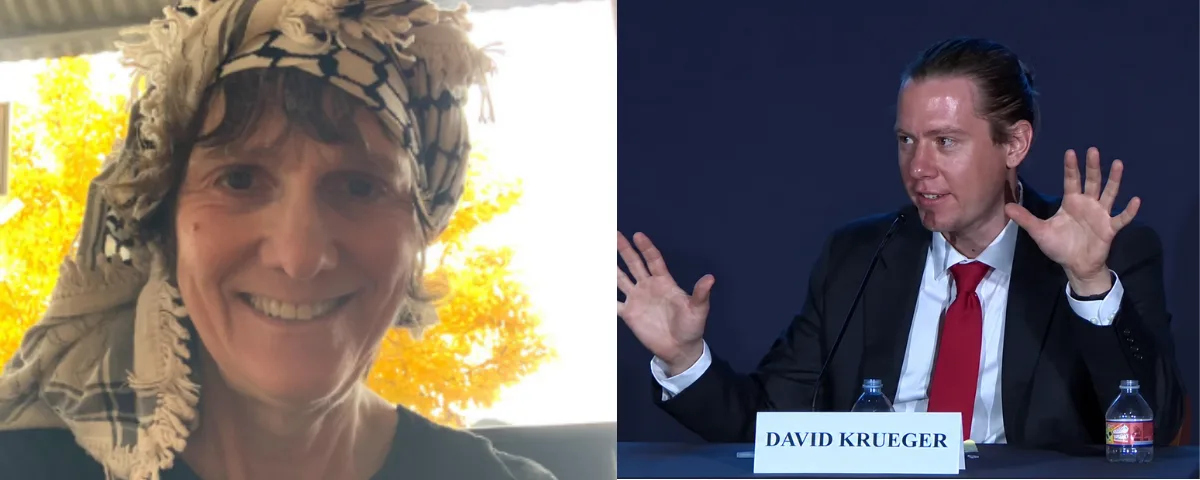
On Friday, a San Francisco courtroom will witness a misdemeanor trespassing case, that is asked to carry a question far heavier than its charge: can blockading doors of an AI company (OpenAI to be precise) be excused as a necessary act to prevent “AI led catastrophe”?
On trial is Wynd Kaufmyn, an activist and retired professor at City College of San Francisco, who is associated with anti-AI group StopAI. Kaufmyn was taken into custody in February 2025 for blocking the doors of OpenAI headquarters in San Francisco along with fellow activists. She now stands on trial facing up to a year in prison if charges stick.
The group has been actively protesting against OpenAI and other AI companies, demanding an immediate halt on frontier AI research that would lead to achieving the state of artificial general intelligence (AGI) and superintelligence. Activists call both the states dangerous and capable of leading to “human extinction” as AI systems will far exceed human capabilities.
Also Read:“Just Say You’ll Pause If Everyone Pauses”: Activist Who Led America’s Largest Anti-AI Protest
Now facing four counts of misdemeanour charges, Kaufmyn, believed to be in her late sixties, will argue through her defense lawyer on Friday, after they submitted a motion to use “necessity defense”.
The judge has allowed Kaufmyn to present her defense where she will argue whether her actions ( blockading OpenAI office door) were necessary to prevent imminent harm from the company’s pursuit of superintelligence.
“On Friday, I will testify against the catastrophic danger AI poses to humanity. This technology is being developed by people who know the existential risk and are racing forward anyway. They care more for their own fortunes than for the good of humanity,” said Kaufmyn, in a statement released via StopAI.
On Monday, UC Berkeley AI professor Stuart Russell is expected to provide his testimony whether Kaufmyn’s actions were justified while the defense has also subpoenaed Sam Altman, the CEO of OpenAI, as a non-party witness in the case. Sam’s lawyers have already filed a motion to quash the subpoena.
If the judge is convinced, a jury might decide whether Kaufmyn deserves a year in jail or whether her actions were justified to “save humanity” from the actions of OpenAI.
For comrades of Kaufmyn, she is no less than Rosa Parks of the civil disobedience movement in the U.S. Parks, a woman of color, was arrested in 1955 after she refused to shift to “black designated seats” in a bus in Montgomery.
Speaking to AI FrontPage, Professor David Krueger, an AI risk expert and CEO of Evitable, said “Governments have been asleep at the wheel and activists like Wynd have stepped up to face this crisis. This case marks the first time a court will get to hear some of the (copious) evidence that AI companies are gambling with our lives.It could also mark the beginning of a much larger campaign of civil disobedience, like what we saw with the civil rights movement. In ten years time, we may look back on Wynd as the Rosa Parks of AI risk.”
Also Read: “Summoning an Alien Species”: David Krueger on Why Superintelligence Could End Us All
Anti-AI activists maintain that they believe in civil disobedience form of non-violence protest against AI companies who have received “very little or gentle criticism for their actions.”
When asked if they believe in Gandhian philosophy of “hate the sin, but never the sinner and leave a bridge for the opponent to convert,” Professor Krueger says, ” “Extinction may seem abstract, but we’re talking about mass killings on an unprecedented scale, something that dwarfs previous genocides. It only seems harsh to point such things out if you don’t take the risk seriously. This is really cartoon supervillain territory. It boggles the mind. I would love for more people at AI companies to “convert”; an easy way would be to quit their jobs and join the protest movement.”
When asked on the “imminent harm” the defense rests on Krueger says, “AI companies are not able to reliably determine whether their systems are safe with any reasonable level of confidence. Despite this, they’ve made clear they intend to keep racing to build and deploy more and more powerful AI — even putting AI itself in charge of that. This process, known as “recursive self-improvement,” is widely acknowledged as a probable point of no return.”
For now, the question of whether stopping a machine can excuse breaking the law rests where Kaufmyn always wanted it: with a jury of ordinary people.
Also Read:“Stop the AI Race”: Hundreds March at OpenAI, Anthropic and xAI Offices