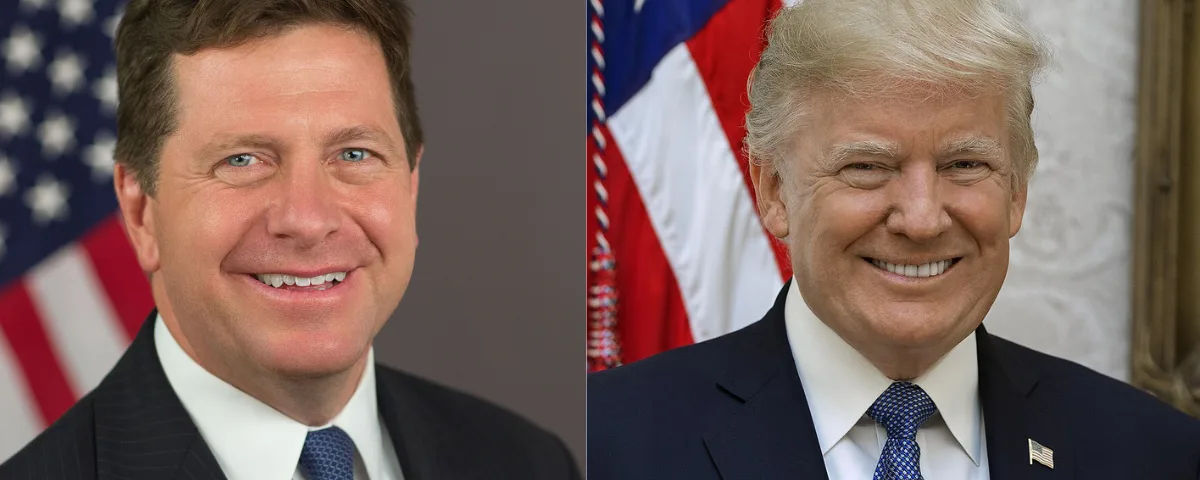
U.S. Director of National Intelligence Jay Clayton is likely to be the US President Donald Trump’s choice for AI czar, while discussions are also underway about allowing him to retain his current position, the CBS News reported.
President Trump is expected to make the final decision shortly, according to sources. He announced plans last month to appoint an AI czar. In a post on Truth Social platform, President Trump said only “high IQ individuals” should apply for the post of AI Czar to lead the Trump AI Force.
On September 19, President Trump announced setting up of an Artificial Intelligence (AI) Force team and had mentioned that he will soon appoint an “AI Czar”
The move comes amid growing debate over how the risks and potential of increasingly powerful artificial intelligence should be managed.
Trump’s announcement was followed by a White House meeting on September 29 involving leaders of the country’s leading AI companies like Elon Musk, Mark Zuckerberg, Sundar Pichai, Dario Amodei, Jensen Huang, Lisa Su at a White House luncheon event held on September 2, who also signed voluntary AI safety accord.
Shortly after the meeting, Trump revealed to reporters that he is planning to name an AI Czar within three to four days. A lawyer by profession, Clayton has previously served as the top federal prosecutor in Manhattan and chaired the Securities and Exchange Commission during most of Trump’s first terms.
Earlier in Trump’s second term, David Sacks was appointed as the administration’s cryptocurrency and AI czar. Sacks stepped down from the role earlier this year but continued to chair the President’s Council of Advisors on Science and Technology.
Recently Trump released a voluntary agreement with six major technology companies that sets out a framework for addressing the risks associated with increasingly capable artificial intelligence systems.
The White House Accord on Super Intelligence: Joint Commitment on Frontier Responsibilities was published by Trump on Truth Social after he had described it as a “morally binding” commitment. The document does not create enforceable legal duties, but mentions that some of its provisions could later be incorporated into legislation or regulations.
Under the accord, companies are encouraged to use independent auditors or external assessors to evaluate whether their AI safeguards and monitoring systems are working as intended. The companies would also establish independent board committees to oversee AI controls.
Following his meeting with the Tech leaders, Trump Trump signed an executive order on September 29 directing the executive branch to use “Super Intelligence” and “SI” instead of “Artificial Intelligence” and AI also changed the name Artificial Intelligence to Superintelligence in the U.S. through an executive order, citing that the new term “more appropriately captures the promise, potential and and rapidly advancing capabilities of these technologies.”
A few days before the meeting, on September 19, Trump in a post on Truth Social platform, hit back at “AI critics” adding that any claims made about AI adding “destruction or decimation” is a hoax.
His comments came amid growing calls from AI researchers and industry leaders for slower development and stronger safeguards, citing concerns including cybersecurity, biosecurity and loss of control over increasingly capable systems.
Read More: Trump Announces ‘AI Force,’ Plans to Appoint AI Czar; Suggests Renaming Artificial Intelligence