It has been seven months since a new government has taken over the helm in Bihar, a state in eastern India that has long struggled with poverty and development challenges, resulting in decades of inter-state migration.
The Chief Minister Samrat Choudhary led government is now banking upon artificial intelligence (AI) to lead a grassroot level policy change in Bihar and attempt to change the popular “brain drain” narrative of the state into “brain-gain” through AI.
The Bihar government’s new AI policy 2026 has some ambitious deliverables to achieve in the next 5 years. It involves training 100,000 youth in AI and emerging technologies and facilitating creation of more than 25,000 quality AI jobs in Bihar, as well as incubating more than 100 Bihar native start-ups and creating an ecosystem that invites AI investment from not just other states of India but overseas organizations.
For that, the state government is offering eligible AI units 30% cumulative capital expenditure (CAPEX) subsidy, reimbursement of interest on term loans, and for five years, reimbursement of 25% of their annual electricity bill, 100% of the employer’s provident fund contributions and 100% of state goods and services tax (SGST).
The Bihar government is also encouraging the development of large language models (LLMs) that must have a minimum parameter of 70 billion through a one-time incentive of two-thirds (⅔) of the model development cost, subject to a maximum of ₹10 crore INR.
The Bihar Cabinet has approved the Bihar AI Policy 2026, under the leadership of Hon’ble Chief Minister Shri Samrat Choudhary ji, marking an important step towards strengthening Bihar’s position in the emerging AI and technology landscape.
The policy offers an attractive framework of incentives for capital investment, AI infrastructure, model development and exports. It aims to attract investments, promote innovation and create new employment opportunities for the youth of Bihar.
In alignment with the vision of Hon’ble Prime Minister Shri Narendra Modi ji for Viksit Bharat, we invite investors, technology companies and AI innovators to explore the opportunities in Bihar and partner with us in this transformative journey.
Invest in Bihar. Innovate in Bihar. Grow with Bihar.
@AshwiniVaishnaw @samrat4bjp
@InvestIndia @OfficialINDIAai @nasscom @stpiindia @GoI_MeitY @DitBihar— Nitish Mishra (@mishranitish) November 1, 2026
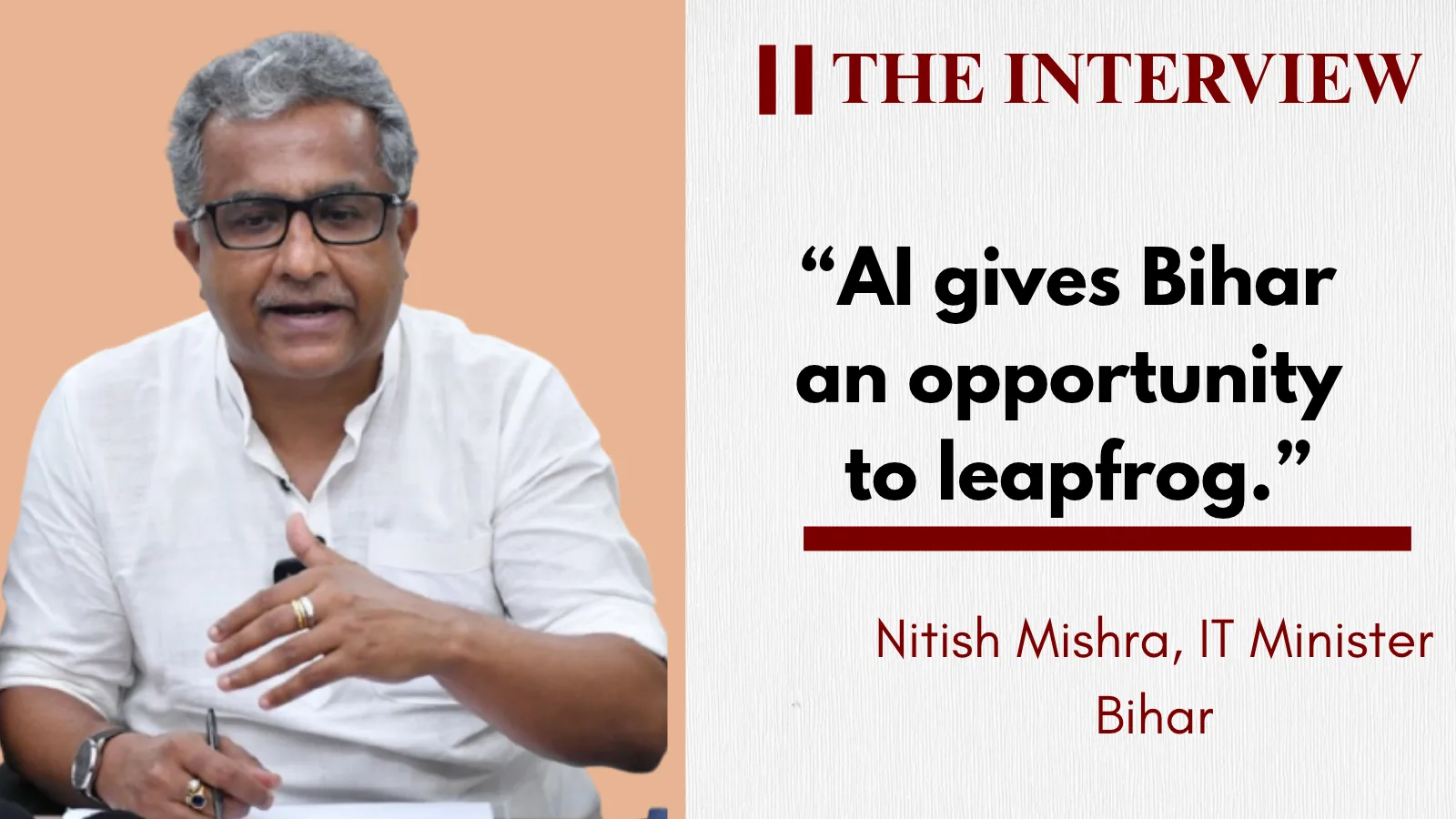
But to put it in words of Nitish Mishra, Bihar Information Technology Minister, artificial intelligence is an opportunity for Bihar to leapfrog and emerge as a centre of innovation, enterprise and high-value employment.
In an exclusive interview with AI FrontPage correspondent Supriya Singh, Bihar IT Minister Mishra speaks about the state’s priorities in AI for the next five years, what Bihar has to offer to companies and how his government can reverse the migration of young-educated-tech savvy Biharis.
Question: How can AI drive innovation, strengthen capabilities and create new opportunities for Bihar’s growth?
Nitish Mishra: “Bihar’s greatest strengths are its youth and its historic legacy of knowledge. Artificial Intelligence gives us an opportunity to convert these strengths into modern innovation. AI is not limited to one sector. It can improve agriculture, healthcare, education, manufacturing and governance simultaneously.
Our approach is therefore based on four pillars: research and innovation, startup development, government use cases and large-scale skilling.
With institutions such as IIT Patna, NIT Patna, IIIT Bhagalpur, C-DAC, NIELIT and STPI, Bihar already has a strong foundation. We will further support companies through capital, cloud, GPU, power and employment-linked incentives, while training one lakh youth in AI and emerging technologies over five years.
AI gives Bihar an opportunity to leapfrog and emerge as a centre of innovation, enterprise and high-value employment.
Question: What role can AI play in transforming Bihar’s governance, industries and employment landscape?
Nitish Mishra: “ In governance, AI can improve beneficiary targeting, identify leakages, speed up land and public services, and provide citizen support in Hindi, Maithili, Bhojpuri and Magahi. Our objective is to move from reactive governance to predictive and citizen-centric governance.
For industries, AI can reduce costs, improve quality and strengthen export competitiveness. It can support quality grading in agro-processing, design and market access for textiles, route optimization in logistics, and predictive maintenance and quality control for MSMEs.
Most importantly, AI will create high-value careers in areas such as machine learning, data science, cloud infrastructure, application development and sector-specific AI solutions. Our vision is that Bihar’s youth should be able to learn, work, innovate and serve global markets while remaining in Bihar.”
Question: Bihar has approved its AI Policy 2026. What are the three measurable outcomes you want to achieve in the next five years?
Nitish Mishra: We have set three clear and measurable priorities for the next five years. Train one lakh youth in AI and emerging technologies and facilitate the creation of more than 25,000 quality AI jobs in Bihar. Introduce at least 25 scalable AI use cases across more than 10 government departments to improve public service delivery. And support and incubate more than 100 startups through the Bihar AI Centre of Excellence, IIT Patna Research Park and other incubation facilities.
Question: Bihar has partnered with Google, Microsoft, BharatGPT and Sarvam AI. What concrete benefits will these partnerships bring to Bihar?
Nitish Mishra: Our partnerships bring together global capabilities and India-focused innovation. Google and Microsoft can provide access to advanced cloud infrastructure, AI tools, technical expertise and industry-recognized training.
BharatGPT and Sarvam AI bring expertise in Indian-language and India-specific AI solutions. For citizens, this can lead to better voice-based services, chatbots and grievance systems in local languages. For youth, it means industry-level training and certifications. For government departments and startups, it provides access to technology, platforms, mentorship and support for practical AI solutions.”
Question: AI development requires reliable electricity, high-speed internet, computing infrastructure and skilled manpower. Is Bihar currently equipped to meet these requirements?
Mishra: The state has improved power availability, expanded high-speed connectivity through BharatNet and private 5G networks, and is developing plug-and-play IT and innovation infrastructure.
For advanced computing, the policy provides support for cloud and GPU usage, including assistance of 50% of eligible expenditure, up to INR 1 crore annually for five years. It also supports investment in AI infrastructure and GPU clusters. Institutions such as IIT Patna, NIT Patna and IIIT Bhagalpur provide a strong talent base. At the same time, we recognize that infrastructure development is a continuous process. The government will work with the private sector to build infrastructure in line with industry requirements.
Question: Bihar produces a large number of graduates, but many migrate outside the state for employment. How will this policy ensure that AI-trained youth get jobs in Bihar itself instead of simply becoming trained manpower for companies in other states?
Mishra: “This concern is at the heart of the policy. Our objective is not only skill development, but also “brain gain” for Bihar. Companies receiving policy benefits will be required to employ at least 50% Bihar-domiciled personnel. Eligible jobs will have a minimum annual salary of INR 3 lakh. Companies creating 100 or more direct jobs may also receive tailor-made incentive packages.
Additional incentives will encourage companies to establish operations outside Patna and Danapur, while special support will promote participation by women, SC, ST, BC, EBC, divyang persons and other eligible groups.
Our aim is simple: Bihar’s youth should be able to acquire advanced skills, secure quality employment, build companies and serve global clients from within Bihar.”
Also Read: Bihar’s First AI Summit Lands in Patna This Month, as State Pushes to Build a Tech Footprint