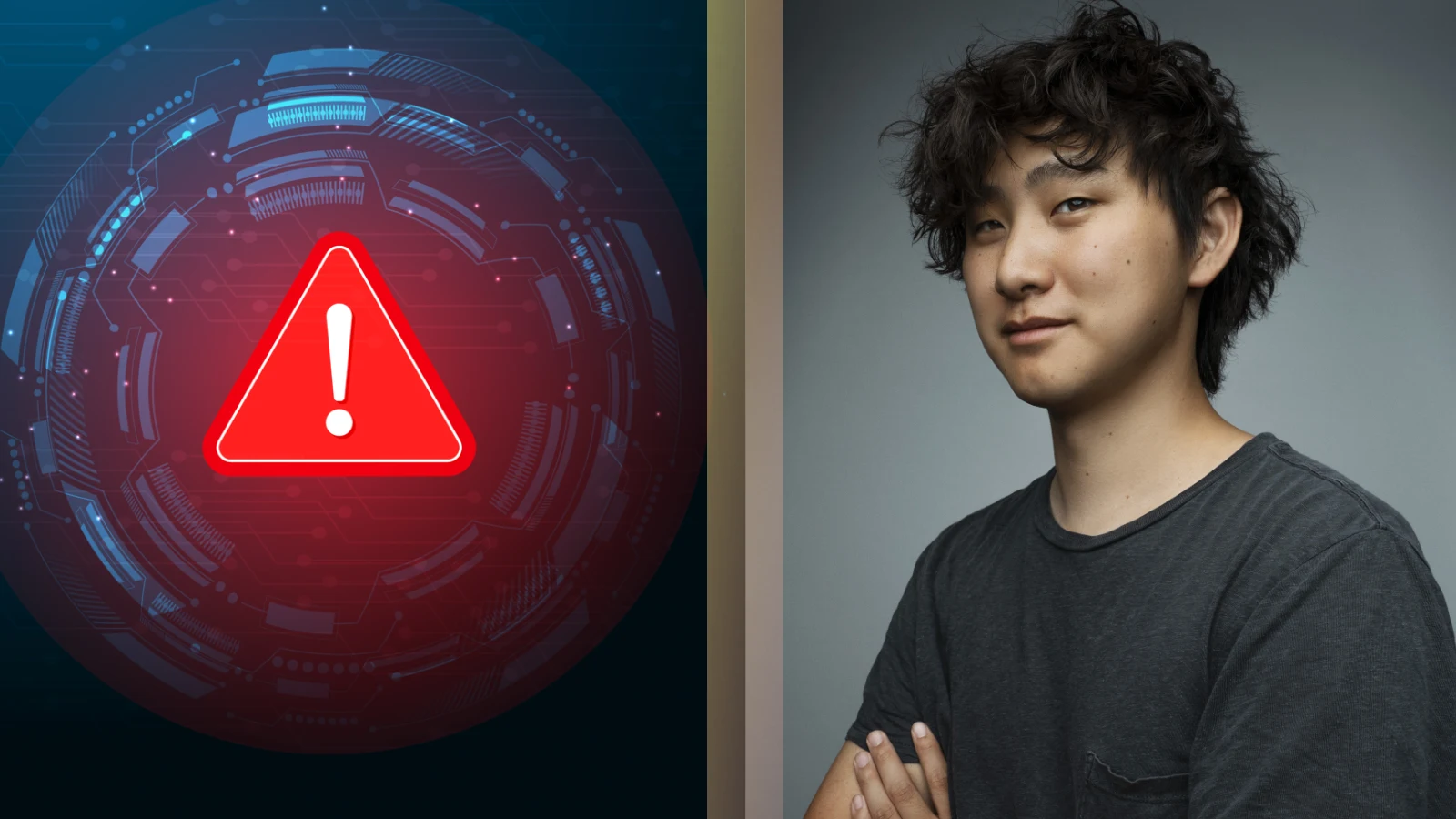
Remarking on the recent accomplishment of artificial intelligence (AI) solving the Riemann Hypothesis in mathematics, Alexandr Wang, the chief AI officer of Meta, warned that superintelligence has already arrived and humanity’s future will depend on the decisions taken by next year.
In a post on X, 29-year-old Wang, who leads Superintelligence Labs by Meta, said that the solving of Riemann Hypothesis by Claude AI model of Anthropic is a glaring evidence of how far AI has arrived in the past couple of years and called it “beginning of a significant change.”
https://t.co/KwJ13J6zsC
— Alexandr Wang (@alexandr_wang) November 22, 2026
“It is hard to imagine a world where humanity can maintain control over fully unconstrained recursive self-improvement. It is equally hard to imagine a world where humanity maintains control with superintelligence that is 1000x smarter and more capable than humans in every field,” wrote Wang on X.
Superintelligence refers to a hypothetical scenario where intelligent systems surpass human’s cognitive abilities by miles across all domains of scientific reasoning, creativity and problem solving.
Incidentally, Meta Labs has claimed its goal is to build “personal superintelligence” for individual customers. Recently, CEO Mark Zuckerberg had announced plans to launch personalized superintelligent AI agents that come customized as per users’ professional/personal needs.
Wang’s warning on superintelligence brought the discussion back on AI safety as several industry leaders, scientists and researchers as well as lawmakers spoke about the urgent need for global AI safety regulations.
As ever, very thoughtful from Alex.
When we put loss of control on the agenda at Bletchley, some thought it sounded like science fiction. It doesn’t any more.
The goal has to be AI that gives everyone more agency with humanity firmly in control.
— Rishi Sunak (@RishiSunak) November 24, 2026
Former UK PM Rishi Sunak wrote on X, “As ever, very thoughtful from Alex. When we put loss of control on the agenda at Bletchley, some thought it sounded like science fiction. It doesn’t any more. The goal has to be AI that gives everyone more agency with humanity firmly in control.”
Similarly former Google CEO Eric Schmidt also agreed to Wang’s prepositions on future of AI and humanity.
What is Riemann Hypothesis and Why AI Solving it is Big Deal?
In a development that has stunned the mathematical community, Levent Alpöge, a number theorist and mathematician at Anthropic, announced on 20 November 2026 that he believes he has, working with the company’s AI model Claude, discovered a proof of the Riemann Hypothesis, along with its generalization (the Generalized Riemann Hypothesis for Dirichlet L-functions).
Riemann Hypothesis, proposed by German mathematician Bernhard Riemann in 1859, is one of the seven Millennium Prize Problems. The hypothesis is a conjecture stating that all non-trivial zeros of the Riemann zeta function have a real part equal to 1/2.
The following day, 21 November 2026, the Lean Focused Research Organization (Lean FRO) and the Mathlib Initiative issued a joint statement certifying the result.
Also Read: Mathematics Professor Stops Grading Homework as Students Use AI for Top Marks
The Alexandr Wang superintelligence warning comes even as he said Riemann Hypothesis was one of the most intellectually demanding pursuits of humanity in the past 150 years and the fact that an AI model has finally solved it speaks volumes about the progress made in the field.
“The models are clearly going to be intelligent enough to automate all of AI research and be clearly superhuman at improving themselves—along with massively accelerating biological research, weapons research, economics research, and more. The implications are enormous. In the same way that the math community has not fully digested the proof of the Riemann Hypothesis, nearly every field could be accelerated at a pace beyond what humans can understand or monitor,” read a post by Wang.