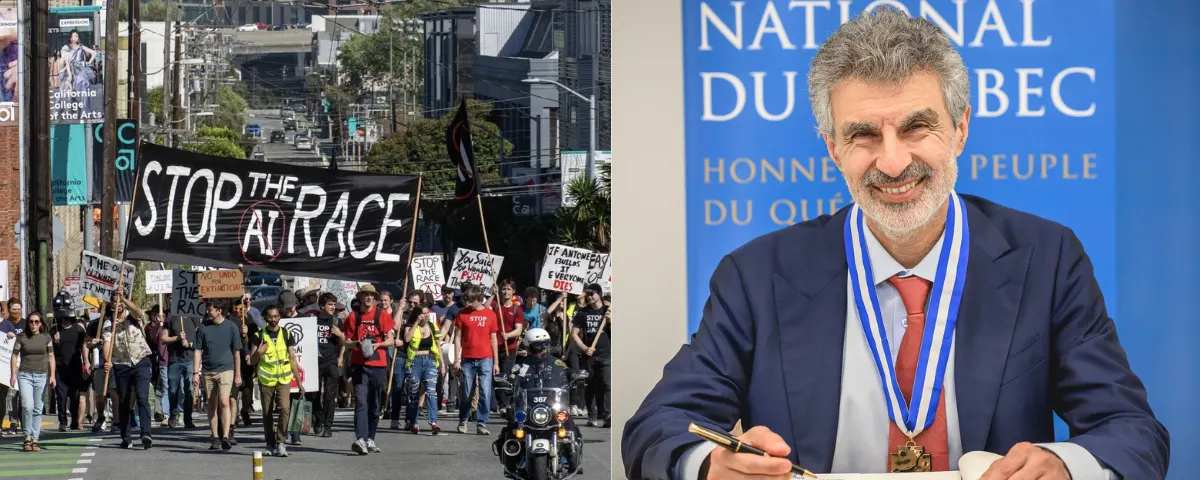
Canadian Computer Scientist and Turing Award winner Yoshua Bengio has highlighted growing public concern in the US over the rapid development of artificial intelligence and lack of representation in AI related key decision-making.
Citing a national poll conducted by Quinnipiac University, Bengio said that the poll has found 73 percent of Americans concerned with future AI systems, fearing it could potentially threaten human survival.
According to Yoshua Bengio AI representation gap exists in US despite such overwhelming sentiment around existential risks of AI shown by young Americans.
“Such decisions will most likely deeply transform our societies and human experience. Yet, just a few companies and governments are calling the shots without meaningful democratic input. This failure of representation cannot continue,” said Yoshua in a post on X.
Multiple recent polls show that citizens do not agree with the current trajectory of AI development. According to a national poll conducted in the US by @QuinnipiacPoll last week:
– 73% are concerned that future AI systems could potentially threaten human survival
– 86% support requiring AI companies to meet independent safety standards, even if it slows down development
– 81% believe safety is more important than staying at the forefront of innovation when it comes to AI
– 77% believe we should slow down or stop developing powerful AI systems until their safety can be evaluated
Such decisions will most likely deeply transform our societies and human experience. Yet, just a few companies and governments are calling the shots without meaningful democratic input. This failure of representation cannot continue.
https://t.co/re6MAQciow
— Yoshua Bengio (@Yoshua_Bengio) October 5, 2026
According to a new national poll by Quinnipiac University, 73 percent of Americans say they are very or somewhat concerned that future AI systems pose a threat to human survival. The poll found that 38 percent are very concerned and 35 percent are somewhat concerned about the threat, while 25 percent said they were either not so concerned or not concerned at all.
The survey mentioned that about 52 percent of Americans say they are more concerned about AI being used by humans to do harm to humanity, while 33 percent say they are more concerned about autonomous AI agents doing harm to humanity.
At the same time 53 percent of Americans think AI will do more harm than good in their day-to-day lives, while 34 percent think AI will do more good than harm in their day-to-day lives. This figure is quite unchanged from Quinnipiac University’s Poll on AI from March 30, 2026.
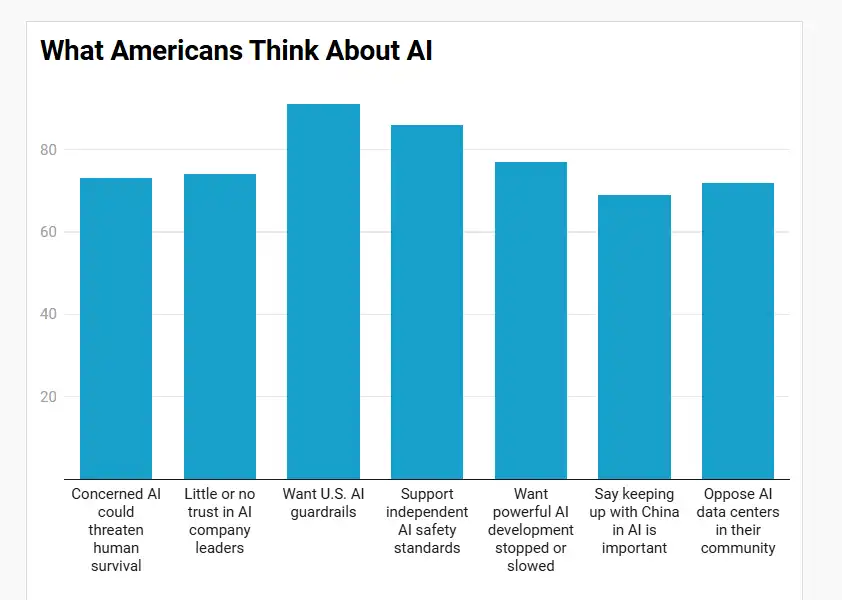
The poll also showed widespread distrust of AI company leadership. Seventy-four percent of Americans said they have little or no trust in the leaders of AI companies, including 29 percent who said they have not so much trust and 45 percent who have none at all. Only 24 percent said they have a lot or some trust in AI company leaders.
“Americans are not convinced AI’s advances are in their interests. More than half expect AI to do more harm than good in their daily lives, and nearly three-quarters express little or no trust in the leaders of AI companies. The industry needs to give people a reason to welcome AI,” said Tamilla Triantoro, Ph.D., Associate Professor of Business Analytics and Information Systems, Quinnipiac University School of Business.
Ninety-one percent said it is very or somewhat important for the US to establish guardrails for AI systems, including 74 percent who called it very important.
In addition 86 percent support requiring AI companies to meet independent safety standards even if those requirements slow AI development, while nine percent oppose such standards.
The poll found that 77 percent of Americans want the development of powerful AI systems either stopped or slowed until their safety can be evaluated. Only 14 percent want AI development to continue at the current pace, while 5 percent want companies to move faster.
“AI companies face a trust problem, not just questions about their technology. These results suggest that the public wants safeguards that do not depend simply on taking company leaders at their word,” said Chetan Jaiswal, Ph.D., Professor of Computer Science and Associate Chair, Department of Computing, Quinnipiac University School of Computing and Engineering.
Despite concerns over AI safety, 69 percent of Americans believe it is important for the US to keep up with China in developing AI systems.
Sixty-nine percent say keeping up with China in AI is important, while 91 percent think establishing guardrails for AI is important. Sixty-five percent of Americans hold both views. That does not tell us how people would resolve every trade-off, but it does show that valuing competition should not be mistaken for opposing safeguards,” Jaiswal added.
As far as data centres are concerned 72 percent of Americans say they would oppose the building of an AI data center in their community, while 21 percent say they would support it.
Meanwhile UN High Commissioner for Human Rights Volker Türk has warned that the world is running out of time to put guardrails on artificial intelligence as a “ruthless race” between companies and countries raises concerns about human safety and even humanity’s survival.
“AI could undermine equality, freedom, privacy and public debate in subtle ways, letting dystopia creep in unnoticed. Entire populations could be cut off from communication, clean water, heating and financial services “at the click of a button,” Turk said while speaking in the UK at an AI and Human Rights Summit in Oxford on Monday.
No country and no company can – or should – define the future of AI and people’s rights alone. This technology is far too powerful to come without matching responsibility. Human rights safeguards and due diligence must be mandatory.
https://t.co/sCd8IBVzhJ https://t.co/gVuFidLpMa
— Volker Türk (@volker_turk) October 5, 2026
He has called for mandatory human rights safeguards and due diligence in how AI is developed and used, adapted as the technology evolves. Turk stressed that countries that host AI companies, or have influence over their supply chains, must require them to act responsibly and hold them to account when they do not.
Also Read: UN AI Panel Warns of Risk of Losing Human Control Over AI Agents