Data centres are becoming a major investment pillar of the AI ecosystem, as growing demand for computing capacity drives a multi-decade infrastructure buildout.
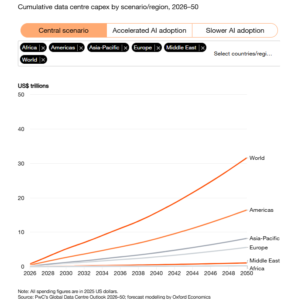
PwC, one of the Big Four firms, said in its outlook that global data centre capital expenditure could reach US$31.6 trillion by 2050, with an upside of nearly US$50 trillion if AI adoption grows faster than anticipated.
Power availability, latency and connectivity, security and trusted-region hosting, access to GPUs and AI ecosystems, and policy certainty and community support have been identified as the five forces that will determine where investment flows.
“Power sits at the top of the list because affordable, reliable, and increasingly low-carbon electricity at scale is the hardest requirement for many markets to meet and delivering it quickly is harder still,” said PwC.
It expects annual capital expenditure on data centres to rise from around US$800 billion in 2026 to US$1.8 trillion by 2050.
Unlike previous infrastructure cycles, the data centre buildout will require continuous investment beyond the initial construction phase. Data centres need constant investment as the technology inside them, especially servers, GPUs, storage and networking equipment, becomes outdated quickly. GPUs and servers typically require replacement every four to six years, creating a recurring cycle of capital expenditure.
The Americas are projected to account for US$16.5 trillion in cumulative investment through 2050, driven largely by the US, which alone is expected to capture US$15.1 trillion, or about 48% of the global total.
Asia-Pacific is forecast to attract US$8.2 trillion, with China and India emerging as major sources of incremental demand, supported by large populations, rapidly expanding digital economies and substantial scope for AI adoption across businesses and consumer activities.
PwC said investors should view data centres as hybrid assets combining property, utilities and semiconductor exposure, warning that “obsolescence and residual-value risk on the semiconductor layer is the most frequently underpriced of the three”.
The report identified AI adoption, buyer behaviour, market conditions, chip supply, sovereignty policies and power-grid capacity as key indicators stakeholders can monitor to assess how the global data centre investment cycle evolves.
PwC said tighter chip export controls could cut cumulative investment to US$25.5 trillion by 2050, while digital sovereignty would shift capital towards markets with strong domestic demand and relatively underdeveloped data centre capacity.
PwC expects information and communications technology (ICT) equipment to account for an increasing share of total data centre investment, rising from 70% today to 93% by 2050.
PwC also said markets where renewable and low-carbon power capacity expands alongside data centre development will hold a long-term advantage, citing the Nordic countries, Chile and Canada as examples.
PwC said the key question is not whether capital and demand exist, but which regions, operators and institutions are best positioned to capture the investment and which aren’t.
It added that investors that account for recurring chip replacement costs, operators that adapt to either global hyperscale or sovereign regional demand, and governments that treat electricity as a strategic asset will be best positioned to benefit from the AI buildout.
It also warned that markets relying on past advantages, outdated regulatory frameworks and traditional approaches to valuing data centres risk falling behind.
PwC commissioned data centre expenditure forecasts from Oxford Economics, covering 46 countries and territories across five regions: the Americas, Asia-Pacific, Europe, the Middle East, and Africa.
Also Read: Warren Calls for Taxes on AI Companies and AI Data Centers as Debate Over AI Wealth Grows