China’s AI boom is expanding rapidly, but financing constraints could limit the pace of its growth relative to the United States, as Chinese AI firms rely heavily on equity and bank loans while US hyperscalers increasingly turn to debt and bond markets to fund their expansion. The challenge is that AI revenues and profitability remain far behind those of US peers, according to US-based research firm Rhodium Group.
Chinese AI firms are spending heavily on infrastructure and compute, raising questions about how long they can sustain investment before their AI businesses generate enough cash to support their own expansion.
Rhodium Group’s report comes as competition between the US and China in AI draws growing attention from investors and markets. An expected Anthropic IPO could renew focus on how the US artificial intelligence buildout is being financed, while the report, titled “Examining China’s AI Financing,” examines how Chinese AI companies are financing their expansion and evaluates the scope and sustainability of those funding sources, including in comparison with US firms.
China’s AI Spending is Surging
Rhodium Group surveyed 13 Chinese listed firms across four categories: hyperscalers, telecoms and Huawei, frontier AI labs, and independent data centre operators.
AI infrastructure capital expenditure by China’s major hyperscalers and telecom companies is projected to rise 103% in 2026 to 932 billion yuan ($139 billion), before exceeding 1.2 trillion yuan ($193 billion) in 2027. That would put China’s 2026 spending at roughly 15%-20% of the estimated $800 billion in US data centre investment.
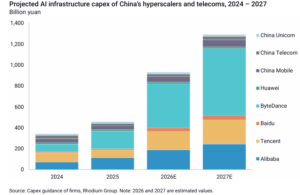
Alibaba, Tencent and Baidu reported combined capital expenditure of 208 billion yuan in the first half of 2026, while ByteDance is expected to be the largest marginal contributor to China’s AI infrastructure spending.
Rhodium said China’s AI infrastructure buildout is constrained by both access to chips and compute and by financing constraints. Domestic chip supplies from Semiconductor Manufacturing International Corp (SMIC), China’s largest contract chipmaker, have increased, while access to Nvidia’s H200 appeared to be easing at the time of the report. However, further US-China tensions could affect access later in the year.
As a result, the pace of China’s AI buildout depends not only on how much firms want to spend, but also on the availability of compute and the financing needed to secure it.
Cash Flow is No Longer Enough
The scale of planned investment is already putting pressure on companies’ internal cash generation. Alibaba, Tencent and Baidu generated 170 billion yuan in free cash flow in 2025, but their combined free cash flow turned negative at 16 billion yuan in the first half of 2026.
Tencent alone made around 51 billion yuan in AI-related prepayments in the second quarter, compared with 59 billion yuan in capital expenditure during the period.
The financing mix also differs significantly by type of AI company. Hyperscalers are increasingly relying on loans and bonds, while frontier AI labs such as Zhipu, MiniMax, DeepSeek and Moonshot have relied primarily on equity financing. Huawei and telecom companies have been able to fund more of their investment through operating cash flow, while their financing mix differs from that of frontier AI labs.
Independent data centre operators have the most diversified financing mix, drawing on operating cash flow, loans and bonds, equity issuance, and alternative channels such as asset-backed securities (ABS), real estate investment trusts (REITs) and financial leases.
Because these operators lack the cash-generating businesses that help hyperscalers and telecom companies absorb AI-related capital spending, and attract relatively little equity financing, they make greater use of these alternative channels.
Across China’s AI sector, Rhodium ranks operating cash flow as the largest financing channel, followed by equity issuance, loans and bonds, and ABS, REITs and financial leases. For new incremental financing, however, equity issuance and new loans and bonds currently play a larger role.
The problem is that operating cash flow from cloud services, data centres and AI businesses cannot yet sustain the level of planned capital expenditure. AI-related revenue and profitability remain low compared with other business lines and US peers, leaving major Chinese companies dependent on cash generated elsewhere in their businesses to finance the AI buildout.
Rhodium says the key financing questions ahead are how much additional funding China’s AI sector can raise through new equity issuance and whether hyperscalers and frontier AI labs will increasingly tap onshore debt to fund AI capital expenditure.
Equity Plays a Key Role in China’s AI Financing
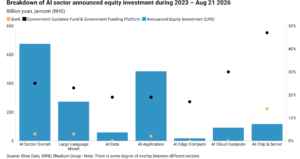
Equity financing has become an increasingly important source of funding as AI investment accelerates. Rhodium estimates that 282 billion yuan in equity investments had been announced through August 21, 2026.
Government guidance funds and government funding platforms accounted for 25% of announced AI-sector equity investment in 2026 through August 21, down from 30% in 2024 and 2025 but still above the pre-pandemic average of 13%.
The role of state-linked capital is particularly visible in AI chips and servers. From 2023 through August 21, 2026, government guidance funds and investment platforms accounted for 47% of equity investment in the sector, while banks, mostly state-owned, accounted for another 14%. More than 60% of equity investment in AI chips and servers therefore came from state-affiliated sources.
Private capital plays a larger role in large language models and AI applications. Frontier AI labs raised 179 billion yuan through private equity, venture capital (PE/VC), IPOs and private placements in the first eight months of 2026, compared with only 9 billion yuan in PE/VC financing during all of 2025.
Zhipu raised 4 billion yuan through its Hong Kong IPO in January and another 27 billion yuan through a private H-share placement in July. Alibaba also announced an HK$80 billion new-share placement, with the company saying 100% of the proceeds would be used for AI investments.
The report said that the valuation of China’s frontier labs also seems “substantially lower” than US counterparts OpenAI and Anthropic. Rhodium cautioned that, “Government support to top-tier companies can be sustained, but the rest of the AI sector might be cut off from equity financing, limiting future capex.”
That makes conditions in China’s equity markets an important factor in determining how much additional AI investment can be financed.
Why China is Turning to Loans More than Bonds
Bank lending has become another major financing channel, particularly for data centre infrastructure. Banks are more comfortable lending against physical assets that can serve as collateral, while the PBOC has also encouraged lending to technology companies.
The surveyed chinese companies received 639 billion yuan in net loan inflows in 2025, compared with 341 billion yuan in bond inflows excluding convertible bonds.
Loans also offer an advantage over bonds because they generally involve less disclosure. This can make bank financing more attractive to companies seeking to fund large infrastructure investments without the reporting requirements associated with public debt issuance.
The cost of yuan financing has also been relatively low. Tencent’s long-term yuan loans carried an average interest rate of about 2.8% in 2025, compared with 5.1% for its long-term US dollar loans and 3.3% for its long-term US dollar bonds. Its short-term yuan loans carried an average rate of 2.1% in the first half of 2026.
Long-term yuan bond coupons for Tencent and Baidu were around 2.6% in the first half of 2026. That compares with an average effective long-term bond rate of about 4.4% for Amazon, Alphabet, Meta, Microsoft and Oracle.
China’s bond market, however, remains dominated by state-owned enterprises. Direct bond issuance by technology companies remains limited, with support instead flowing indirectly through financial institutions, private equity and venture capital funds, and state-owned enterprises and local government platforms.
Alternative financing is also expanding. Rhodium Group says these financing facilities are designed by Chinese regulators to help operators revitalize existing assets and reduce their debt ratios. The report expects financing through these channels to grow, although financial leasing also carries risks because GPU values and market demand can vary significantly.
China’s AI Financing Model Compared with the US
The financing structure of China’s AI buildout differs significantly from that of major US hyperscalers.
The combined free cash flow of Microsoft, Amazon, Alphabet, Meta and Oracle fell from $191 billion in 2025 to $14 billion in the first half of 2026. At the same time, their net debt cash raised increased from $90 billion in 2025 to $163 billion in the first half of 2026, with long-term bonds accounting for most of the increase.
Chinese AI companies, by contrast, are relying more heavily on equity issuance and bank lending, while bonds have so far played a smaller role.
The cost of financing also differs. Long-term yuan bond coupons for leading Chinese hyperscalers were around 2.6%, compared with an average effective long-term bond rate of roughly 4.4% for major US hyperscalers. Tencent’s long-term yuan borrowing rate of 2.8% was also below its dollar-denominated borrowing costs.
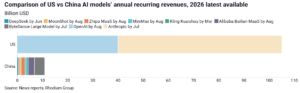
The difference extends to AI revenue. Rhodium estimates that the combined annual recurring revenue of China’s AI models was around $10.7 billion, while cautioning that ARR is an imperfect aggregate revenue metric. That figure was roughly 10% of recently reported levels for OpenAI and Anthropic.
There are signs of rapid growth from individual Chinese companies. Zhipu’s annual recurring revenue rose from $74 million in January to $1.6 billion in August, while MiniMax’s ARR increased roughly fourfold between February and August.
Ahead of Chinese President Xi Jinping’s planned September 23–25 visit to the US, Washington and Beijing are discussing an AI dialogue, while top officials have discussed a notification mechanism for AI-related incidents that could rise to the national-security level.
Can AI Revenue Catch Up with Spending?
The financing question ultimately comes back to revenue.
Chinese frontier AI companies are increasing their commercial activity, but profitability remains under pressure. Zhipu’s gross margin fell from 41% in 2025 to 26% in the first half of 2026, while MiniMax’s declined from 25% to 18%, even as their AI revenues grew.
Pricing is one factor. As of September 4, 2026, Chinese frontier models generally charged around $0.04–$0.50 per task, with the best-performing models reaching roughly $0.50–$1. By comparison, Anthropic’s Claude was priced at around $2–$4 per task, while higher-end GPT models were around $1–$2.
Rhodium says Chinese AI firms face lower pricing power, intense competition, the widespread availability of open-weight models and rising infrastructure and compute costs. Companies also need to develop higher-margin enterprise and API businesses to improve profitability.
API margins can be much stronger than company-wide margins. DeepSeek’s API gross margin reached 83% in July, while Anthropic’s was above 80%. Zhipu’s API and open-model business had a 25% margin in the first half of 2026, while MoonShot’s was 45% in December 2025. However, the overall profitability of Chinese frontier AI companies remains below that of leading US peers.
Open-weight models create another monetization challenge because third-party cloud providers can deploy models without directly paying the model developer. Moonshot and Alibaba, for example, use revenue-sharing arrangements to capture some value from third-party deployment.
Overseas markets are another source of revenue. More than half of Moonshot’s revenue came from overseas markets at the end of 2025, while Kuaishou’s Kling generated 75% of its ARR overseas through March. MiniMax generated 61% of its revenue overseas in the first half of 2026. However, overseas revenue can also create geopolitical and compliance risks.
The profitability gap is also visible in cloud businesses. Alibaba Cloud’s adjusted EBITA margin was 9% in 2025 and 10% in the first half of 2026, compared with much higher cloud operating margins at Amazon and Alphabet.
At the application level, Alibaba’s AI app generated 3 billion yuan in Q2 revenue but recorded a 14 billion yuan net loss in adjusted EBITA terms. Doubao had more than 200 million daily active users, yet generated less than 1 million yuan in daily revenue, with most of that revenue coming from e-commerce commissions.
This creates a broader financing problem. Around 57% of hyperscaler revenue in 2025 was linked to domestic consumption through e-commerce, entertainment and advertising. But slowing domestic consumption can weaken the businesses that currently help subsidize AI investment. Alibaba’s e-commerce adjusted EBITA, for example, fell 44% in fiscal 2026, primarily due to a price war with JD.com and Meituan.
The financing challenge therefore extends beyond finding enough capital. China’s frontier AI companies remain highly unprofitable, while hyperscalers and telecom companies are increasingly using cash from other business lines to fund AI investment.
As capital expenditure is expected to rise further in late 2026 and 2027, the pace of expansion could depend increasingly on whether companies can raise additional equity or debt and whether AI revenues and margins improve.
Equity remains the most important financing channel for China’s AI sector, while hyperscalers and telecom companies are better positioned to use debt. Frontier AI labs and smaller data centre operators may face greater difficulty accessing bond markets.
However, Rhodium said, “Continued expansion likely depends upon equity market conditions. Even more aggressive state-led investments aligned with China’s industrial policy priorities are likely to remain focused on chips rather than on frontier labs.”
Conclusion
China’s AI buildout is therefore being financed through a combination of equity, bank lending, corporate cash flow and, increasingly, alternative financing channels. But Rhodium Group’s analysis suggests that the longer-term question is whether these funding sources can keep supporting investment at a time when AI-related revenues and profitability remain relatively low.
As spending on chips, compute and data centres continues to rise, the longer-term sustainability of China’s AI expansion will depend not only on access to capital, but also on whether AI businesses can generate more revenue and cash flow to support their own growth.
Also Read: Inside Story: How Claude Code Dispute Escalated Between Alibaba and Anthropic