Some of the most prominent names in the AI industry (OpenAI’s Sam Altman and Elon Musk among them) claim we are already inside ‘the technological singularity’. One might wonder what it means and what it is.
We are in the Singularity https://t.co/1OzjRQDySH
— Elon Musk (@elonmusk) July 22, 2026
The word ‘singularity’, as defined by the dictionary – is used to describe something (an event or a phenomenon) , that is unusual, unlike anything else, and thus embodies the quality / fact of being singular. Things, concepts, and phenomena that can be described as singular are rather rare.
What is Singularity in Maths?
In Mathematics, an idea/concept characterized as a singularity goes as follows.
For the mathematical function f(x)=1/x .When you divide the number 1 by 0.1 , the result(y) is 10. When you divide it by 0.01 it’s 100, by 0.001 it’s 1000, by 0.000000000001 it’s 1000000000000 and so on. So as the denominator ‘X’ approaches 0 , the result(y) approaches infinity. However , no number can be divided by zero and this is something that is ‘undefined’.
This phenomenon of approaching infinity as you get closer and closer to 0 is an example of a singularity in mathematics. This point is called a singularity because when you try to divide 1 by zero, the normal rules of mathematical equations do not apply.
What is Singularity in Physics?
Like mathematicians, physicists and astrophysicists have discovered singularities in their own realms. They theorize that at the absolute center of every black hole sits a singularity. The gravitational force within a black hole is so great that nothing escapes its outer boundary, not even light (Read that with Hans Zimmer’s ominous soundtrack in play!)
So what happens at the center of the black hole is that matter gets crushed into an infinitely small space which leads to infinite density and zero volume resulting in a gravitational singularity.
Imagine all the mass of a collapsed star compressed down to a single point with no physical size, zero volume. At this juncture, the known laws of physics collapse.
Sure dividing a number by 0 and the center of black holes are both singularities , but what do they have to do with ‘the singularity’ that the likes of Musk and Altman talk about?
What is Technological Singularity?
The technological singularity is an event horizon after which machines will be way smarter than the smartest humans and technology will be so advanced and more importantly, continue to advance at such an astronomical rate- thereby greatly surpassing human intelligence and beyond which it will be impossible to predict what happens next.
At first glance this might seem like a far off event, but that is not the case. To understand why the proponents of ‘singularity’ keep talking about its imminence, we just need to look at the trajectory of technological advancements throughout the history of mankind.
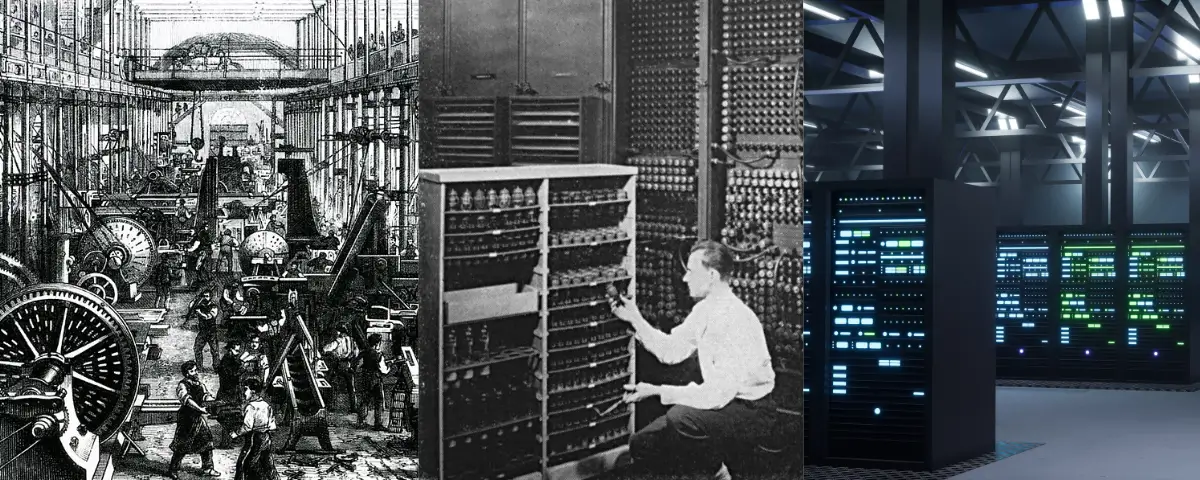
Since the industrial revolution began in 1760 , it took only a hundred years for the advent of electricity in 1870 and another 40 odd years for the age of automobiles and aviation to commence. Electronic computers first appeared in 1945 and and since the semiconductor revolution in the late 50’s, there has been no looking back.
What is Moore’s law ?
Gordon Moore, cofounder of Intel , predicted in 1965 that the number of transistors on a chip would double roughly every year, a forecast he revised in 1975 to every two years, in what became known as Moore’s law. While not a law of physics, developments in semiconductor technology have kept up with this law until recently.
Developments here might not strictly adhere to the word of the law, now that chips are so sophisticated that doubling the number of transistors every two years isn’t really possible, yet chips continue to improve thereby still adhering to it in spirit. Yet computing power has continued to grow rapidly, driven by breakthroughs in GPUs, specialized AI chips, parallel computing and better software
This exponential growth in computing hardware, since the early years of the semiconductor revolution, had led scientists and thinkers into postulating whether intelligence could also grow exponentially. John Von Neumann , one of the greatest mathematicians of the twentieth century who also worked on computers popularized the idea that technological progress itself is accelerating and spoke about an “essential singularity” in human affairs .
The quote survives second-hand: mathematician Stanisław Ulam, in a 1958 tribute, recalled a conversation with von Neumann that “centered on the ever accelerating progress of technology which gives the appearance of approaching some essential singularity in the history of the race beyond which human affairs, as we know them, could not continue.”
What Connects The Singularity in Maths, Physics and AI?
This is also perhaps why the technological singularity is called ‘the singularity’ because it will forever change human civilization–for better or worse, we don’t know that yet.
Just as a mathematical singularity marks a point where equations cease to apply, and a gravitational singularity marks a point where the known laws of physics no longer hold, the technological singularity represents a point beyond which the future becomes unpredictable and all that we knew and believed to be true about how things are and ought to be hitherto, shall perhaps be irrelevant.
Ray Kurzweil, author of the book ,‘The Singularity is Near’ has written extensively on the law of accelerating returns and made astonishing predictions, that today sound eerily imminent, based on how progress compounds and how every technological generation builds on previous ones.
For example, better computers enable the design and development of better computers, better AI leads to further better AI. Some of his predictions such as AI reaching human level intelligence, nanotechnology, radical life extension and humans merging with AI (all unproven up til now) are now taken as a serious possibility by critics and industry leaders like Dario Amodei and Sam Altman alike.
One of the strongest arguments made by Kurzweil in his book is that not only is technology improving , but that the time between major technological revolutions is shrinking drastically.
Smartphones emerged roughly two decades after the advent of commercial internet in the late eighties. Post the deep learning breakthrough in 2012, generative AI was at the scene in roughly 10 years and AI agents and reasoning models followed suit in merely a span of 2-3 years. This is exactly what exponential technological growth is.
Going by these trends, several industry leaders — including Altman and Kurzweil — predict AGI by the end of this decade. Many researchers dispute both the timeline and the premise.
AGI is expected to pave the way for super-intelligence, which will lead to the singularity, which Kurzweil predicts is very near and will happen by 2045.
I.J Good , in a paper which he wrote in 1965 had discussed the idea of an intelligence explosion. Where a machine more intelligent than humans once built, will go on to develop further more better and capable machines. This will create a positive feedback loop , intelligence shall improve recursively and humans shall no longer be the ones driving technological progress. To top it all , all this will occur at speeds unprecedented.
This is ‘the singularity’ and perhaps this is why Good wrote: “Thus the first ultra intelligent machine is the last invention that man need ever make, provided that the machine is docile enough to tell us how to keep it under control.”
How Will a Post-Singularity World Look Like?
As tricky as it might be to speculate how a post singularity world will look like, it hasn’t hindered experts from imagining and speculating – both very vital exercises as humanity will have to prepare for a world where ‘the singularity’ will be reality.
The only thing certain is that the consequences will be profound.
AI will fuel breakthroughs in virtually all domains. From robotics, to self building infrastructure, to energy technology, to drug discovery, to automation to autonomous space exploration. Elon Musk believes at least he hopes, that the singularity will usher in an era of unimaginable abundance.
Kurzweil thinks this new age will enable humans to transcend their biological limitations. Pollution will be stopped, world hunger and poverty will be solved, aging and illness will be reversed and death itself might be reduced to a solvable problem. He maintains an optimistic view of the future course of human development even as these changes will bring forth both profound social and philosophical ramifications and considerable threats along.
Not Everyone Has the Same Rosy Opinion on AI.
Some researchers argue that intelligence isn’t just computational and predictions about 2045 are too optimistic. Gary Marcus, an American cognitive scientist and psychologist is somewhat skeptical of the current approach of reaching AGI simply through scaling. Scaling may hit physical limitations and we may run into energy constraints and data limitations along the way.
Whether the singularity arrives ten years from now or twenty years from now , or much later (or maybe never at all), AI and increasingly powerful and capable AI will be omnipresent in the future. With AI to answer all of our questions , one unsettling question rings loudest, where will a world with AI more intelligent than humans leave humankind.
Also Read: Explained: Why is Anthropic Calling for a Global Pause on Frontier AI?