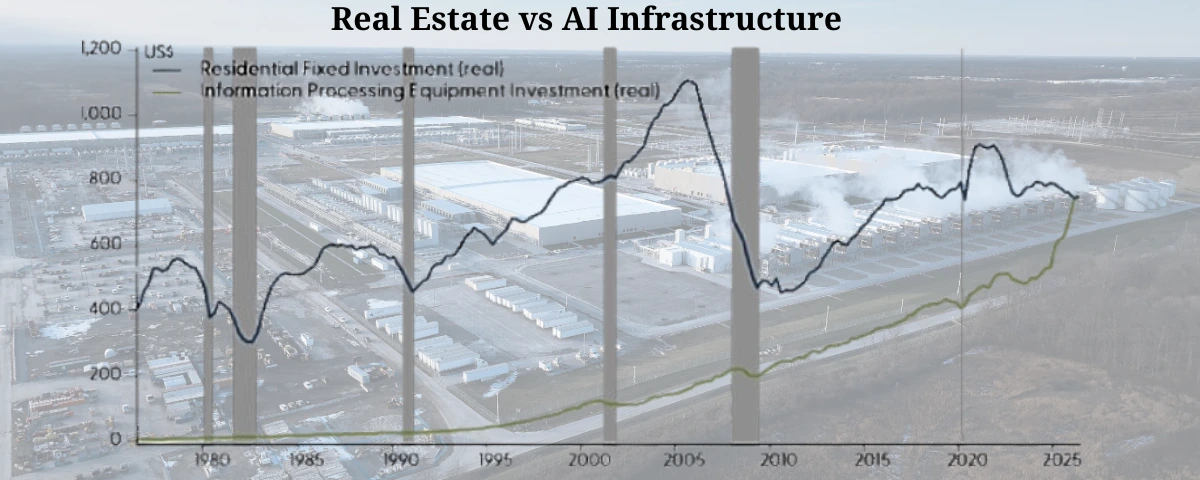
With AI becoming an increasingly important driver of US investment and economic growth, the direction of US investment is shifting, with spending on information-processing equipment now exceeding real private residential fixed investment.
US investment in information-processing equipment, which includes data centers and computer hardware, reached $752.1 billion in the second quarter of 2026, surpassing real private residential fixed investment at $748.0 billion, according to Bureau of Economic Analysis data.
Real private residential fixed investment stood at $748.0 billion in Q2 2026, down about 17% from $901.7 billion in Q2 2021. The figure was also about 18% below its Q1 2021 peak of $911.8 billion.
Over the same period, investment in information-processing equipment rose from $475.4 billion in Q2 2021 to $752.1 billion in Q2 2026, an increase of about 58%.
Adam Shapiro, vice president at the Federal Reserve Bank of San Francisco, described the shift as a pivotal change in the US economy, with investment moving away from residential investment and toward computers. “The AI investment boom is massive,” Shapiro said in a LinkedIn post.
Emphasizing the financing gap between the two sectors, Shapiro said residential investment, including home and apartment construction, is more sensitive to borrowing costs and has been held down by high interest rates. “By contrast, tech sector investment (building data centers) tends to rely less on borrowing and more on cash (although this has been reversing more recently).”
US Treasury Secretary Scott Bessent has also pointed to increased corporate issuance linked to AI infrastructure, describing much of it as “yield-agnostic” as companies appear relatively less sensitive to borrowing costs amid expectations of high returns from AI buildouts.
Also Read: AI Demand Drives Hong Kong’s Fastest June Export Growth Since 1984; Shipments to US Jump 114.3%