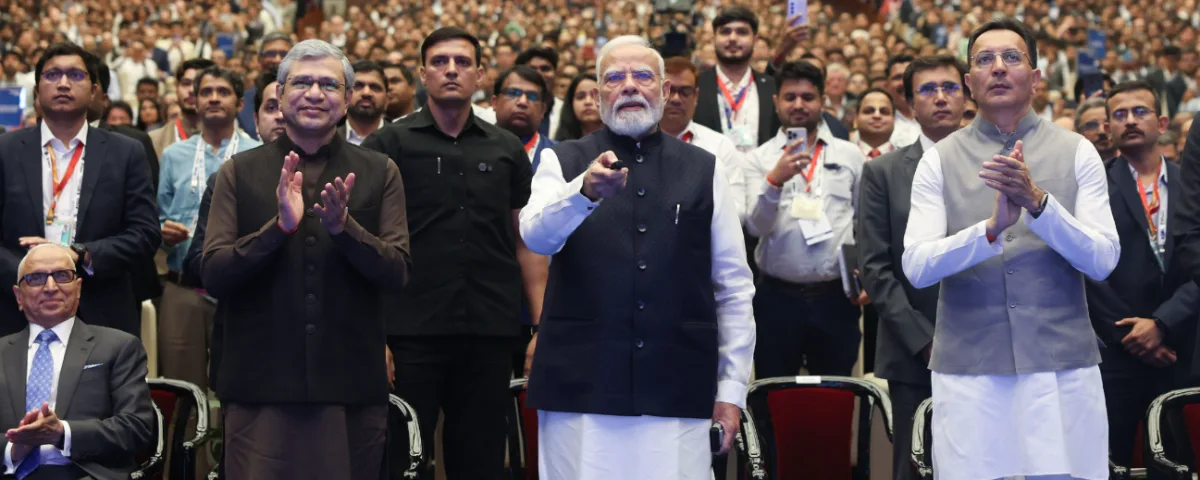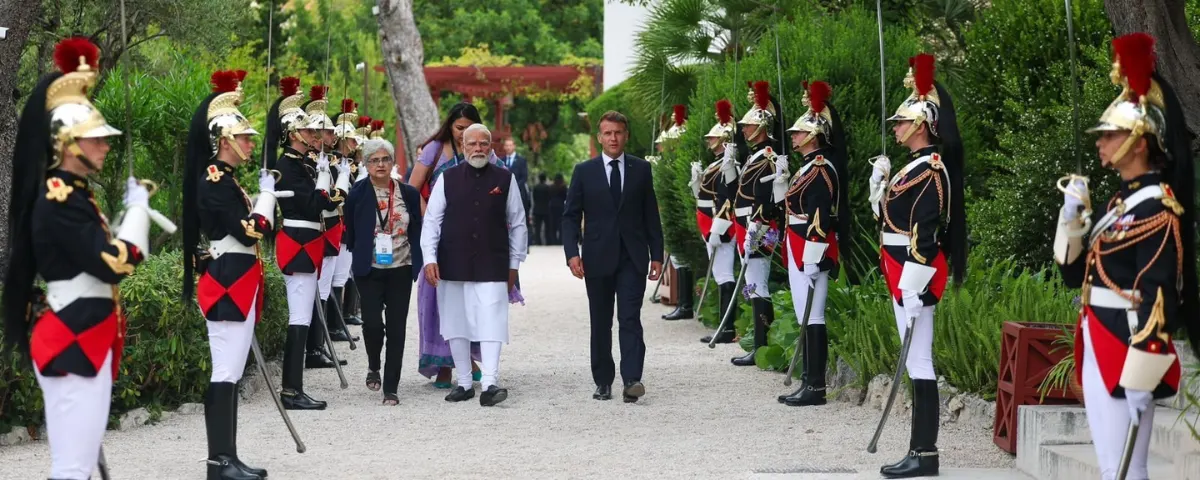
On Sunday, as the French President Emmanuel Macron addressed the inaugural ceremony of ‘Bharat Innovates’ in Nice, France, he took the opportunity to remind the world of the perils of one country owning the pull plug on artificial intelligence technology, and why India-France AI Framework can carve out a third space.
Criticizing the U.S. government for turning AI models into a “power tool”, Macron said unlike them, France and India are two countries that share the definition of a “reliable, open and safe AI that could be trusted, responsible and ethical.”
Read More: Macron Pushes AI Alliance with India as U.S. Bans Claude Fable for Non-Americans
Macron’s comments, made in front of Indian Prime Minister Narendra Modi, came just days after the U.S. banned export of Anthropic’s Claude Fable AI model for all non-Americans, deeming it a national security issue.
The move by the U.S. government to prohibit export of Anthropic’s Frontier AI model has made several countries including UK, India and France realize the importance of sovereign AI as well as shared resources.
Against this backdrop, the Bharat Innovates event in Nice saw “Trusted AI” becoming the central pillar of France-India ‘innovation roadmap 2030’ as the two countries announced a Joint Working Group on AI covering AI governance, trusted AI, online child safety, data-sharing frameworks and international standards on emerging tech.
In this article, we explain the importance of the Indo-French bilateral AI alliance, the future roadmap and what’s at stake for the two middle powers, with exclusive inputs from the former Indian ambassador to France.
India and France Pitch for Safe, Secure AI at Bharat Innovates 2026
Developing safe, secure and trustworthy AI systems will be one of the top priorities of India and France under the Innovation Roadmap 2030.
According to a release by the Indian Government’s Ministry of External Affairs both sides have partnered to work together to promote the development of safe, secure and trustworthy AI systems, aligned with democratic values and human rights.
“Our two countries share the definition of a reliable, open and safe AI, that could be trusted, that could be responsible, that could be ethical,” said PM Modi at Bharat Innovates event, calling upon innovators, investors and entrepreneurs to develop technologies that are trusted, inclusive and human centric.
Glimpses from Bharat Innovates 2026.
This platform showcases the best of Indian innovation, which is driving our developmental journey.
I invite the world to invest in India and partner with our youth.@BharatInnov2026 pic.twitter.com/ImDKc1bNLR
— Narendra Modi (@narendramodi) June 14, 2026
Apart from the innovation roadmap, a joint working group by India-France focusing on artificial intelligence, signing of 19 agreements between innovation based institutions of both countries, a memorandum of understanding on establishing a center of excellence in skilling in aeronautics at the campus of the Indian Institute of Technology in Kanpur were some of the key outcomes of Bharat Innovates 2026.
Building on the discussions held though the Expert Engagement Group on AI and Child Safety at the AI Impact Summit 2026 as well as India’s evolving techno-legal framework on child safety online, the two sides have decided to develop privacy-preserving age verification technologies, promoting child safe AI design and establishing safety standards for AI systems that interact with children.
Speaking to AI FrontPage, Dr. Mohan Kumar, Former Indian Ambassador to France and currently a professor and Dean at O.P. Jindal Global University said, “Traditionally the relationship was based on nuclear, energy, defence, space, but by introducing things like innovation and technology, the two leaders have taken the relationship to the next level,” he expressed.
Taking cognizance of the recent geopolitical turbulence including the US-Iran war and ongoing AI dominance race between U.S. and China, Kumar said the relevance of Indo-French AI alliance has only grown stronger.
“I believe that innovation is actually derived from inspiration. So what the two leaders (Macron and Modi ) have done is to make sure that the relationship is based on inspiration and innovation. What the two leaders have managed to do is to make the relationship relevant for the present time, especially in a world characterised by geopolitical turbulence,” he added.
Major AI Initiatives Announced at Bharat Innovates
India’s Data Empowerment and Protection Architecture (DEPA) and France’s own work on trusted data spaces and health data platforms can strengthen and secure consent-based data flows for research, healthcare, and public services, an official release by the government mentioned.
The India-France joint working group on AI will serve as a crucial platform for cooperation on AI governance, trusted AI, online child safety, data-sharing frameworks, and the development of international standards for emerging technologies.
Several initiatives aimed at strengthening global partnerships for innovation, research, and entrepreneurship were also announced at the event.
IIT Gandhinagar has signed a memorandum of understanding (Mou) with ECE Engineering School, Paris for academic and faculty exchanges, joint research, and innovation initiatives.
Strengthening Global Partnerships for Innovation, Research, and Entrepreneurship.
IIT Gandhinagar is pleased to announce the signing of three international collaborations during Bharat Innovates 2026 in Nice, France.
– MoU with ECE Engineering School, Paris, to foster academic… pic.twitter.com/HDmiB7UTDY
— Bharat Innovates 2026 (@BharatInnov2026) June 15, 2026
The institute has also collaborated with BlaBlaCar, the world’s leading community-based mobility platform, to explore opportunities in smart mobility, AI-enabled transportation systems, sustainability, innovation challenges, entrepreneurship, and startup engagement. It has also partnered with Compilatio, Europe’s leading platform for AI-content detection and plagiarism prevention, to advance academic integrity, responsible AI adoption, digital assessment frameworks, and research in AI-enabled education.
Meanwhile an Incubator Innovation Bridge, co-chaired by IIT Delhi and IIT Bombay to connect innovators with leading incubators, academic and ecosystem partners across the world was also announced at the event.
The initiative will support collaboration across incubation, validation, soft landing, market discovery, mentorship and institutional partnerships. It aims to help innovators move beyond the pilot stage and access the right networks for global readiness. By bringing together Indian and international innovation ecosystems, the Bridge will act as a pathway for young companies and research-led ventures to scale with stronger institutional support.
India, France and AI: Attempts to Carve Out a Third Space for AI
The AI and associated tech world has seen a dominance race between the U.S. and China with both giants making efforts to consolidate the tech. Infrastructure and resources including critical minerals.
In that regard, France and India have been attempting to carve out a third space for middle power countries where the technology can serve as a bridge between South Asia and Europe.
In February 2025, both Modi and Macron co-chaired the AI Action Summit in Paris, France wherein the two nations signed the AI agreement establishing “shared principles for safe, secure, trustworthy and human-centric AI serving the public interest, people, planet and progress.”
The key elements in this agreement included supporting digital public infrastructures for AI, shared objectives, capacity-building, international cooperation, and preventing AI-driven inequalities or misinformation.
The agreement became the foundational stone for further IAI initiatives that includes setting up of the Indo-French Centre for AI in Health (IF-CAIH) at AIIMS hospital, New Delhi in February 2026.
Additionally a joint declaration for setting up of a binational center on digital sciences and technology in India between Institut National de Recherche en Informatique et en Automatique (INRIA), France and Department of Science and Technology (DST) India.
During his visit to India for the Artificial Intelligence Impact Summit, held in February 2026 French President Emmanuel Macron and Prime Minister Narendra Modi jointly inaugurated the 2026 India-France Year of Innovation
Speaking to AI Frontpage, Professor Gulshan Sachdeva, Center for European Studies, Jawaharlal Nehru University (JNU) highlighted that the collaboration between the two countries for building a safe and secure AI will strengthen the focus on basic sciences in Indian universities and research institutions.
“It reflects a growing recognition that without enhanced funding, improved governance, and stronger support for fundamental scientific research, Indian universities will find it difficult to excel in emerging technologies such as artificial intelligence, quantum technologies, semiconductors, and advanced materials,” Professor Gulshan said.
Also Read: India’s Tryst with AI: White Paper Offers Roadmap for Foundation Models