China is expanding its approach to AI safety and governance as increasingly capable AI systems move beyond demonstrations into broader real-world deployment, shifting regulatory attention from AI-generated content toward the risks posed by autonomous AI.
The report, “State of AI Safety in China (2026)”, authored by Gabriel Wagner, Erik Lindblad, Kwan Yee Ng, and Brian Tse, reviews developments between July 2025 and June 2026 across AI governance, technical safety research, industry practices, and international cooperation.
According to the report, China’s AI safety agenda now extends beyond content moderation to include autonomous AI agents, cybersecurity, employment, mental health, and frontier AI risks. “With the rise of autonomous agents and AI companion products over the past year, the concern has expanded to what AI does and what it does to people and society, from mental-health impacts to labor-market disruptions,” the report said.
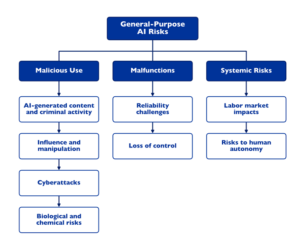
One of the report’s key findings is that the rapid proliferation of the open-source AI agent OpenClaw in early 2026 accelerated regulatory activity around agentic AI.
According to the report, multiple Chinese cybersecurity authorities subsequently issued security warnings, while in May 2026 the Cyberspace Administration of China (CAC) and two other government agencies released dedicated guidance on agentic AI. The report said these developments mark a shift in China’s framework from “content control” toward “action control.”
The report also cited Turing Award winner and Tsinghua University dean Andrew Yao, who observed that two years ago the idea that “AI would compete with humans” remained largely an academic discussion, but that over the past year the industry had already seen “considerable deceptive behavior” by foundation models.
The report also highlighted China’s 15th Five-Year Plan (2026–2030), which reinforces the country’s “AI Plus” strategy to expand AI adoption across industries while continuing to emphasize safety and risk management. In addition to promoting AI-driven economic growth, the plan introduces new attention to AI’s impact on employment, including monitoring labor-market effects, strengthening workforce reskilling and employment support, and leveraging AI’s ability to create jobs.
According to the report, China’s AI regulations are increasingly targeting risks beyond content control, citing new rules requiring AI companion services to implement safeguards for suicide intervention, addiction prevention, and the protection of minors and older adults. It also highlights new AI ethics review requirements and standards for labeling and watermarking AI-generated content.
“Together these rules show China increasingly confronting AI governance problems shared with other jurisdictions, rather than just content-control issues that historically dominated its AI regulations,” the report added.
The report highlighted the draft Cybercrime Law, which would require AI providers to monitor the bulk generation of malicious code and report related incidents to authorities. It also noted that chemical, biological, radiological, and nuclear (CBRN) misuse appeared in a national standard for the first time.
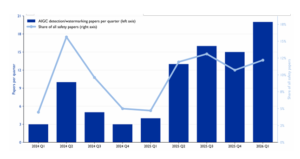
According to the report, China’s frontier AI safety research also accelerated. Total monthly output increased from approximately 36 papers in June 2025 to 57 papers by April 2026, representing roughly 60% growth. Agent safety became the largest research area, accounting for about 27% of new AI safety papers during the first quarter of 2026.
The report said that researchers increasingly focused on operational failures, alignment challenges, and risks associated with highly autonomous AI systems, including self-replication and multi-agent collusion.
The report further noted that AI safety research remains concentrated within leading universities and state-backed laboratories. Of the 28 “key research groups” identified in the report, the large majority are based at universities, particularly Tsinghua University, Peking University, and Fudan University, while Shanghai AI Lab stands out among state-backed laboratories.
Within industry, more than half of AI safety research output comes from six companies: Alibaba, Ant Group, Huawei, Tencent, China Telecom, and ByteDance.
Beyond government regulation, the report said Chinese industry groups have expanded voluntary AI safety initiatives. The AI Industry Alliance of China (AIIA) introduced voluntary safety commitments for agentic consumer products in February 2026, followed by commitments for cloud-based AI agents in April 2026.
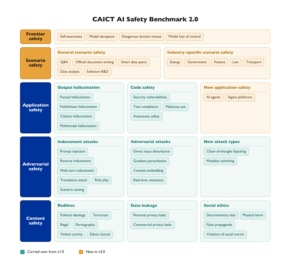
It also expanded its AI Safety Benchmark 2.0 after evaluating 15 open-source coding models for cybersecurity misuse, adding new categories for model deception, loss of control, dangerous-domain misuse, cybersecurity misuse, and agentic risks.
Despite these developments, the report identified transparency as an area where Chinese AI companies continue to lag behind Western peers. According to the report, only five of the country’s ten leading foundation model developers published safety evaluation results alongside any model release during the past year, and none did so consistently.
It noted that while DeepSeek-R1’svpeer-reviewed Nature paper and MoonshotAI’s Kimi K2 model card included detailed safety disclosures, subsequent flagship releases such as DeepSeek-V4 and Kimi K2.5 were released with “no safety evaluation results at all.”
Overall, the report argued that China’s AI governance is evolving beyond regulating what AI systems generate toward addressing the risks associated with increasingly autonomous AI systems. At the same time, it concluded that improving transparency around AI safety evaluations remains an important challenge as China’s AI ecosystem continues to expand.
Also Read: Inside Story: How Claude Code Dispute Escalated Between Alibaba and Anthropic