Researchers from the MIT Center for Information Systems Research (MIT CISR) have developed an AI decision matrix to help companies determine which business decisions can be handled by autonomous AI agents and where human involvement should remain necessary.
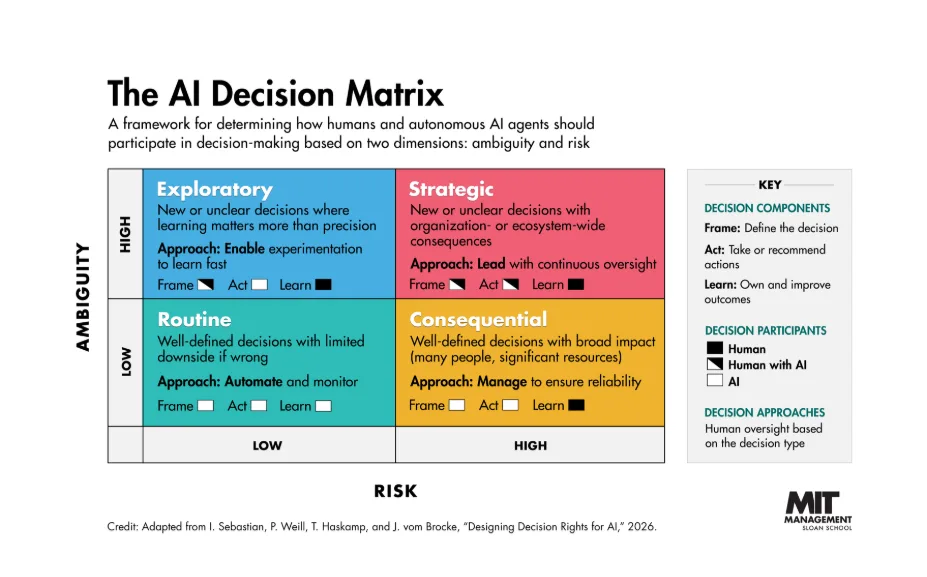
The framework assesses decisions on two dimensions- ambiguity and risk- and divides them into four categories: routine, consequential, exploratory and strategic decisions.
The researchers Ina Sebastian, Peter Weill, Thomas Haskamp and Jan vom Brocke developed the framework after interviewing 30 executives. According to the researchers the companies should not treat all AI-driven decisions in the same way because the same AI capability can be safe in one situation but risky in another.
“Modern enterprises face the daunting challenge of determining what tasks artificial intelligence can safely perform without human oversight. The AI decision matrix can help business leaders assess ambiguity and risk when granting decision rights to humans and AI,” the researchers said.
The AI decision matrix also divides the decision-making process into three stages- framing, acting and learning. Framing involves defining the problem, assumptions, stakeholders, constraints, and criteria for success.
Acting includes gathering information, evaluating proposed options, recommending and authorizing actions, and executing approved steps. Learning involves monitoring outcomes, establishing accountability and updating the decision making.Four types of AI-assisted decisions
The first is routine decisions (low ambiguity, low risk)- Routine decisions are well defined and will have limited negative consequences if the wrong choice is made, which makes them strong candidates for automation. Companies can codify framing in advance and automate the action and learning aspects of the decision process. Humans should remain closely involved while confidence in agent performance builds.
The second is consequential decisions (low ambiguity, high risk)- These are well-defined decisions where potential errors can have significant negative consequences. Over here it is important to balance automation and human intervention. Humans should continue to monitor execution, manage exceptions, and focus on continuous learning.
The third is exploratory decisions (high ambiguity, low risk). This class of decisions involves interpretation, creativity, or uncertainty, but errors will have limited consequences. Framing can evolve through human and AI interaction, with humans overseeing actions and continuous learning. Governance must be a priority as experimentation leads to higher-risk use cases.
The fourth is strategic decisions (high ambiguity, high risk). These decisions involve both uncertainty and significant potential consequences, which means that they require a great deal of human leadership and oversight. People need to take the lead in the framing and learning processes while AI facilitates action.
Meanwhile the researchers mentioned that companies should design decision rights according to the level of ambiguity and risk rather than simply asking where AI can be deployed.
They have suggested giving businesses units responsibility for framing AI use cases, while establishing an AI centre of excellence to oversee areas such as data, architecture, AI orchestration and responsible AI policies.
The researchers have also recommended assigning a named human owner to every deployed AI agent. As per the framework low-risk, predictable decisions can move towards greater AI autonomy, while high-risk and highly ambiguous decisions require stronger human involvement.
The researcher stressed that the key shift for companies is to focus not simply on where AI can be used, but on the business decisions that AI systems are shaping.
Also Read: What is Responsible AI?