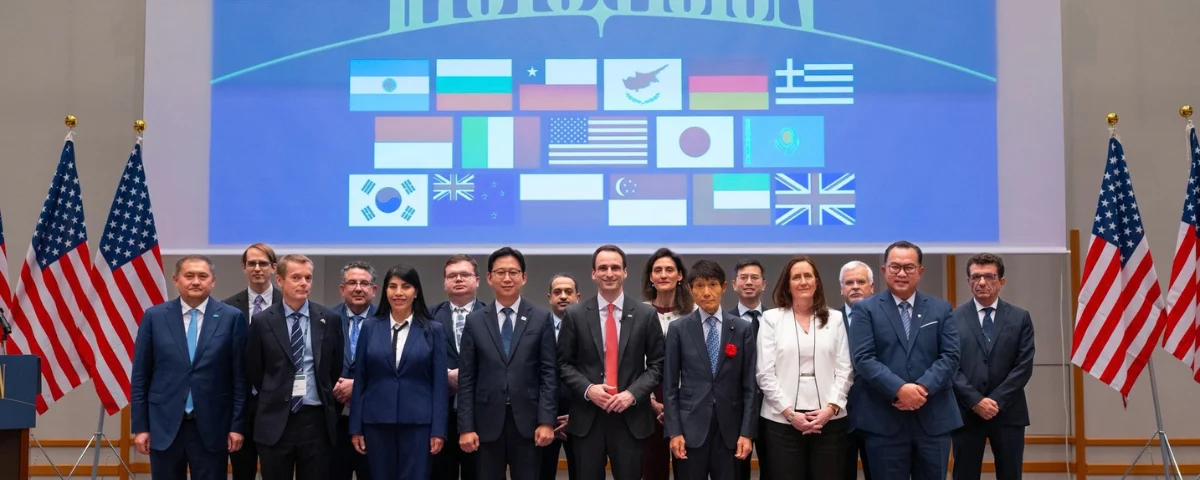
The United States and 16 other countries have endorsed the Kyoto Vision for Golden Age of Science, calling for greater use of super intelligence (SI) to accelerate scientific discovery and expand access to advanced AI tools, computing infrastructure and experiential facilities.
The joint declaration was established at the 23rd annual meeting of the Science and Technology in Society (STS) forum convened in Kyoto and was led by Michael Kratsios, White House Office of Science and Technology Policy Director.
Argentina, Bulgaria, Chile, Cyprus, Germany, Greece, Indonesia, Italy, Japan, Kazakhstan, Republic of Korea, New Zealand, Poland, Singapore, United Arab Emirates, United Kingdom and United States of America are the countries which have endorsed the declaration.
Today the U.S. led an international coalition of 17 countries to endorse the Kyoto Vision for a Golden Age of Science.
The way we make scientific discoveries has changed, and the Kyoto Vision is a recognition of that shift and a call to action. https://t.co/kfRD6AGnRr
— Director Michael Kratsios (@mkratsios47) October 4, 2026
“Super Intelligence (SI) and new ways of organizing research are opening entirely new frontiers of discovery. We recognize the opportunity to take advantage of these changes to increase the productivity of our researchers, remove unnecessary administrative burdens to allow our scientists to flourish, and ensure funding systems incentivize ambitious, transformative ideas,” read an excerpt from the declaration.
The Kyoto Vision for a Golden Age of Science has identified super intelligence as a major opportunity to transform how research is conducted. It said AI systems capable of autonomous experimentation at scale could enable new experiential and analytical capabilities and open entirely new areas of scientific inquiry.
The participating countries have called for integration of SI into scientific workflows and have pledged to expand researcher access to SI for science tools, scientific data, computing infrastructure, and experimental facilities.
The declaration has also called for changes to how scientific research is funded and organised. Ministers have endorsed the use of a wider range of funding mechanisms, including long-duration research awards, rapid grants, prizes and challenges, while encouraging experimentation with new institutional models offering different levels of autonomy and resources.
It is my great honor to serve on President Trump’s Super Intelligence Force (SIF).
At the @DeptofWar we have seen what is possible when red tape is removed and America’s best technology is rapidly put into action. Working alongside America’s leading technology companies, we are putting the most advanced SI capabilities into the hands of our warfighters at speed and scale.
I look forward to serving alongside DNI Jay Clayton, @AFergusonFTC and @skupor to secure America’s leadership in Super Intelligence and ensure this transformative technology directly serves all Americans.
— Under Secretary of War Emil Michael (@USWREMichael) October 4, 2026
The counties have also backed metascience as an empirical field to improve how science is conducted, organized, and funded for public benefit.
“The way we make scientific discoveries has changed, and the Kyoto Vision is a recognition of that shift and a call to action. Superintelligence applied to science will be the greatest force in history for democratizing research. Seizing this moment requires us to reinvigorate our research enterprises and leverage new institutional models for discovery,” said Director Kratsios.
Meanwhile US President Donald Trump has announced the formation of a new taskforce focused on artificial intelligence, which will be led by Director of National Intelligence Jay Clayton.
In a post on X Trump said that the “Super Intelligence Force” is tasked with coordinating the effort of the federal government to ensure that America continues to lead the World in Super Intelligence and will protect the interests, and improve the lives of all Americans.
“I am announcing the formation of the Super Intelligence Force (SIF). The Super Intelligence Force is tasked with coordinating the effort of the Federal Government to ensure that America continues to lead the World in Super Intelligence, which many say is bigger than the Industrial Revolution, and the Internet, and will protect the interests, and improve the lives, of all Americans.” – President DONALD J. TRUMP 🇺🇸
— The White House (@WhiteHouse) October 4, 2026
Following his meeting with the Tech leaders, Trump Trump signed an executive order on September 29 directing the executive branch to use “Super Intelligence” and “SI” instead of “Artificial Intelligence” and AI also changed the name Artificial Intelligence to Superintelligence in the U.S. through an executive order, citing that the new term “more appropriately captures the promise, potential and and rapidly advancing capabilities of these technologies.”
Also Read: U.S. Adds Nine Nations to Pax Silica Sharpening AI and Rare-Earth Push Against China