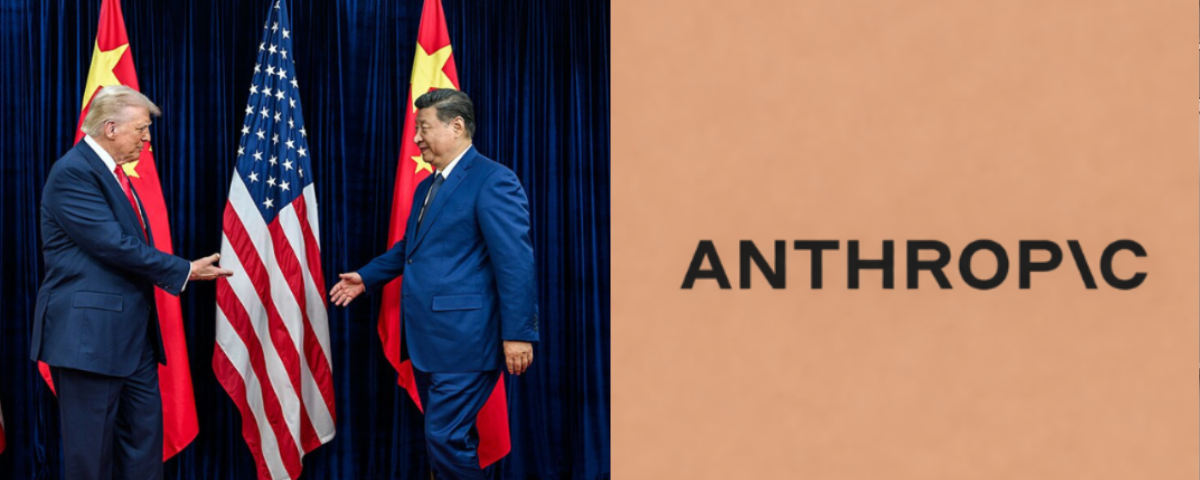
Anthropic AI, the creators of Claude, published a policy paper on May 14 warning that China could reach parity with American AI capabilities by 2028 unless the United States tightened chip export controls and blocked what the company called large-scale “distillation attacks” on its models.
The paper, titled “2028: Two scenarios for global AI leadership,” was released as US President Donald Trump held his first summit with Chinese President Xi Jinping in Beijing. Trump’s delegation included Nvidia CEO Jensen Huang, whose company makes the advanced chips at the center of Anthropic’s argument.
Anthropic said the United States and its allies currently hold a substantial lead in access to advanced computing hardware. The company described this as the primary input for building frontier AI models.
According to Anthropic, China could narrow that gap in two ways. The first is by exploiting loopholes in US export controls to access restricted chips. The second is by using distillation attacks to extract capabilities from American models.
Also Read: With Anthropic, AI Companies are Finally Realizing How It Feels to be Scraped
The paper outlined two possible outcomes by 2028. In the first, the United States defends its advanced compute advantage by locking in a 12 to 24 month lead in frontier AI development by tightening controls, disrupting distillation attacks, and accelerating allied adoption of American AI systems.
In the second scenario, weaker enforcement allows Chinese firms to reach near-frontier capability. Anthropic argued that this would shift the ability to set global AI norms toward authoritarian governments.
Anthropic mentioned the Chinese Communist Party (CCP) by name. The company argued that frontier AI in authoritarian hands could automate repression at a scale not previously possible. The paper cited existing CCP use of AI for speech censorship, surveillance of ethnic minorities, and cyberattacks on foreign governments and corporations.
Anthropic did not address the Trump-Xi summit directly. However, the paper called on the Trump administration to maintain export controls, including restrictions on Nvidia’s H200 chip. Anthropic had previously argued that the chip should not be exported to China.
Also Read: Jensen Huang Uses ‘Mythos’ to Urge US – China AI Cooperation, Flags China’s Compute Capacity
As of May 15, Reuters, citing three sources, has reported that the US Commerce Department has approved around 10 Chinese companies, including Alibaba, Tencent, ByteDance and JD.com, to purchase Nvidia’s H200 chips. Lenovo has also confirmed to the write service that it has received approval.
China has not officially confirmed the approvals, according to Channel NewsAsia.
The 2026 Trump-Xi summit is the first US presidential visit to China since 2017 and covered trade, Taiwan and the ongoing Israel-US-Iran war.
Huang was not initially included in the US delegation. He flew to Alaska to board Air Force One and joined the trip.
Also Read: Trump-Xi AI Talks Test Washington’s Strategy to Restrict China’s AI Growth