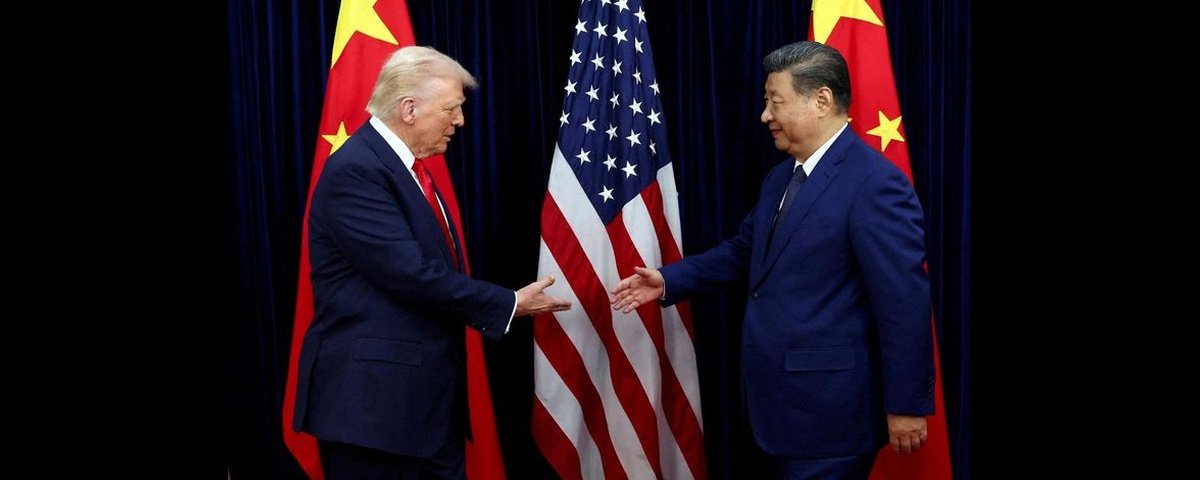
Artificial intelligence is expected to be a major focus of discussions between US President Donald Trump and Chinese President Xi Jinping during the May 13–15 US-China high-stakes summit in Beijing, alongside issues including trade, Taiwan, and the Iran war.
The AI dialogue is likely to cover AI safety, semiconductors, cybersecurity, and potential guardrails around military uses of artificial intelligence.
The White House’s July 2025 AI Action Plan described artificial intelligence as a strategic global competition, stating that “America is in a race to achieve global dominance in artificial intelligence.”
The strategy document also called for strengthening “AI compute export control enforcement,” plugging “loopholes” in semiconductor restrictions, and countering “Chinese influence in international governance bodies.”
Ahead of the summit, Trump said he planned to emphasize that the United States was “leading in AI” during discussions with Xi Jinping, according to Reuters.
Trump also described the upcoming summit as “potentially, Historic” in a post on Truth Social that was later shared on X, writing: “Our meeting in China will be a special one and, potentially, Historic.”
— Commentary Donald J. Trump Posts From Truth Social (@TrumpDailyPosts) May 11, 2026
Trump also confirmed Jensen Huang’s participation in the delegation, saying he would ask Xi Jinping to “open up” China so American technology companies could “work their magic.”
China is expected to press Washington to ease semiconductor restrictions during broader summit negotiations.
On May 13, 2025, the US Department of Commerce rescinded the Biden administration’s AI Diffusion Rule, while simultaneously strengthening semiconductor-related export controls worldwide. In a March 2026 post on X, the department described the rule as ‘burdensome, overreaching, and disastrous.'”
According to media reports, Trump’s Beijing delegation included more than a dozen executives, including Tim Cook of Apple, Elon Musk of Tesla and SpaceX, Boeing’s Kelly Ortberg, and Meta’s Dina Powell McCormick, alongside executives from BlackRock, Blackstone, Cargill, Citigroup, Coherent, GE Aerospace, Goldman Sachs, Illumina, Mastercard, Micron, Qualcomm, and Visa.
Jensen Huang said he joined the delegation at the last minute during a stopover in Alaska after Trump asked him to attend the China summit.
After US export controls on advanced AI chips to China began in 2022, NVIDIA developed modified processors such as the H20 to continue sales in China. In its latest quarterly report, the company disclosed a $4.5 billion charge tied to H20 chips and additional shipment restrictions affecting China sales.
AI FrontPage previously reported that on March 6, the US Commerce Department rejected claims it was reviving the Biden-era AI Diffusion Rule even as discussions continued on broader controls over global shipments of advanced AI chips from US companies including NVIDIA and AMD.
Also Read: Washington Calls It “Promoting Secure Exports.” But Is It a Chokehold on Global AI?
The Bureau of Industry and Security issued guidance warning companies about risks involving Chinese advanced-computing chips, including Huawei Ascend processors, and about the potential export-control risks associated with allowing US AI chips to be used for training and inference of Chinese AI models.
Meanwhile, China has continued publicly positioning itself as supportive of international AI cooperation. China’s Ministry of Foreign Affairs has called on countries to “strengthen communication and cooperation” on artificial intelligence while opposing barriers that disrupt the global AI supply chain through technological monopolies and unilateral coercive measures under its Global AI Governance Initiative.
AI FrontPage also previously reported comments from Jensen Huang questioning whether export restrictions alone can significantly slow China’s AI development, warning that limiting access to US technology could push developers toward alternative AI ecosystems.
“We want the United States to win,” Huang said earlier this year on the Dwarkesh Patel podcast. “But I think having a dialogue and having a research dialogue is probably the safest thing to do.”
Also Read: Jensen Huang Uses ‘Mythos’ to Urge US – China AI Cooperation, Flags China’s Compute Capacity