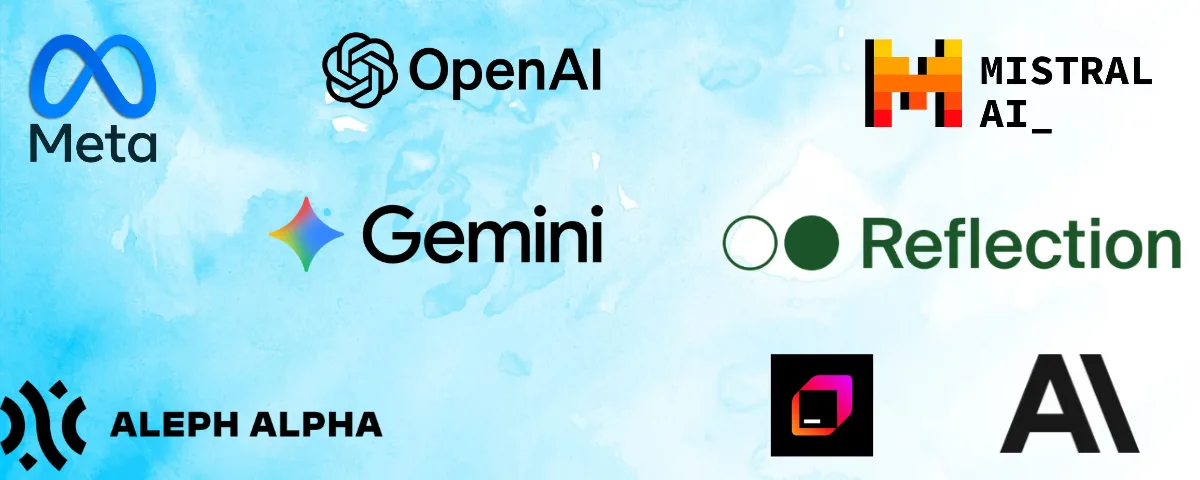
Open-weight dominated the AI models launch in the first two weeks of October that saw a wave of releases from Meta, Anthropic, Reflection AI, Aleph Alpha, JetBrains and other developers, bringing the shift to autonomous coding agents, convergence of multimodality and lower inference cost.
While industry giants like Google and Meta clouded the headlines with the launch of Gemini 4 Argon and Meta Muse Wonder, Wonder Full and Spark Open series, sovereign and indigenous models like Jais 3 and Kolibri also gained spotlight.
October 2026 AI Model Launches offered a glimpse of how the AI race is evolving beyond the pursuit of ever-larger, more powerful LLMs and towards enterprise deployment, sovereign AI and cheaper economy of intelligence.
At AI FrontPage, we did an analysis of every major LLM launch from October 1 to October 15 and found a clear trend of open weight models dominating the list.
Open-weight Models Dominate October 2026 Releases
Open-weight AI models are now expanding across model sizes, languages and deployment requirements, although access to weights does not necessarily mean unrestricted commercial use or fully open-source development.
The month began with Aleph Alpha releasing Kolibri, followed by Reflection AI unveiling Beam and JetBrains announcing launch of Mellum 2.1 to Meta releasing the weights of Muse Spark Open, an 816-billion-parameter model with native text, image, video and audio input capabilities. The same day, the Institute of Foundation Models and Inception42 introduced Jais 3, a family of six open Arabic-language models.
Focus on Autonomous Task Execution by AI Agents
The model releases also suggest that coding AI is moving beyond code generation and towards autonomous execution.
Reflection AI’s Beam, introduced as its first open-weight model, targets coding, reasoning and agentic workloads, while JetBrains’ Mellum 2.1 focuses on smaller, self-hostable coding agents. Anthropic’s Claude Haiku 5.5, meanwhile, is designed for high-volume tasks and can operate as a subagent alongside larger Claude models in coding workflows.
Trends clearly show how AI systems are increasingly expected to navigate software repositories, edit files, run tests and verify changes, rather than simply suggest snippets of code.
But the performance clearly shows a glaring gap between improving at specific coding tasks and reliably handling complex software engineering.
JetBrains reported that Mellum 2.1 made its largest gains in agentic coding, while Anthropic’s published evaluations showed Haiku 5.5 scoring 72.4% on the offline subset of OSWorld 2.1, compared with 15.7% for Haiku 4.5. Yet Haiku 5.5 scored 39.2% on Terminal-Bench 4.0, well below Sonnet 5.5’s 70.6%.
Economics of Intelligence: Lower Inference Cost and Enterprise Deployment
The economics of running AI models is emerging as a competitive differentiator alongside their raw capabilities. Anthropic positioned Claude Haiku 5.5 as a cheaper, faster option for high-volume workloads, estimating that it costs around 75% less to run than Haiku 4.5 on average.
Reflection AI, meanwhile, claims its Beam model can deliver performance comparable to GLM-5.2 on selected advanced reasoning benchmarks while using three to four times less inference compute.
Also Read: AI Pricing Battle Intensifies as Anthropic and OpenAI Cut Costs with New Models
OpenAI’s GPT-6 Luna Decisions API takes a different approach, targeting bounded tasks such as classification, prioritization and request routing, with the company claiming it can make decisions up to ten times faster than using Luna through its standard Responses API. For enterprise solutions, open-weight AI models such as Kolibri and JetBrains’ Mellum 2.1 offer additional options for organisations that want to run models on their own infrastructure
AI Model Launches in October 2026
Gemini 4 Argon
Google released its latest flagship model Gemini 4 Argon on October 1 with full dev access given only on October 13. Google claims Gemini 4 Argon excels at “deep work in complex, real-world tasks across domains including coding, finance, legal, cybersecurity, and science” allowing the model to outperform other frontier AI models on several benchmarks across domains.
Gemini 4 Argon is available for developers and enterprises via the API in AI Studio and Gemini platform, for Google AI Ultra subscribers in Google Antigravity, and Google AI Ultra and Pro subscribers in the Gemini app and AI Mode in Search. The introductory price has been kept at $2 per million input tokens and $10 per million output tokens.
Also Read: Google Launches Gemini 4 Argon Globally for Developers and Enterprises
Mistral Large 4
French AI Company Mistral Launched a public preview of its latest AI model Mistral Large 4 (ML4), aka, Le Chonk, a 1 trillion parameter natively multimodal model with 49 billion active parameters, claiming it to be their largest and most capable model yet.
According to Mistral, Le Chonk model has been trained in coordination with leading European enterprises in finance, engineering, manufacturing, logistics, pharmaceuticals, science, shipping, public sector among others, informed Mistral.
According to Mistral, the ML4 AI model’s weight will be released by October end and it will be available under EU laws across multiple regions worldwide.
Claude Haiku 5.5
Anthropic announced Claude Haiku 5.5 on October 7, describing it as its cheapest, fastest, and most capable small model to date. As per Anthropic, Claude Haiku 5.5 is designed for high-volume, cost-sensitive workloads such as summarization, context compaction, database queries, classification, live customer support, and browser-based tasks. Anthropic also recommends using Haiku 5.5 as a subagent alongside Claude Sonnet 5.5 or Claude Opus 5.5 for coding workflows.
Alongside the launch, Anthropic halved Sonnet 5.5’s cache-read price from $0.20 to $0.10 per million tokens, estimating that this would reduce costs by around 20% for most agentic workloads. It also introduced monthly Claude Platform API credits for eligible Max and Team subscribers: $100 for Max 5x, $200 for Max 20x, and up to $500 pooled for Team.
Beam
Reflection AI announced Beam on October 5, 2026, as its first open-weight model, pretrained on 6,144 NVIDIA GB300 NVL72 GPUs.
Beam is a sparse Mixture-of-Experts model with 501 billion total parameters and 23 billion active parameters, designed for coding, reasoning, and agentic workloads.
In its announcement, Reflection said Beam is competitive with larger open models such as Zhipu AI (Z.ai)’s GLM-5.2 and approaches Alibaba’s Qwen 3.8-Max on coding and agentic tasks, while Moonshot AI’s Kimi K3 remains ahead on raw capability. The company said Beam’s advantage is its efficiency at inference time
Kolibri-1
German AI Company Aleph Alpha released Kolibri-1, an open-weight English–German Mixture of Experts (MoE) decoder-only transformer, with 78.1 billion total parameters of which only 3.46 billion (4.4%) activated for any given token.
Designed for sovereign deployment in regulated European environments, Kolibri-1 was released on Hugging Face under the Apache 2.0 license on October 3 as a MoE transformer.
Aleph Alpha claims this sparsity, combined with hybrid attention, enables competitive quality at substantially lower inference cost than dense models of similar capability.
Trained on 24 trillion tokens with German accounting for more than 20% of data mix, Aleph Alpha claims Kolibri- 1 excels in benchmarks for agentic, maths, code, industry and general knowledge.
Mellum2.1
JetBrains released Mellum2.1 on October 8, 2026, as an update to Mellum2, its 12-billion-parameter Mixture-of-Experts model first open-sourced in June. The architecture remains unchanged, with 2.5 billion active parameters and an Apache 2.0 license; the main improvements come from post-training, particularly reinforcement learning.
The company positions the model as a fast worker or subagent within larger agentic systems—for example, identifying the cause of a failing test, drafting a fix, and checking whether it works. It can also be used as a general assistant or deployed on private infrastructure, allowing organizations to keep their code and data under their own control. Model weights are available on Hugging Face under the Apache 2.0 license.
Muse Wonder, Muse Wonder Full and Muse Spark Open
Meta introduced Muse Wonder and Muse Wonder Full on October 12, 2026, describing them as its most capable AI models to date for personal and professional agentic tasks. The models build on the foundations of Muse Spark and are designed for applications spanning legal and financial work, healthcare, software development, and other complex tasks. Meta says they were trained using its large-scale AI infrastructure, including the Prometheus data center.
Then on October 15, Meta announced the release of Muse Spark Open, an open-weight natively multimodal AI model with 816B total parameters (42B active) and a 1M-token context window, natively multimodal across text, image, video, audio and optimized to run on Mac Studio with M5 Ultra.
Meta released the weights on Hugging Face and Amazon SageMaker AI, Google Cloud Model Garden, and Microsoft Foundry Models under the Muse Model License with limited commercial terms.
Also Read: Meta Releases Muse Spark Open, an 816B-Parameter Open-Weight AI Model
Jais 3
The Institute of Foundation Models (IFM), part of Mohamed bin Zayed University of Artificial Intelligence (MBZUAI), and Inception42 introduced Jais 3 on October 15, 2026, as a family of six open Arabic-language models ranging from 900 million to 375 billion parameters, alongside Jais Speech, an Arabic speech recognition model. Built on IFM’s K2 Horizon family of open models released in September 2026, Jais 3 supports context windows of up to 512,000 tokens, except for the 900-million-parameter model, which supports 128,000 tokens. The developers describe 512K as the longest context window among Arabic-native models.
GPT-6 Luna Decisions
OpenAI introduced its Decisions API in public beta on October 6, 2026, using GPT-6 Luna as its underlying model. Rather than generating open-ended text, the API evaluates text, images, or both and returns typed answers for application workflows: a predicate that estimates the probability of a condition being true, a choice from a predefined set of options, or a score against an ordered rubric.
Taken together, October’s model launches point to a more fragmented and practical AI race, in which no single measure of capability tells the whole story. Open-weight releases are widening deployment choices, coding agents are pushing models towards autonomous execution, and inference economics are becoming central to commercial viability.
Also Read: Microsoft Unveils Code of Conduct for ‘Humanist AI Models: “AI To Remain Subservient to Humanity”