
Young Australians are becoming less engaged with news while increasingly turning to social media and generative artificial intelligence for information, according to a new report based on a survey of 1,027 young persons aged 10 to 17.
The report titled “News and Young Australians in 2026“ found that active news engagement among children and teenagers has declined across almost every measure since 2023. The study was conducted between February 20 and March 12, 2026 and is the fourth survey in a row tracking young Australians’s news habits since 2017.
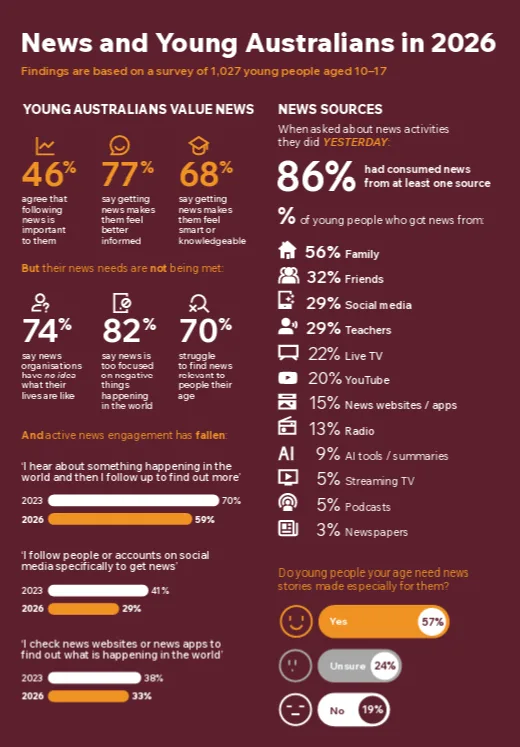
“Across nearly every indicator, young people are less engaged with news in 2026 than they were in our previous survey in 2023. Fewer children and teens are actively seeking out news. Young people following up on news after hearing about something happening in the world fell from 70% to 59%,” read an excerpt from the report.
The survey also found that those who follow social media accounts specifically for news declined from 41% to 29% while those who check news websites or apps fell from 38% to 33%.
The report highlighted that generative AI has emerged as a major source of news.
“More than one-third (36%) of young people often or sometimes use an AI tool to ask about news. This makes AI the second most common way young people proactively seek out news, level with news websites/apps and ahead of social media, TV and radio,” read the report.
“Young people who receive more news media literacy lessons in school demonstrate greater digital media knowledge but there is still a disconnect between what young people know and how they actually behave,” said Professor Tanya Notley of Western Sydney University, who is the lead author of the report.
The report mentioned that the proportion of using AI tools to seek news increases from 28% among children aged between 10-12 to 41% among teenagers aged 13-17. Checking news websites or apps also rises from 21% to 43%, while following social media accounts for news increases from 19% to 40%.
Despite the growing role of digital platforms, family remains the most important source of news. On the day before the survey, 56% of young people said they had heard news from family members, compared with 32% from friends, 29% from social media and 22% from live television. AI tools or AI-generated summaries were used by 9% as a source of news that day.
The report also discovered a significant shift in news habits as children become teenagers. Social media use for news rises from 14% among children to 38% among teenagers, while reliance on teachers falls from 34% to 27%. Overall, teenagers use an average of 5.7 news sources compared with 4.4 among children, driven largely by greater use of digital sources.
The report pointed out that misinformation remains another major concern. Only 47% of young people said they were confident they could distinguish fact from fiction online. It further said that young people are more likely to encounter news incidentally on social media than actively seek out: 48% said they come across news while using social media for other purposes, compared with 19% who actively seek news on the platforms.
The researchers also found a gap between young people’s digital media knowledge and their behaviour. Those who receive more news-literacy education at school demonstrate greater knowledge of how digital media work, but this does not necessarily translate into verifying information or checking sources online.
Teenagers in the country are not only dependent on AI for news but also for their classwork or assignments.
In May, a study titled “AI Use in Schools: Taking Action Now” by Australian education research group Learning First had warned that the negative impact of AI on student learning is increasing. The study argued that supporters of AI perceive risk to education as a future problem which can be managed, but this perception is both misplaced and dangerous.
The study found that around half of secondary teachers reported students using AI for schoolwork. More specifically, 56% of senior secondary teachers and 43% of lower secondary teachers confirmed student AI use with the problem most acute in the final years of schooling where results carry the greatest weight.
Among these teachers, nearly three-quarters said students use AI to complete assessments, despite more than 80% of secondary teachers stating that restrictions on using AI were already in place.
Also Read: Australia’s Classroom AI Crisis: Cheating, Learning Loss and No Easy Fix