Google has published a large-scale study titled “AI & Economy ATLAS” to analyze how people are using Google’s AI products and tools for various tasks at work and in their everyday lives.
Google said ATLAS’s (Activity, Task, Landscape, and Adoption Study) first dataset (v1.0) is built from 15 million aggregated and de-identified human-AI interactions across the Gemini app, AI Mode, and the Gemini API, which together are used by more than 1 billion people monthly. The study spans more than 150 countries, 140 languages, 800 occupations, and 4,000 tasks.
The study was authored by Zanna Iscenko, AI & Economy Lead in Google’s Chief Economist’s Office, and Scott Strand, Head of Strategic Operations and Special Projects for Technology & Society at Google.
The study found AI use at work is “broad but shallow”, with workplace adoption spanning 68% of occupations that collectively represent 90% of total U.S. employment. However, within a typical job, AI is used for only about 21% of tasks.
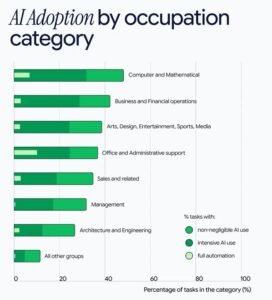
“At work, most AI use is focused on collaboration and assistance with tasks, and so far task automation is uncommon,” the study highlighted. Google said most workplace AI use is collaborative rather than automated, with employees relying on AI for tasks such as ideation, strategy, information retrieval, and learning.
According to the study, tasks like creative design and hypothesis testing accounted for a disproportionately high share of workplace AI interactions, with fewer than 10% of work-related AI interactions involved full task automation.
The study also found that AI use is not limited to white-collar workers. It is also assisting workers in physical and manual occupations with adjacent tasks.
“AI use for work is not limited to jobs traditionally seen as knowledge work. While not as prevalent, workers in manual and technical trades (e.g., auto technicians, industrial mechanics) are using conversational AI as a live collaborator for real-time diagnostics, troubleshooting, and on-the-fly learning,” the study stated.
“When workers in these areas use our AI tools, they’re 2x more likely to use multimodal AI (i.e. using AI to create images or video). For example, automotive technicians and industrial mechanics use AI to interpret complex test results, debug electrical wiring, and inspect machinery for wear,” it said.
The study also found that over 86% of AI interactions occur outside the workplace. It said people are using the technology for productive household activities such as researching purchases, getting help with appliances and tools, as well as administrative tasks such as navigating government services like taxes, licensing, and fines.
According to the study, AI adoption has spread across more than 150 countries and territories, covering 99% of the world’s population, with users interacting in over 140 languages. AI usage per capita broadly tracks a country’s income levels.
Google said English accounts for only about one-third of global AI conversations, with most users continuing to use their native language for complex tasks. The study also found that several middle-income countries in South America and the Middle East are adopting AI at rates comparable to wealthier economies.
Also Read: OpenAI, Microsoft, Amazon, Anthropic Back RAISE US for AI Workforce Transition