A decade ago in 2016, India experienced one of the strongest El Nino events, leading to severe drought and water crisis.
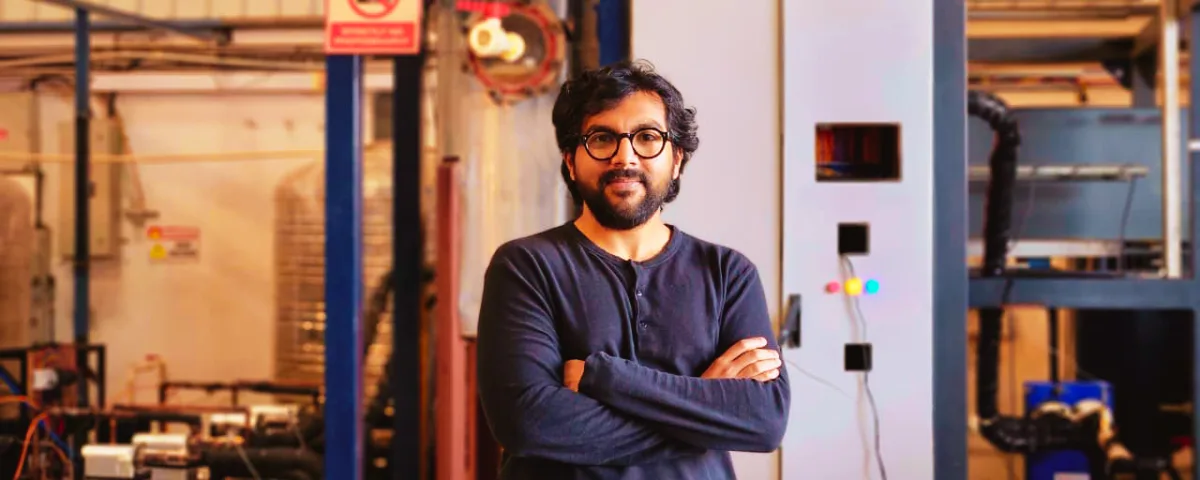
Back then 33-year-old Swapnil Shrivastav, CEO and co-founder of deep tech startup Uravu Labs, was a final year architecture student at National Institute of Technology (NIT) Calicut.
Calicut, officially known as Kozhikode, in Kerala is one of the few districts in India that first receives southwest monsoon rainfalls. However, the El Nino effect—the change in the trajectory of east-to-west trade winds—had resulted in rivers drying up in Kerala and parts of India.
Shrivastav recollects a severe water crisis in his college campus, that otherwise boasted of a modern waste-water treatment plant.
“Of what use is a waste-water treatment plant if there is no water at all? What is the future of waterless cities? These thoughts provoked me and my cofounder Venkatesh RY to come up with the idea of turning water out of air,” shares Shrivastav, in a free-wheeling conversation with AI FrontPage editor Vaibhav Jha.
The shared idea then resulted in Uravu Labs, a Bengaluru based startup that offers “water positive cooling” for AI data centers. The company uses “liquid-desiccant (salty) loop where a proprietary liquid salt absorbs water vapor from ambient air and uses low grade waste heat (35-60°C) to release heat as well as pure distilled water.
A decade later, as India and the world braces for one of the strongest El Nino events again, the stakes are higher with the advancements of artificial intelligence and infrastructure expansion of data centers in water-deficient countries like India and UAE.
As per reports, large AI data centers are increasing surface temperatures by 2 degree Celsius on average, thereby creating “data heat island effect” that could affect 340 million people. While there have been protests against data centers by climate activists, middle-power countries also cannot afford to lag behind in the AI infrastructure race, especially given the neck-to-neck competition between the U.S and China.
Also Read: AI Data Centers are Warming Up Earth; 340 Million Affected: New Study
In that context, Shrivastav claims his startup Uravu Labs’ platform “Clausius” (named after German physicist and father of thermodynamics) and cooling unit “Tatooine” (named after Star Wars Franchise) offers water positive cooling effect to data centers.
The product, in its data-centre configuration, is a liquid-desiccant thermal unit that plugs into the centre’s existing cooling loop at the heat-rejection stage. A proprietary liquid salt pulls water vapour from the air; the data centre’s own waste heat (35–60°C) then dries the salt out, releasing pure distilled water while the system feeds chilled water back into the loop.
Recently, Uravu Labs was chosen as one of the 27 start-ups under Abu Dhabi Hub71’s Cohort18 plan, with a total grant of 0.5 million Dirham.
In an exclusive interview with AI FrontPage, Shrivastav discusses the different ways in which AI data centers are closing the water and power wastage, the future of India in the AI race and the need to address the most pressing issue-water scarcity.
Excerpts from the interview:
Question: You’ve said the idea was born during a water crisis at your own university. Take us back to that year. What did losing the water actually feel like on campus, and what question did it leave you with?
Swapnil: “I am a big star wars fan and the water device name Tatooine came from there. So my college campus was 25 kms away from the city and the only water access for the campus and hostel was a waste water treatment plan and water purifier system that took water from a nearby lake. So due to El Nino the lake dried up and we had to depend on water tankers and it made me think about the future of waterless cities and what use is the waste water treatment plan if there is no water at all.”
Question: You describe the goal as turning a data centre from a water-spending asset into a water-producing one. Walk us through how that’s even possible, starting from where the heat comes from.
Swapnil: So we know hydropower has a very high footprint and energy based clusters have both onsite and secondary footprint…we can make data centers water positive and a surplus water producing asset rather than a water spending asset. Earlier, we had air-cooled data centers with 20-30 degrees air , we needed liquid cooling for a lot of purposes including chips, then we had a higher temperature shift with Blackwell going till 40 degree Celsius and it also now allows sometimes 40-60 degrees Celsius, this was a big shift in pattern, problem is once you generate heat, it gets out and is dependent on location weather and availability, so it is here that we come by generating water out of the heat that data centres emit so creating a closed loop we not only get higher efficiency but also ensure that data centers are saving cost on water from their waste.
Question: What is your vision with Uravu Labs? hat’s the largest unit you have running today, and where? How many data centres are actually using the system right now, pilots included?
Swapnil: Our future vision is to see data centers create a separate water market for them where they distribute surplus water We can produce 30 metric cubes of water per megawatt from a 10MW data center and by 2028 we want to develop data centers as water independent with water in 2030. Currently we have 2000L capacity for 1KW of heat and then we transcend to 350KW and gradually 1MW.
Question: How do you see India’s role in the larger race for semi-conductors and AI?
Swapnil: India has a lot going on especially in the field of green energy, as of now we are not ready for chip layer infrastructure or frontier models but we have to invent and innovate a lot in the coming years. We have to be aware of energy waste reduction techniques especially since India is drought prone and as per reports during summers, metropolitan cities hardly have few weeks of water left.
Also Read: NVIDIA Claims 100% Liquid Cooling and Near-Zero Water for Rubin AI Data Centres