The U.S. Commerce Department, on March 6, rejected reports that it was reviving the AI Diffusion Rule introduced during the administration of Joe Biden, even as internal government discussions continue on a framework that could require Washington’s approval for shipments of advanced AI chips produced by U.S. companies anywhere in the world.
The statement came after media reports that Washington was drafting rules requiring U.S. government approval before advanced AI chips could be shipped to any destination abroad. In a post on X, the U.S. Department of Commerce said: “Today there was reporting that we were returning to the AI Diffusion Rule. We will not. It was burdensome, overreaching, and disastrous.” It pointed to its November 2025 Middle East agreements and said, “there are ongoing internal government discussions about formalizing that approach.”
The Commerce Department is committed to promoting secure exports of the American tech stack.
We successfully advanced exports through our historic Middle East agreements, and there are ongoing internal government discussions about formalizing that approach.
Today there was…
— U.S. Department of Commerce (@CommerceGov) March 5, 2026
The proposed rule would require companies to seek US permission for nearly all exports of AI accelerators from companies like NVIDIA and Advanced Micro Devices Inc. (AMD), a global expansion of curbs that currently cover around 40 countries and would set up the US government as gatekeeper for the AI industry.
The draft framework now under discussion would extend that logic globally, creating a licensing structure in which- for deployments exceeding 200,000 GB300 GPUs owned by one company in one country, the host government would need to participate in the approval process. The U.S. would only approve such exports to allies that make security commitments and matching investments in American AI.
“The US Department of Commerce has authorized export of advanced US AI chips to UAE-based artificial intelligence company G42 and Saudi Arabia’s national AI company HUMAIN – each company will receive approvals to purchase the equivalent of up to 35,000 NVIDIA Blackwell chips (GB300s),” reported Middle East AI News on November 20, 2025.
The authorizations were conditioned on meeting rigorous security and reporting requirements to promote American AI dominance and global technological leadership consistent with U.S. President Donald Trump’s July 2025 AI Action Plan. The announcement was made during the Washington visit of Mohammed bin Salman. Saudi Arabia’s commitment to the United States expanded from $600 billion pledged in May 2025 to $1 trillion by November, when Washington approved AI chip exports to regional firms, according to the U.S. Department of Commerce.
Markets responded immediately. Shares of NVIDIA fell about 1.8%, while Advanced Micro Devices dropped around 2.2% in Nasdaq trading, before partially recovering after the Commerce Department’s statement.
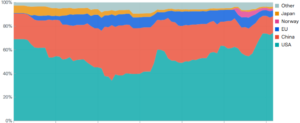
As per Epoch AI’s May 2025 analysis of over 500 GPU clusters worldwide, the United States holds roughly 75% of global AI training compute, while China ranks second with about 15%. Meanwhile, traditional high-performance computing leaders such as Germany, Japan, and France now play only marginal roles in the AI cluster landscape. “This shift largely reflects the growing dominance of major technology companies, which are predominantly based in the United States,” said Epoch AI.
No major AI company has issued a public statement on the draft. The industry’s silence has a documented cost behind it.
After the United States imposed export controls on advanced AI chips to China beginning in 2022 and tightened them in subsequent years, The chip giant NVIDIA designed modified processors such as the Nvidia H20 to comply with the restrictions while continuing sales to Chinese customers. NVIDIA reported a $4.5 billion charge in the first quarter related to its Nvidia H20 chips, and said it was also unable to ship an additional $2.5 billion worth of H20 products to China after new U.S. export restrictions took effect, the company revealed in its quarterly financial report.
On 15 January 2025, the administration of Joe Biden introduced the Framework for Artificial Intelligence Diffusion, commonly known as the AI Diffusion Rule, to regulate transactions involving advanced AI model weights and high-performance semiconductor chips.
The proposal signaled a broader U.S. approach to controlling the global flow of advanced AI technologies. While supporters said it addressed national-security risks, critics, including industry groups and allies- argued the rule’s vague language and enforcement challenges could hinder innovation and international collaboration.