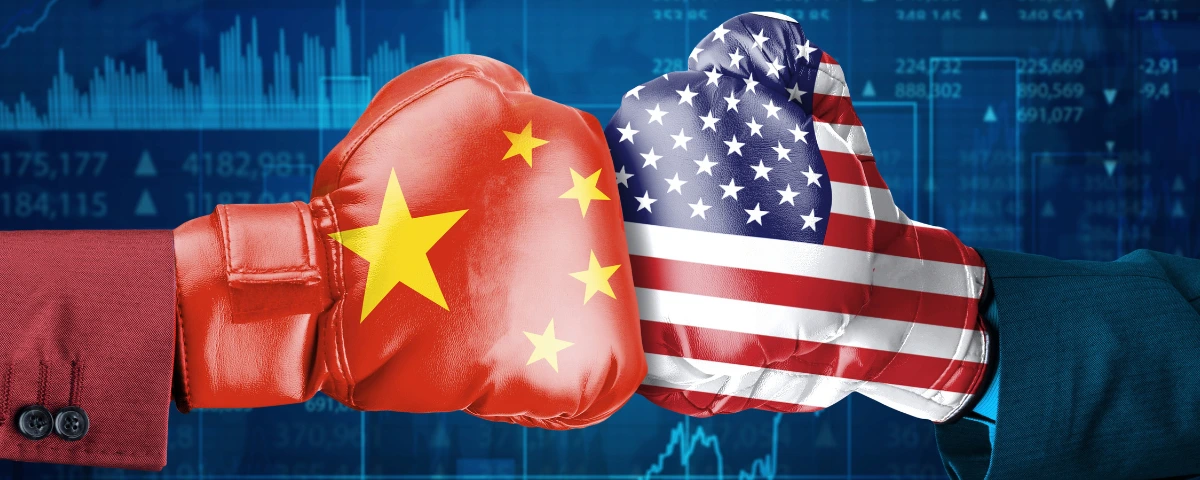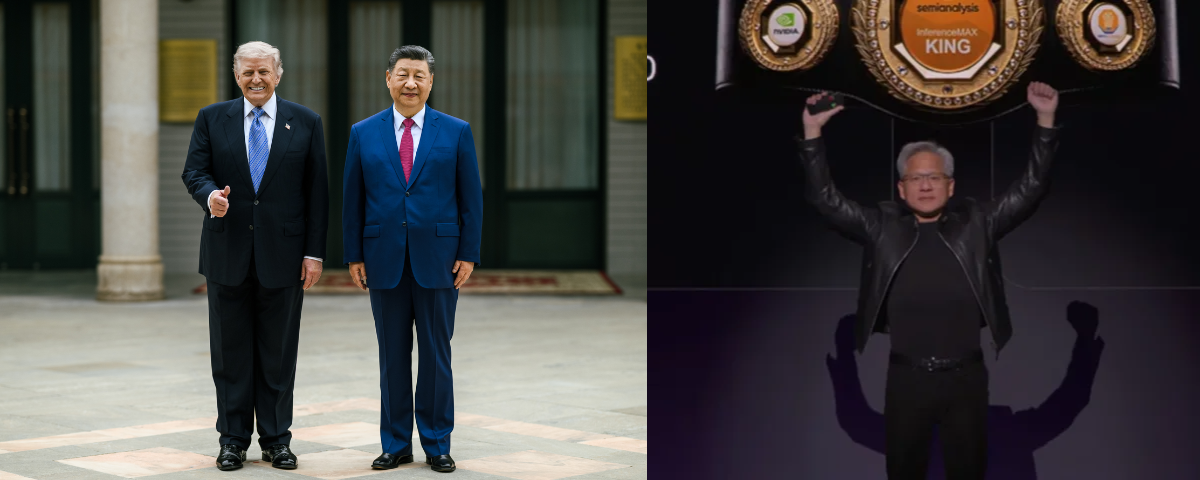
Jensen Huang, the CEO of Nvidia, is back in China, hitchhiking a last minute ride on Air Force One from Alaska, as he joined President Donald Trump’s entourage to Beijing on Wednesday.
A lot had been anticipated ahead of the Trump-Xi talks. Huang was hitchhiking with the likes of Musk and Tim Cook and the summit had expected to bore critical decisions related to AI infrastructure and critical minerals supply chain.
At the core of this summit was the regulatory framework around H200 Nvidia chips.
Hi from the Alaska refuel. Navida CEO Jensen Huang boarding Air Force One here to join President Trump on China trip. Elon Musk is also on the plane pic.twitter.com/KKp9TaJTS8
— Emily Goodin (@Emilylgoodin) May 13, 2026
The last time Huang was in Beijing in July 2025, he made a rockstar appearance- signing autographs dressed in his trademark black leather jacket, greeting the local populace with his unpolished Mandarin and running marathon media interviews.
Jensen’s visit had coincided with a commercial breakthrough as Nvidia’s H20 chip had just been cleared for export to China. However, a few weeks after his visit, China started a probe into H20 and imposed a de facto import ban. Later when the US cleared the more powerful H200, China did not budge.
As Trump’s convoy reached Beijing on Wednesday, this was the first US presidential state visit to China since Trump’s own trip in November 2017.
There were essentially three outcomes the discussions could have produced. The US could have formalized a licensing framework for Nvidia’s H200 chips in China. China could have relaxed its controls on rare earth mineral exports to the US. The two governments could also have established a bilateral channel to discuss AI development risks. However, the summit did not clearly resolve any of these industry concerns.
The Chip Stalemate
The H200 situation was already a paradox even before the summit started. Trump had announced in December 2025 that Nvidia could sell H200 chips to China, reversing a posture that the Biden administration had held through April 2025.
A January 13, 2026 Commerce Department rule formalized the licensing framework, allowing case-by-case review of China export applications for Nvidia’s H200, AMD’s MI325X and similar chips. Reuters reported that Trump’s arrangement for H200 sales required the US government to receive 25% of revenue from the chip sales, structured through a routing requirement because US law does not permit direct export fees.
On May 14, Reuters reported that the US had cleared roughly ten Chinese firms, including Alibaba, Tencent, ByteDance and JD.com, to buy H200 chips. A handful of distributors including Lenovo and Foxconn were also cleared. Each cleared customer was permitted to purchase up to 75,000 chips under the licensing terms. However, not a single chip had been shipped as of May 15th at the summit’s conclusion.
The Chinese firms paused their orders following ‘guidance’ from Beijing. Reuters, citing sources, reported that pressure inside the Chinese government was building to block all purchases, partly over the routing requirement through US territory creating a risk of tampering.
Nvidia in their FY2026 10-K filing confirmed that they are “effectively foreclosed from competing in China’s data center computing market” and are not assuming any data center revenue from the region in its current guidance. Before export controls tightened, Nvidia held roughly 95 % of China’s advanced chip market. That share is now essentially zero.
Meanwhile, the Blackwell generation of chips, Nvidia’s most advanced, remains banned from China entirely.
China Did Not Wait
While the H200 stalemate played out at the diplomatic front, Chinese AI development moved in a different direction. In April 2026 DeepSeek released V4, a 1.6 trillion parameter model, and optimized it specifically for Huawei’s Ascend 950PR processors. It was the first AI model built on Chinese domestic semiconductor infrastructure. DeepSeek gave Huawei early architecture access while denying the same to Nvidia and AMD.
There was an immediate commercial response, with ByteDance, Tencent, and Alibaba rushing to secure orders for Huawei’s Ascend 950 chips.
Huawei expects AI chip revenue of roughly $12 billion in 2026, up from $7.5 billion in 2025, driven primarily by demand that US export controls helped create.The irony is that the same controls also now contrarian Huawei’s ability to manufacture chips fast enough to meet the demand they accelerated.
There is a real hardware gap between the two countries, but its narrowing. DeepSeek’s own research shows that Huawei’s best chip, the Ascend 910C, performs at 60% the level of the Nvidia H100.
Huawei’s total AI chip production currently represents 3 to 5% of Nvidia’s aggregate computing power. However, Nvidia CEO Jensen Huang said on the Dwarkesh Podcast that raw hardware performance is only one variable, and that software optimization, researcher talent, and energy availability can compensate for silicon gaps.The Stanford University’s 2026 AI Index concluded that “the US-China AI model performance gap has effectively closed.” The Council on Foreign Relations (CFR) estimated the US lead at roughly eight months.
The Rare Earths Conversation
China restricted earth mineral exports in April 2025 as retaliation for Trump’s tariffs. While a partial recovery followed after trade talks later that year. At the time of Trump heading to the summit, Chinese exports of controlled heavy rare earths were still running roughly 50% below pre-restriction levels, according to Reuters, and the meetings produced no full reversal of Beijing’s licensing regime.
The US responded to the 2025 restrictions with a $12 billion initiative to stockpile critical materials and fund domestic rare earth mining and processing. While this effort is underway, it has yet to produce any alternative supply chain of any scale. Heidi Crebo-Rediker, senior fellow at the CFR, told CNBC before the summit that China’s April 2025 decision to restrict rare earths, combined with Trump’s decision not to escalate in response, “puts the US administration on the back foot.”.
Wafer Thin AI Diplomacy
Apart from the optics of Huang getting a lift to Beijing on Air Force One, the AI governance discussion was the thinnest part of the summit. No documents got signed.
Before the summit the framework being discussed centered on two key elements. The mutual capability notification where each government would inform the other when an AI system crossed defined performance thresholds and an incident information sharing channel for AI-related security failures or misuse at deployment scale. However, neither were formalized.
Reuters reported that the US Treasury Secretary Scott Bessent said the US and China were discussing AI guardrails and a protocol for best practices to prevent non-state actors from misusing powerful models, Reuters reported. Any formal channel would be limited at first, but it would mark a rare standing dialogue between the two governments on AI safety.
Both countries’ approaches to AI regulation remain sharply different. China requires all powerful generative AI models to be registered with the central government before public release. The Trump administration treats equivalent safety testing as voluntary. The Center for Strategic and International Studies flagged before the summit that Chinese foundation models, including DeepSeek, show concerning escalatory tendencies in national security simulation settings, and that both governments need common benchmarks for crisis management before AI systems are more widely integrated into military and foreign policy workflows.
In a pre-summit analysis CFR argued that China’s prior approach to AI diplomacy has been to use safety dialogues as a vehicle to press for access to U.S. technology, rather than to negotiate substantive safety constraints. During the sole 2024 US-China AI safety dialogue under Biden, the United States sent technical experts to outline shared risks. China instead sent diplomats to raise objections to chip export controls.
What the Summit Signals to the Rest of the World
Trump left Beijing saying “a lot of different problems were settled”. China’s official readout framed the summit around a “constructive China-US relationship of strategic stability,” but did not confirm specific technology outcomes such as an H200 licensing framework, a rare earth rollback, or a formal AI governance channel.
There is a gap between the summit’s diplomatic warmth and the concrete technology outcomes that were expected, it is less of a failed negotiation and rather points towards how both governments though want stability but are unwilling to give up any leverage over chips, rare earths or AI governance.
The US and China are building two parallel AI stacks . The H 200 licensing framework, if it ever functions, connects two systems that are otherwise decoupling at the software level.
DeepSeek’s move to support Huawei’s Ascend hardware is the clearest sign of that divergence. Reuters reported that Huawei’s Ascend supernode, built around its Ascend 950 chips, would fully support DeepSeek’s V4 model. But this is not yet proof of a clean break from Nvidia’s CUDA ecosystem. Earlier reporting showed DeepSeek still faced technical limits in moving training workloads to Huawei chips.
Wedbush Securities analyst Dan Ives was quoted in CNBC before the summit that “what is at stake is not just one trip or one headline but the direction of AI supply chains, the shape of future export controls, and the degree to which U.S. chip leadership remains monetizable in China.” The summit produced a trade truce extension, warm photographs, and no resolution on any of those three things. The AI race did not pause for the meeting, it just continued while the meeting was happening.
Also Read: Washington Calls It “Promoting Secure Exports.” But Is It a Chokehold on Global AI?