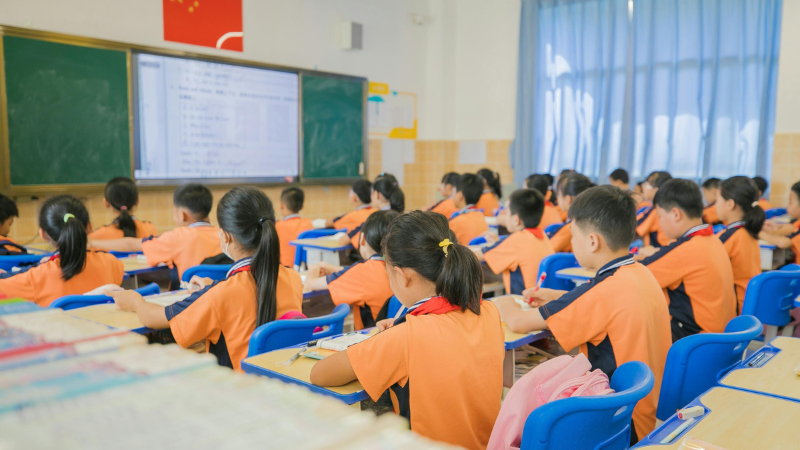
China announced its nationwide AI Plus Education program, with an aim to integrate artificial intelligence (AI) into classrooms as early as primary schools as the nation accelerates its AI adoption amid fierce global competition.
Under the AI+ Education program of People’s Republic of China, primary and secondary schools will see AI education with introduction of dedicated courses and efforts to weave the subject across disciplines. The plan will also encourage schools in China to extend AI-related learning into after school programs and hands-on activities.
“By 2030, China aims to establish a comprehensive AI education system that spans all levels of schooling and extends to the broader public,” read a statement from the Ministry of Education, PRC, on April 10.
The policy builds on China’s long-term education blueprint extending to 2035, which identifies AI as a key driver of reform in response to the demands of a rapidly evolving digital economy. Officials described the move as a necessary step to keep pace with other major economies, including the United States, the European Union, and Singapore, all of which have introduced similar efforts to expand AI training and innovation.
A central feature of the plan is the development of nationwide AI infrastructure. Rather than relying on scattered regional initiatives, China will consolidate computing resources and data platforms into a unified national system to improve efficiency and accessibility.
The strategy introduces a tiered approach to AI education. At the school level, students will be encouraged to develop curiosity, creativity, and problem-solving skills. Universities are set to enhance their foundational AI courses and encourage interdisciplinary learning. Meanwhile, vocational and adult education programs will concentrate on leveraging AI to modernize traditional industries and increase public access to digital skills.
“In parallel, universities will be steered to realign programs with evolving industries, and add majors to meet the demands of emerging technologies and new business models, according to the plan,” read a statement from the State Council, People’s Republic of China.
The process of teacher training also faces an overhaul. Knowledge in artificial intelligence will be part of the certification process, enabling teachers to utilize technology effectively in their classrooms.
Most of the funding will come from the federal government, although more contributions from local governments and other education organizations are recommended.
Also Read: NeurIPS Apologizes to China After Barring US-Sanctioned Institutes