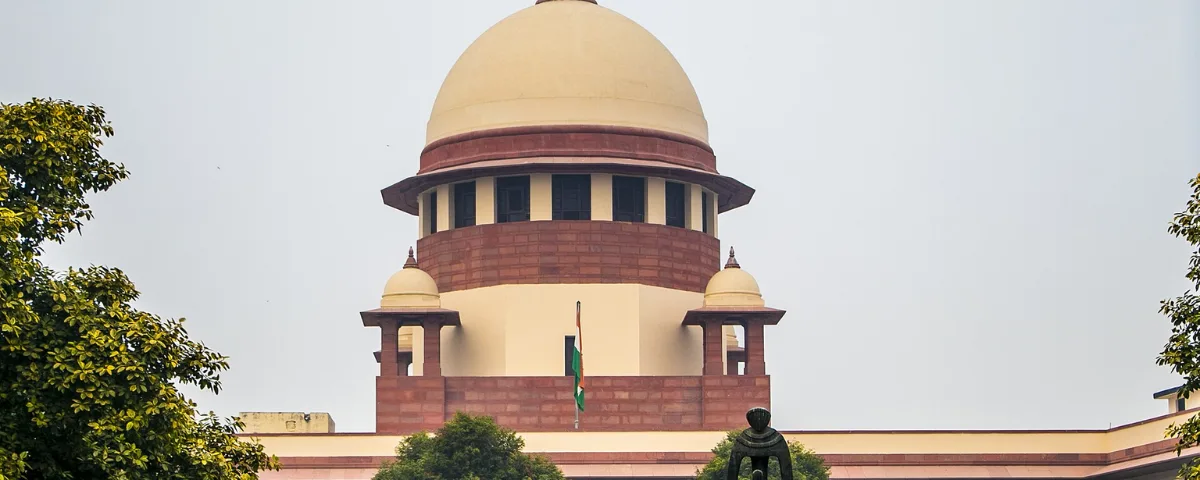
With an intent to introduce innovation in its judicial system, India’s Supreme Court rolled out a draft regulatory framework to govern the use of Artificial Intelligence in courts, favoring the use of technology for streamlining of judicial work while banning sole use of AI for any judgement/ adjudication or sentencing.
India’s three tier judicial system(Supreme Court- High Courts-District Courts) has over 55 million pending cases with majority of the backlogs in the lower courts.
As per a draft regulatory framework document released by the Supreme Court of India on May 3, the SC has allowed the use of AI for case management, cause list preparation, hearing scheduling and docket prioritization, automated court transcription, translation of judgements, orders, legal research, citation verification, document summarization, administrative functions, accessibility services (example audio to text), chatbots for assistance as well as anonymization of judgements.
Under the draft framework, use of AI has been prohibited for “risk scoring” (flight risk assessment, bail orders violation etc), standalone use in any judicial outcome/order/finding of fact and standalone use of AI for adjudication or sentencing.
Use of AI has also been banned for predicting, profiling or inferring future conduct of parties.
“No AI-generated output shall be submitted to a Court as an independent source of evidence without full and transparent disclosure of its AI-generated character; and (i) no AI System shall be used in any manner that may compromise the confidentiality of judicial deliberations or the independence of the judicial decision-making process,” read an excerpt from the document viewed by AI FrontPage.
The framework has also asked for setting up of an apex body at SC to “regulate and promote innovation, integration, oversight, standard setting and policy development on AI in judiciary and “ensure that no AI system, whether autonomous AI agent or static predictive model or any AI Tool, is in violation of any of the provisions of the Constitution or any law for the time being in force and are in compliance with the operational safeguards.”
The apex AI body will constitute of two SC judges, two chief justices and two judges of high courts, one member from an institute of national importance, an officer not below the rank of joint secretary from the ministry of electronics and information technology, Union government, a finance expert, a cybersecurity expert and an AI professor.
“The adoption of AI in Court processes shall be pursued, in a responsible manner, as a catalyst for impactful innovation in the justice delivery system. The use of AI-generated recommendations will be purely advisory and cannot serve as the sole basis for a court’s ultimate ruling,” read an excerpt.
To effectively monitor compliance with these new rules, the Supreme Court intends to develop an enduring national-level Apex Body, form AI Committees in all levels of the court system, conduct regular audits of AI systems and maintain incident-reporting processes and issue annual transparency reports.
Taken together, the developments described above represent a significant and comprehensive effort by the judiciary to establish a framework that addresses the implications of AI on the operation of the courts while preserving the constitutional rights of individuals and public trust in the court system.
Also Read: “AI Cannot Replace the Trained Mind of a Lawyer”: India’s Supreme Court Judge Vikram Nath