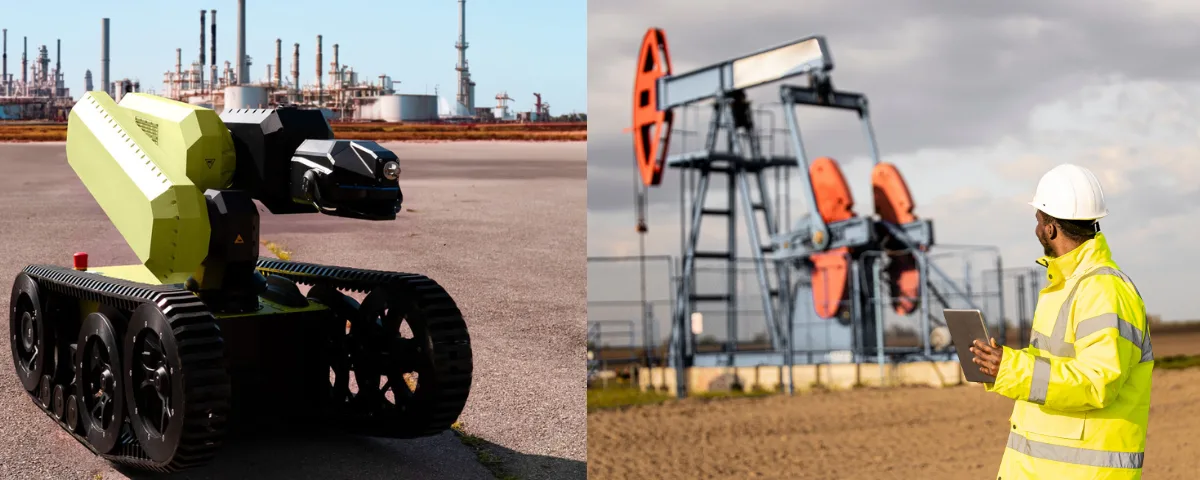
With energy companies increasingly deploying AI and automation technologies across critical infrastructure and strategies, Abu Dhabi-based ADNOC has deployed Taurob’s heavy-duty inspector robot at its Taweelah Gas Compression Pant as part of its broader ambition into AI-powered industrial robotics and autonomous operations.
The robot, now conducting routine autonomous inspections in hazardous environments at the Taweelah plant, serves as the first line of surveillance that detects potential gas leaks, abnormal heat signatures and other operational risks without requiring personnel to enter high-risk areas.
Equipped with 3D LiDAR (Light Detection and Ranging) technology and thermal cameras with 360-degree visibility, it is built to operate in the extreme industrial conditions typical of energy infrastructure in the region.
The deployment at Taweelah plant, a vital onshore facility located 50 km north of Abu Dhabi, is more than an operational upgrade. Dena Almansoori, ADNOC’s Group Chief Technology and Innovation Officer, said, “Artificial and physical intelligence are core to ADNOC’s long-term energy strategy, transforming how we operate across the value chain.”
She added, “This is innovation with purpose, enhancing safety, reducing emissions, improving performance and supporting the UAE’s AI Strategy 2031 and Robotics & Automation agenda.” The deployment also reflects a broader trend across the oil and gas industry, where energy ecosystem is progressively turning to AI to improve safety, efficiency and reliability.
From Inspection to Intervention
The company has also announced plans to co-develop the energy industry’s first heavy-duty operator robot, a system capable of physically interacting with industrial equipment, turning valves, operating gauges and lifting heavy tools in environments too dangerous for workers.
The initiative is being developed under the ARGOS Joint Industry Project, a consortium that includes Equinor, TotalEnergies, Petrobras, the Net Zero Technology Centre, Saft and Taurob.
The heavy-duty operator robot is designed to function in temperatures ranging from -20°C to 60°C, which will assist in lifting heavy equipment to avoid workers entering high-risk areas and it can operate both autonomously and via remote control. It is expected to be operational by the end of 2026.
It represents a coordinated push by some of the world’s major energy players to redefine what autonomous operations could look like in the oil and gas industry.
AI Across the Value Chain
ADNOC’s Taweelah Gas Compression Plant deployment sits within a wider AI and robotics strategy to scale autonomous technologies across its oil and gas operations and reduce risk exposure and strengthen safe, reliable operations.
Matthias Biegl, Managing Director, Taurob GmbH, said: “We greatly valued ADNOC’s contribution to the ARGOS Joint Industry Project. Their extensive experience operating in challenging environments, including the extreme heat of the Middle East, brought an essential regional dimension to the initiative.
ADNOC’s and the UAE’s strong focus on digital transformation and robotics enabled us to apply advanced technologies in ways that enhance safety and efficiency, while supporting our shared ambition to reduce emissions through the expanded use of robotics.”
The company said its HSE Cockpit.ai platform has reduced safety incidents by 30%.
Across its operations, ADNOC is deploying robots and drones for hazardous inspections, emissions monitoring and incident response across land, sea and air, including use cases such as red-zone and confined-space operations, demonstrating how AI-powered industrial automation can enhance safety, efficiency and operational resilience at scale.
As AI evolves from software-based analytics into physical, real-world deployment, oil and gas operators are increasingly looking to autonomous systems not just to cut costs, but to improve safety, maintenance and operational resilience across critical energy infrastructure.
Also Read: AI Chipmaker Cerebras Files for IPO Again: 86% Revenue From Abu Dhabi Customers