
A recent job market analysis report from PricewaterhouseCoopers (PwC), one of the “big four” firms, has revealed that artificial intelligence (AI) is creating a two-track labor market with the technology “professionalizing” as well as “democratizing” jobs.
According to PwC, the report titled ‘Two Futures for Jobs in an AI Era- 2026 Global AI Jobs Barometer’, shows that AI is diversifying the job market by professionalizing jobs (i.e. jobs requiring more human expertise) and democratizing jobs (i.e. making jobs easier for non-experts to perform).
However, there is a steep difference between professionalizing jobs versus democratizing jobs with the former twice as fast compared to the latter with 42% higher wage growth.
The PwC report also states a 75% increase in the skills needed for most AI-exposed jobs compared to skills needed for least exposed roles. Additionally, the new tasks added to AI-exposed roles are 2.5 times more likely to rely on skills like empathy, judgement and creativity.
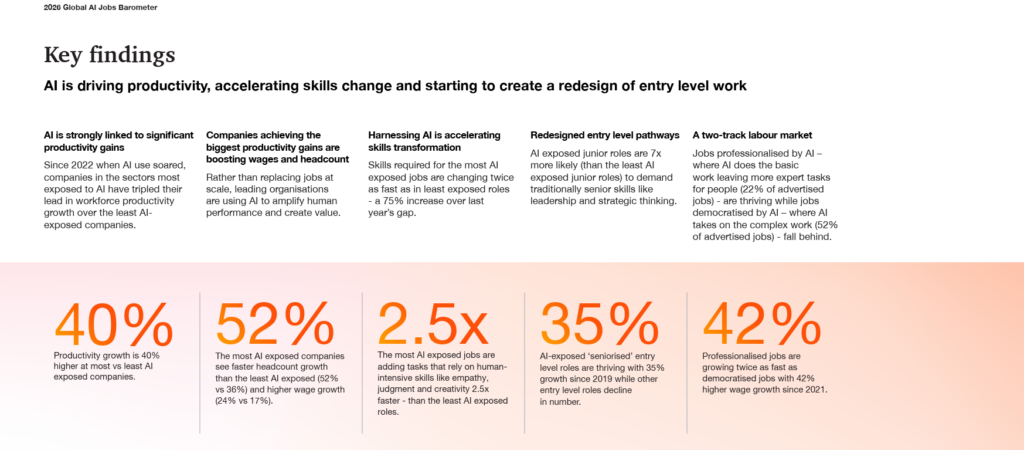
While companies across the globe are cutting numbers to invest more on AI, the PwC report states that most AI-exposed and AI-adopting companies are making “biggest gains” and are hiring more staff and increasing their wages.
“PwC’s 2026 Global AI Jobs Barometer analyses over a billion job ads from six continents to reveal that AI is creating a two-track labor market in which skills like judgement and leadership are even more critical–and more rewarded,” read an excerpt from the report.
The countries taken into account for this PwC report are Europe (Belgium, Denmark, France Germany, Ireland, Italy, Netherlands, Norway, Poland, Spain, Sweden, Switzerland and UK) Americas (Brazil, Canada, Mexico, US) Asia (Chinese Mainland, Hong Kong, SAR, India, Japan, Malaysia, Singapore, UAE) Australia, New Zealand and South Africa.
The report also states that most AI-exposed companies have 40% higher productivity growth and 52% faster headcount than least AI-exposed companies.
When it comes to hiring, consumer markets remain one of the largest sectors at 12.6%, despite an overall decline in its total job postings. Energy, Utilities and Resources (EUR) has lower exposure to AI than other sectors, The share of AI hiring in the Financial Services sector has accelerated with 5.4% share in 2025.
Also Read: AI Job Loss Fears Benefit AI Firms, Businesses: Andrew Ng