China continued to lead the global industrial robotics market in 2025, while India recorded strong 15% growth in robot installations to rank 6th, according to the latest figures from the International Federation of Robotics (IFR).
According to the report, the global operational stock of global industrial robot installations rose 9 percent to a record 5 million units in 2025, with factories worldwide installing more than 600,000 new robots, an 11 percent increase from the previous year.
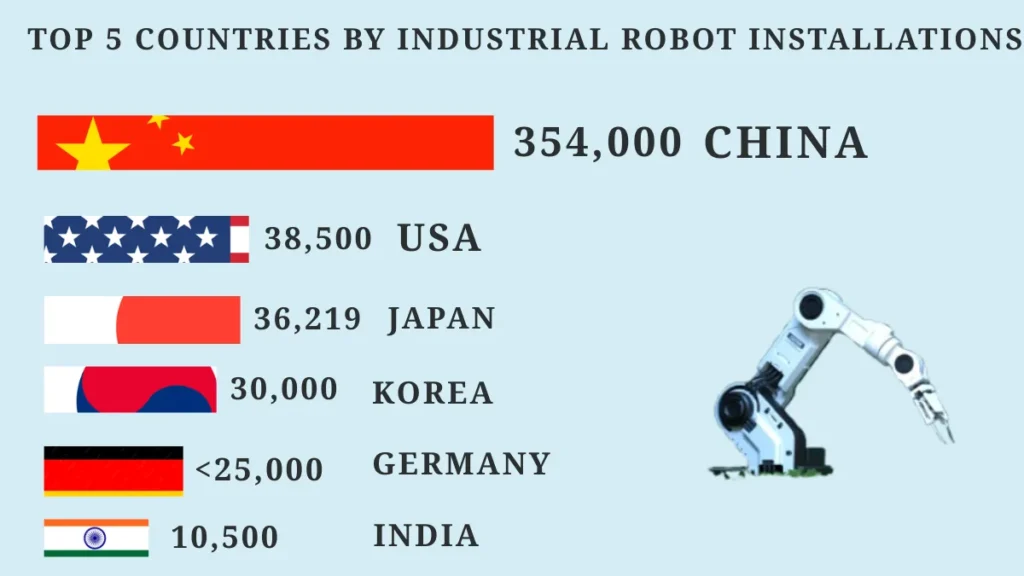
China accounted for 59 percent of global industrial robot installations, with annual installations rising 20 percent to 354,000 units in 2025. The figure was nearly 60,000 higher than the previous annual record.
“Global robot demand is expected to continue its long-term growth trajectory. Installations are forecast to rise by 9% to 655,000 units in 2026 and reach 806,000 units in 2029. Despite substantial regional differences, with countries such as China, the US, and India as strong growth markets, the global outlook remains positive,” the report said.
According to the report Chinese manufacturers also strengthened their position in the domestic market. Their robot installations increased 15 percent to 195,000 units, giving them a 55 percent share of China’s domestic industrial robot market in 2025, compared with 57 percent in 2024.
India, meanwhile, installed almost 10,500 industrial robots in 2025, an increase of 15 percent, placing it sixth globally, behind Germany.
Although the volume of new installations is still relatively low compared to the top 5 established robot adopting countries, the country has recorded rapid growth in recent years. Between 2020-2025 India’s annual installations grew by 27% on average per year (CAGR).
“India installed almost 10,500 units in 2025 – up 15%, claiming sixth place worldwide, behind Germany. Although the volume of new installations is still relatively low compared to the top 5 established robot adopting countries, India´s growth is remarkable: Between 2020-2025 annual installations grew by 27% on average per year (CAGR),” read an excerpt from the report.
The figures come as Asia continues to lead global growth in industrial automation, with the region accounting for the strongest expansion in robot installations.
“Industrial automation is progressing at high speed. The new mark of five million robots operational in factories worldwide is more than double the number seven years ago. The strongest growth is taking place in Asia, followed by America. Europe is moving ahead more slowly,” said Jane Heffner, president of the International Federation of Robotics.
Japan remained the second largest industrial robot market in Asia, although installations fell 19 percent to 36, 219 units in 2025. The United States overtook Japan to become the world’s second largest market, with installations rising 12 percent to almost 38,500 units.
South Korea installed around 30,000 industrial robots in 2025, down 1 percent while Germany remained Europe’s largest market despite an eight percent decline in installations to fewer than 25,000 units.
India’s Robotics Push: Challenges and Opportunities Ahead
A recent report by India’s NITI Aayog– country’s primer policy thinktank, observed that India continues to depend heavily on imports of magnets, batteries, high-precision sensors, specialized semiconductors and advanced motion control components. This creates vulnerabilities for domestic robotics manufacturing.
India’s Physical AI ecosystem is expanding across sanitation, underwater operations and defense, with robots taking on hazardous, repetitive and time-sensitive tasks.
Deep-tech company Genrobotics has developed the Bandicoot, a robotic system that cleans and inspects manholes and sewer networks without requiring people to enter spaces. The company has also built robots for drain and tank cleaning, creating a sanitation robotics ecosystem deployed by municipalities, government agencies and urban local bodies.
In the underwater sector, Indian company EyeRov has developed remotely operated and autonomous systems for infrastructure inspection, marine monitoring, search and recovery, and industrial applications.
Defense is also emerging as an area, with the report framing Physical AI around human-machine teaming rather than replacing soldiers. Robots could handle hazardous or repetitive missions while humans retain command and decision-making authority. The NITI Aayog report proposes an interoperable defence robotics stack, enabling startups, MSMEs, DRDO and defense companies to integrate systems through interfaces and standards.
Also Read: NVIDIA, Doosan Link Robotics, Power Systems to AI Factory Infrastructure