
The global labour-market environment remains challenging, with lukewarm economic growth and an increasingly uncertain global environment. In several subregions, youth population growth has also outpaced total employment growth, raising concerns about economies’ capacity to generate sufficient opportunities for young people.
Against this backdrop, the International Labour Organization (ILO), a United Nations agency, in its “Global Employment Trends for Youth 2026″ report, finds that global youth unemployment rose from 12.3% in 2023 to 12.4% in 2025, with 67 million young people unemployed worldwide, an increase of 2 million from 2023. Youth unemployment worsened or remained broadly unchanged in 8 of the 11 subregions.
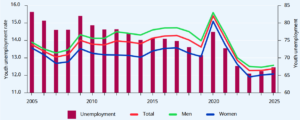
The share of young people not in employment, education or training (NEET) also rose, reaching 20% in 2025 from 19.7% in 2023. This represented an increase of 9 million young people in NEET status since 2023, bringing the total to 257 million in 2025.
Where youth employment is shrinking, middle-skilled occupations have been persistently among the most affected. These include clerical support, service and sales work, skilled agricultural, forestry and fishery work, craft and related trades, and plant and machine operators and assemblers.
The report said, “The ‘hollowing out’ of middle-skilled jobs thus includes some occupations that overlap with those deemed most exposed to disruption by artificial intelligence (AI) – mainly clerical and administrative occupations.”
On AI, the ILO estimates that 6.1% of jobs currently held by young people aged 15 to 29 fall into categories most exposed to AI and thus most at risk of some level of AI-task or job replacement.
If only 10% of the jobs exposed to AI were to disappear in full, it would translate into 5.6 million employed young people, largely in high-income countries, facing unemployment, changing jobs or exiting the labour force.
The report says recent attention around AI has focused on its disruptive effects on the labour market and the risks of dissipating entry-level employment opportunities amid the growing entrenchment of automation by large language models (LLMs).
Also Read: Gig Workers Face Growing Algorithmic Control, Human Rights Watch Says
It cites studies reporting employment declines among early-career workers in AI-exposed occupations, including a 16% relative decline among workers aged 22 to 25 in highly AI-exposed fields in the United States and a 4.5% decline in workforces at highly AI-exposed enterprises in the United Kingdom, with the effect concentrated almost entirely in junior positions.
The report also finds that AI skills will be an increasingly valuable asset for young people. While AI and other new technologies could create barriers to labour-market entry, the ILO notes that young people, as digital natives and quick learners of new technologies, could also have an advantage with employers, especially as AI literacy becomes one of the fastest-growing skills demanded across regions and job functions.
Yet digital and technical skills alone are not sufficient. The International Labour Organization stresses that human-centred skills, including social and emotional skills, remain important for working alongside artificial intelligence.
Also Read: AI in Workplace is Booming But Gallup, Pew and McKinsey Show Growing Disconnect