Artificial intelligence is rapidly expanding its role in climate monitoring, helping transform vast volumes of satellite data into actionable environmental insights. According to the World Economic Forum, AI is helping cut methane emissions through satellite monitoring, while the broader Earth Observation industry that includes this technology could unlock hundreds of billions of dollars in economic value.
In a new analysis, the Forum highlights a recent United Nations report showing that AI-powered satellite monitoring has helped cut methane emissions in the oil and gas sector, a climate benefit comparable to removing the annual emissions of nearly 24 million petrol-powered passenger cars.
The Economics Behind the Push
Beyond spotlighting the UN’s results, the World Economic Forum uses the report to make its own economic argument. A Forum analysis, conducted with Deloitte, finds that Earth Observation (EO) data could contribute more than $700 billion to the global economy by the early 2030s, with $263 billion of that value still unrealized, spread across gaps in data acquisition ($84 billion), data processing ($117 billion), and deployment into real-world decision-making ($62 billion).
The analysis also finds that wider EO adoption could help cut global greenhouse gas emissions by more than two gigatonnes a year.
Methane tracking in particular stands out to the Forum as a “dual-value” application of satellite data, delivering climate benefits and commercial returns at once. In the US alone, methane leaks cost the oil and gas sector an estimated $2 billion in lost revenue.
How AI is Doing Detection
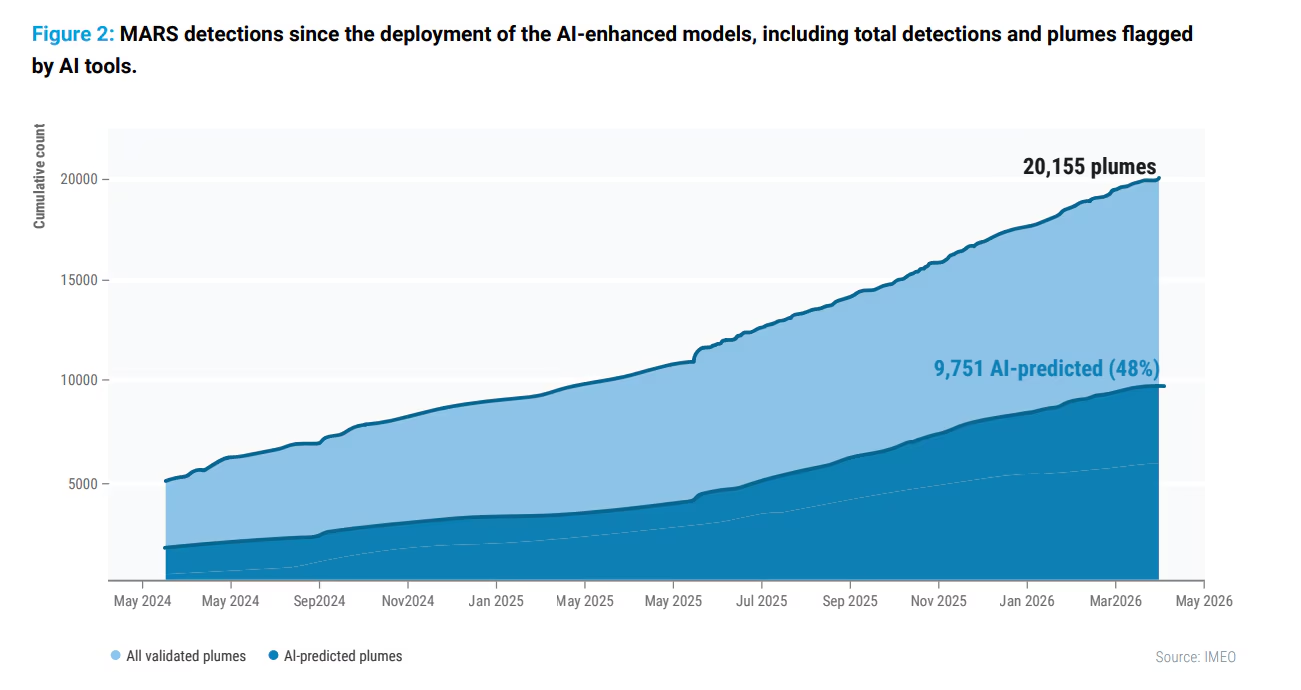
The Forum’s piece centers on “Spotlighting Opportunity: How Artificial Intelligence is Accelerating Methane Action“, a report published by the UN Environment Programme (UNEP). The report details how UNEP’s International Methane Emissions Observatory (IMEO) uses AI through its Methane Alert and Response System (MARS) to flag major methane emissions and notify governments and companies so they can act quickly.
Since becoming fully operational in 2024, MARS has contributed to more than 40 mitigation actions globally. According to UNEP, AI-assisted workflows now identify 80 to 85% of confirmed methane detections before human experts even review them, helping analysts process 12 to 15 times more satellite data while mitigating sources estimated to have emitted 1.2 million tonnes of methane.
“Methane is only the beginning,” said Martin Krause, Director of UNEP’s Climate Change Division, in the report. “The real lesson from this work is that AI can help convert the explosion of environmental data into practical action.”
“By combining scientific expertise with lightweight and energy-efficient AI tools, we can respond faster not only to methane emissions, but to a wide range of environmental challenges.” he added.
The UNEP model demonstrates that AI-driven climate solutions don’t have to come at a heavy environmental burden.
Why Methane, Why Now
The Forum’s analysis points out that methane is responsible for roughly a third of the warming the planet has experienced since the Industrial Revolution, with a Global Warming Potential around 80 times stronger than carbon dioxide over a 20-year period. That combination of high potency and a comparatively short atmospheric lifetime is why the Forum frames methane cuts as one of the fastest available levers against near-term warming.
Atmospheric methane concentrations reached about 1,942 parts per billion in 2024, roughly 266% above pre-industrial levels and the highest level in at least 800,000 years, according to World Meteorological Organization data cited by the Forum.
What Comes Next
The Forum’s conclusion is that AI and satellite monitoring have made methane detection largely reliable at scale. The remaining challenge is ensuring governments and companies act on what the satellites find.
Speaking at London Climate Action Week in June, UN Secretary-General António Guterres launched the Call to Action on Methane, under which governments are being asked to raise their response rate to methane alerts to 80% by 2030, up from just 12% in 2025, a benchmark that will determine whether this detection capability translates into real-world emissions cuts.
Methane drives around 1/3 of global warming and is 80 times more powerful than CO2. But aggressive cuts could deliver visible temperature benefits within a generation.
That’s why I’m launching a global call to cut methane emissions – in waste, agriculture & fossil fuels. This…
— António Guterres (@antonioguterres) June 23, 2026
Also Read: UN Chief Urges AI Firms to Disclose Environmental Impact of their Systems