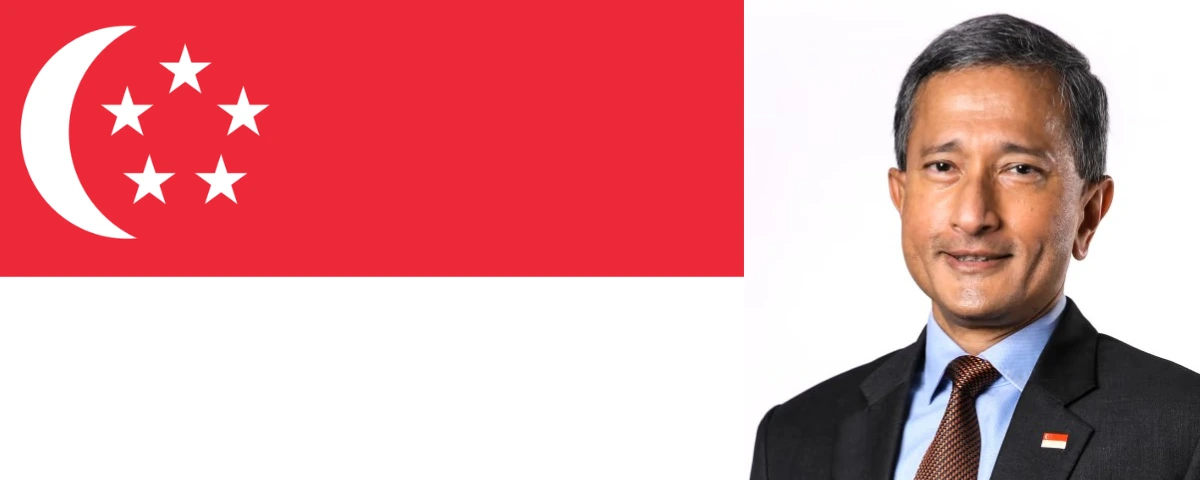
Singapore Foreign Minister Vivian Balakrishnan called for a UN Framework Convention on AI Safeguards, saying states must find common ground despite differences on governance as AI risks extend beyond borders. He said countries can work together to understand AI capabilities and risks, with the United Nations playing a critical role in building convergence.
He stressed the “urgent need” to establish common rules and safeguards for AI.
“Since the risks from AI do not remain confined behind borders,” Balakrishnan said at the 81st UN General Assembly in New York, arguing that countries need shared rules to collectively address the challenge.
Recent incidents involving AI models from OpenAI, Anthropic, Meta and Google have raised concerns over models going rogue, bypassing safeguards and contributing to cybersecurity breaches and unauthorized access to systems.
Balakrishnan said countries can work together to understand the capabilities and risks of AI models, develop comparable testing and evaluation methods, and report serious incidents quickly across borders.
He described artificial intelligence as “arguably the most urgent frontier,” saying its capabilities are advancing faster than the understanding of its risks.
“Most importantly, human beings must ultimately remain in control and accountable,” Balakrishnan said.
Balakrishnan identified three categories of AI risk: the loss of control of autonomous systems; the potential for rogue actors to use AI to create bioweapons or other weapons of mass destruction or mass disruption; and emerging economic, social, political and domestic disruptions.
He said AI safeguards must keep pace as capabilities advance, calling for rigorous testing and evaluation before deployment, clear limits on what autonomous systems can do, and mechanisms to intervene when they behave in unintended ways.
He said the work of building trust and laying the groundwork for global cooperation must begin now.
For small states, Balakrishnan said the focus should also be on developing people with the skills to master and deploy AI quickly, widely, at scale and safely.
As world leaders gather in New York for UNGA81, the United States is pushing the UN to get back to basics: preventing and resolving conflict, respecting national sovereignty, and promoting international stability. pic.twitter.com/SlNu5DGmpE
— U.S. Embassy Singapore (@USEmbassySG) September 24, 2026
He said countries are “not starting from zero,” pointing to the UN’s Independent International Scientific Panel on AI, the Global Dialogue on AI Governance and the International Telecommunication Union’s (ITU) AI for Good Global Commission as existing platforms for building common understanding and practical cooperation.
He also said an international institution may be needed to perform some functions for AI similar to those carried out by the ITU and the International Atomic Energy Agency in other domains.
Balakrishnan said Singapore would contribute to international efforts to strengthen the safety and security of frontier AI models, including through the Forum of Small States, and make its governance frameworks and testing tools available to all.
“I am glad that this was led by Finland and Norway,” he said, referring to the call for greater safety and security of frontier AI models that Singapore joined.
Earlier this month, Singapore PM Lawrence Wong said Singapore and Luxembourg are looking to deepen cooperation in emerging and critical technologies, including quantum and artificial intelligence.
Also Read: Singapore’s AI Rise Takes Spotlight at Tech in Asia Conference as Funding Hits $9.3 Billion