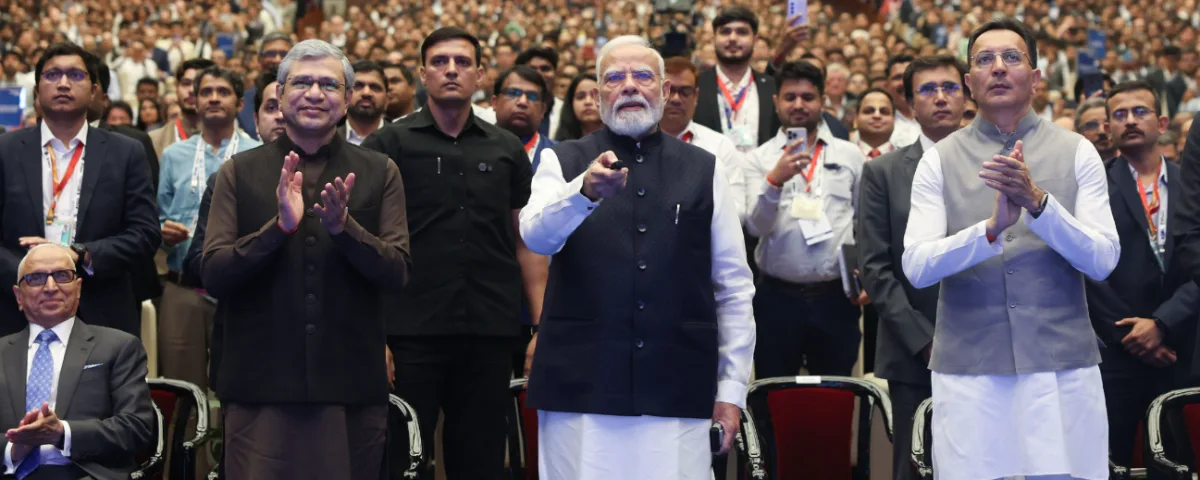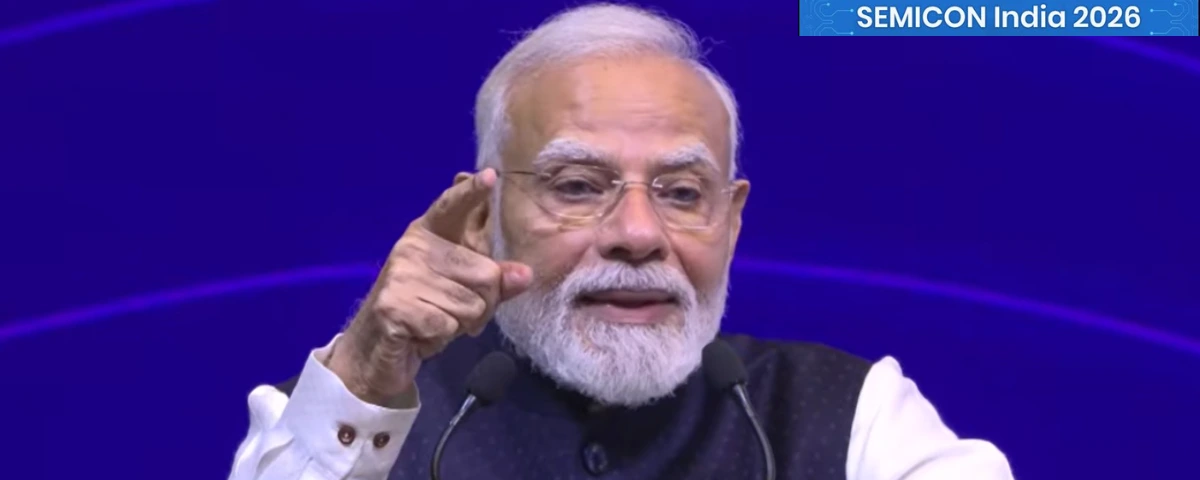
Prime Minister Narendra Modi on Thursday said India has entered the second phase of its semiconductor mission, as he warned that the growing “weaponization” of global supply chains has made the country’s semiconductor push more important.
Addressing the fifth edition of SEMICON India 2026 at Yashobhoomi in New Delhi, Modi said semiconductor ecosystems elsewhere had taken decades to develop, while India had worked on several parts of the industry at the same time.
“Wherever semiconductor ecosystems have been built in the world, they have been prepared after decades of effort,” he said, adding that India had worked simultaneously on chip design, manufacturing, equipment manufacturing, materials and testing.
Modi said India’s semiconductor journey had moved from policy formulation to projects, pilot lines and test chips, and now to commercial production.
“And this year, we are talking about commercial production,” Modi said. He added that chips were now coming out of Indian plants and reaching customers in India and abroad, while commercial production had begun at two more plants in Mohali and Surat.
Modi said India had started the second phase of its semiconductor mission, comparing it with the industry’s “tape-out” process, when a completed chip design moves into production. He said the first phase was about $8 billion, while the second phase had been set at $13.5 billion.
He also said further reforms would allow international companies to collaborate with Indian startups, design companies and OCI-owned companies.
Modi said the government had set a target of training 100,000 engineering students for the semiconductor industry, with more than 70,000 already trained. He also called for Indian researchers working abroad to connect with advanced-technology development in the country and urged semiconductor companies to take a leading role in R&D.
Modi said the government wants to expand the ecosystem beyond chip manufacturing, including through fabless companies, intellectual property, compound semiconductors, silicon photonics and infrastructure for AI. He also pointed to efforts to strengthen supply chains and develop the equipment, chemicals, gases and materials segments.
So far, 12 semiconductor projects have been approved, he said, adding that the scope would expand in the next phase.
Modi linked the semiconductor industry’s next phase to the rapid expansion of artificial intelligence, saying AI was creating new challenges for semiconductor design and manufacturing.
These include bringing memory closer to processors, connecting multiple chips to operate as a single system, transferring large volumes of data with minimal delay, and managing heat and power.
He said the global semiconductor market had grown by more than 20% over the past two years, with AI accounting for a significant share of the growth.
“Amidst these challenges, the world most needs new and reliable manufacturing locations,” Modi said, adding that India is continuously preparing itself for this.
Modi also linked the semiconductor industry’s expansion to energy security, pointing to rising electricity demand from AI data centres. He said thousands of high-performance processors operate together in AI data centres and that rising computing requirements would translate into higher electricity demand.
“That is why India is making very large investments in the power sector today,” he said.
Modi highlighted India’s expansion of power infrastructure, including solar capacity, which he said had risen from about 2 GW to more than 160 GW over the past decade.
He also pointed to India’s nuclear-energy plans, including the opening of the sector to private players and work on small modular reactors. He said that in the past decade, India had also expanded its transmission network.
Modi ended by linking India’s semiconductor ambitions to changes in global supply chains.
“When such a country succeeds in a critical industry, it strengthens the entire world’s supply chain,” he said. “And today, when supply chains are being weaponized, its importance increases even more.”
Also Read: Ahead of SEMICON India, USIBC Pushes Deeper US-India Tech Partnership