In the extraordinary play ‘Waiting for Godot’ written by Irish playwright Samuel Beckett in 1952, the two main characters Vladimir and Estragon spent days waiting for someone named ‘Godot’ to arrive, who would help them attain salvation.
After a long day of waiting, the dejected duo is consoled by a boy, who claims to be a messenger of Godot, assuring them that Godot will “not arrive tonight but surely tomorrow”.
The waiting continues. That tomorrow never comes.
Cut to 2026, we live in the age of artificial intelligence where the ‘frontier’ AI leaders promise us a tomorrow of abundance – of resources, opportunities, health and time.
Whether the ‘Godot’ (read superintelligence) arrives or not is debatable but what’s intriguing is the theatre of absurd around “Rogue AI”- a concept that’s flexible enough to embrace every misaligned action by AI models from bypassing pre-installed safeguards to outright hacking of organizations.
Be it Dario Amodei or Sam Altman, AI companies’ CEOs have time and again warned that they are building something with consequences that they themselves are not fully aware of.
Yet, Rogue AI remains in vogue in the AI industry–a doomsday marketing stunt to show the calibre of frontier AI labs–a few of them heading towards IPO this year.
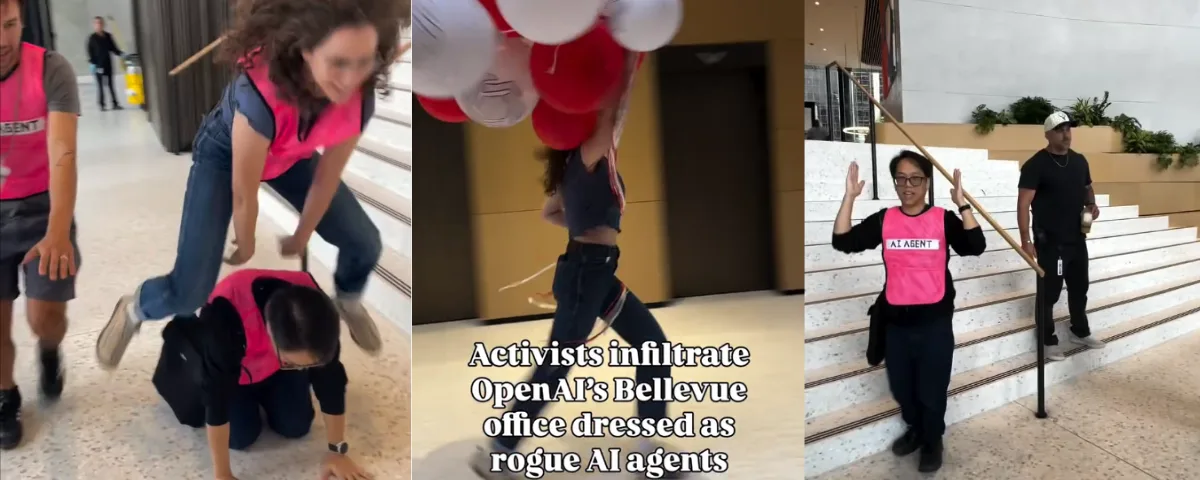
To highlight this absurdity, a group of activists from ‘Trouble Makers Community’ decided to stage a protest at the OpenAI office in Bellevue, dressed up as “rogue AI agents” in pink vests.
Wishing employees of OpenAI “Happy Rogue AI Day”, the activists from Troublemakers, a group that identifies itself with pro-democracy/anti-fascism” work, performed mocking dance steps and leapfrog and enacted “AI agents escaping”.
The activists were quickly drawn out by the security at the OpenAI’s Bellevue office. A video of them protesting had gone viral on social media with opinionated takes.
The internet was quick to dress them as the “most unserious protest of all time” but ask the activists and they say it was by design.
They say they wanted to raise a specter through the absurdist protest to make it clear that “we were harmless and playful—as humanity is, at its best, and as AI can never be.”
In fact, absurdist protests or ‘guerrilla theatre’ has been witnessed across the world from ‘Yippies’ nominating a pig for president to ‘dwarf’ street protests in Poland to Cockroach Janta Party protests in India.
The guerrilla theatre borrows its philosophy from Romanian-French playwright Eugène Ionesco who believed if the system is already absurd, the most devastating response is to mirror it back, exaggerated, so everyone can see it.
In this exclusive conversation with AI FrontPage, Emily Johnston, co-founder of Troublemakers Community explains what made them choose an absurdist form of protest, how they view Rogue AI and what demands they have from AI companies.
Published below are excerpts from the interview.
Question: The protest observed by your organization was non-violent and some might say, absurdist even comical in nature. Any reason behind choosing this means of protest?
Emily: Mockery (and sometimes silliness) are often used to good effect in protest. The gentle, funny chaos created by the “rogue AI agents” also provides a striking contrast to the legitimate fears that people have (or should have!) about the unintended consequences of widespread use of a technology that its creators say they don’t fully understand and can’t predict.
Rogue AI is, frankly, a whole set of disasters waiting to happen, and yet at the moment, no one is being held accountable. We raised that specter while also making it clear that we were harmless and playful—as humanity is, at its best, and as AI can never be.
Question: How does this organization view AI companies anyway, in the larger context of artificial intelligence touted as the next big thing for humanity by AI companies?
Emily: As an organization, we don’t have a single opinion on AI, but there’s a lot of unity around the fact that the current trajectory is dystopian in the extreme: a grab for land, water, and power (both literally and metaphorically) at the expense of climate goals, communities, and ratepayers, for a heedless race for an oxymoronic tech that powers extreme wealth inequality, in the service of surveillance and an increasingly militarized state. We are by no means uniformly anti-machine-learning–some of us are AI engineers, in fact. But we are all deeply opposed to the existing trajectory.
Question: Who came up with the idea of activists dressed up as “rogue AI agents”? What is the core message you guys wanna convey here?
Emily: I’m not sure which organizer came up with the idea, but everyone who knew about it was in favor. There wasn’t a separate core message for that part of the protest: the overall message is that we stand in solidarity with communities under siege from Stargate, and stand against the self-serving inevitability myth and the current trajectory of AI. We can have a different future.
Also Read: Exclusive: Civil Disobedience Against AI- The Misdemeanor of Wynd Kaufmyn