
The Position Paper Track (PPT) for the upcoming NeurIPS 2026, a prestigious AI/ML annual conference, has flagged 301 position papers out of total 969 submissions to have “substantially used” artificial intelligence; rejecting 178 of them and has asked for further proof of human efforts from 123 submissions.
NeurIPS PPT, a dedicated track for “perspective, arguments and meta-level opinions on AI research, policy and ethics, teamed up with Pangram AI to audit position paper submissions.. It is separate from NeurIPS track submissions for the upcoming conference in Sydney, Australia later this year in December.
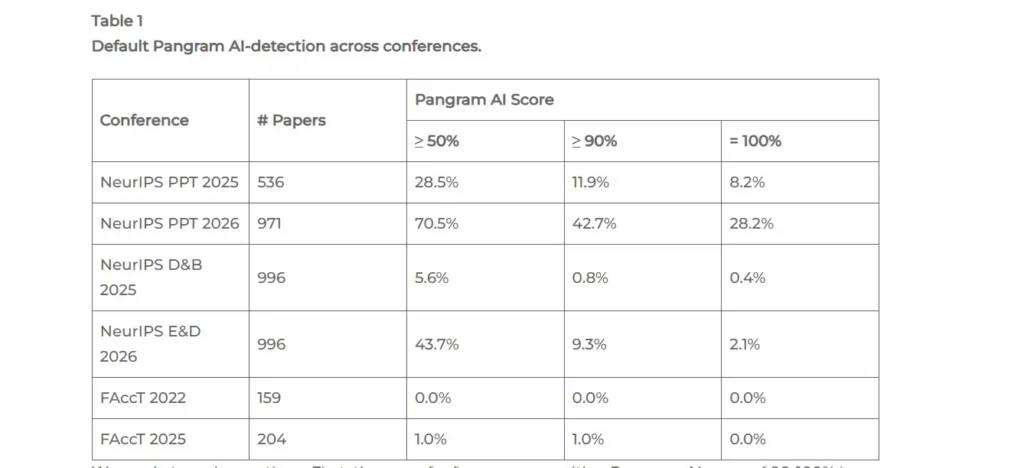
“Our preliminary investigation found that 28.2% (273/969) submissions to NeurIPS 2026 PPT received a Pangram AI score of 100%” read a statement from the NeurIPS PPT Chair on Tuesday.
“After several independent analyses to verify the correctness of this (Pangram) model and rule out scenarios in which significant false positives would be created, we are now making the difficult decision that 178 submissions will be desk rejected and 123 submissions will be requested to provide evidence of substantial human engagements or risk rejection,” added the statement.
NeurIPS 2026 PPT found over 70.5% Pangram score on 50% paper submissions, 90% score on 42.7% papers and 100% AI score for 28.2% papers.
The Position Paper Track at NeurIPS 2026 claimed that it has adopted a strict AI-use policy, requiring papers to be substantially human-written, with limiting the use of AI only to copy-editing.
“We took a conservative approach in policy this year as we believe in argumentative work like position papers, excessive use of AI in writing submitted papers has little benefit for the research community as a whole,” the organizers said.
According to the Position Paper Track policy 2026 AI tools can be used only for research purposes and for copy-editing but the final paper must be written by the author. The policy mentioned while submitting their paper authors will be required to state how AI tools were used in the preparation of the paper, if at all, and to attest that they have not used AI in ways contrary to the above rule.
It further stressed that if reviewers and authors violated their commitments of not using AI, then they may be subject to desk-rejection. “The use of AI to write papers creates an acute risk to the peer review system. Proactive steps are necessary to build the norms and institutions that will preserve its integrity. This policy is an attempt to begin that process,” the organizers informed.
Also Read: NeurIPS 2026 Creative AI Track Puts ‘Agency’ at the Centre