It’s a sweltering afternoon of May in Chandigarh, India’s first planned city. At a busy traffic signal the light had barely turned red when a rider nudged his motorcycle a few inches ahead of the zebra crossing. No cop stopped him. No whistle blew. No roadside argument followed.
A few hours later, his phone buzzed with an e-challan. Courtesy the AI powered Intelligent Traffic Management System (ITMS) of Chandigarh Traffic Police.
More than 2000 CCTV cameras, mounted high above intersections, powered by artificial intelligence and connected through a dedicated fibre grid, are currently mapping the city’s roads, catching violators ranging from red-light jumping to over speeding to illegal parking.
Police insist that AI has become a central force in enforcing traffic discipline in Chandigarh and numbers are telling.
Traffic challans in Chandigarh have surged nearly fivefold in just five years, with the sharpest increase coming after the city rolled out its AI-enabled Integrated Traffic Management System (ITMS) in 2023.
Data tabled in the Lok Sabha this week revealed that Chandigarh issued 995,000 challans in 2024 and 993,000 in 2023—staggering figures for a city long celebrated for its orderly roads and meticulous urban planning.
To put that into perspective, the city issued 603,000 challans in 2022, 242,000 in 2021 and just 181,000 in 2020.
Speaking to AI FrontPage correspondent Neelam Sharma, Traffic Police Inspector (admin) Surinder Kumar said Chandigarh’s AI-based monitoring systems are proving useful not only in issuing traffic challans but also in identifying suspicious movement patterns.
“The system can detect helmet violations, identify turbaned riders separately, track prohibited U-turns, seat belt violations, red-light jumping and even vehicles moving on footpaths. AI helps us in detection and identification through surveillance footage, face recognition and entry-exit tracking of suspects,” he said.
On the other hand, the reactions from Chandigarh citizens are mixed, with some insisting on strict implementation of traffic laws while others deeming automation as too harsh. In fact the transformation has been so dramatic that Chandigarh MP Manish Tewari joked that people living around the city have started calling it “Challangarh.”
Chandigarh-Every Second Vehicle Seems To Be Breaking a Rule
Hailed as India’s first planned city designed by Swiss-French architect Le Corbusier, Chandigarh houses over a million people as per Census 2011 figures.
The population figures from 2011 are outdated and misfitted to represent a city that has seen sporadic growth in the past decade. For context, a 2024 filing in Lok Sabha showed 995,000 challan violations registered in a year under IMTS.
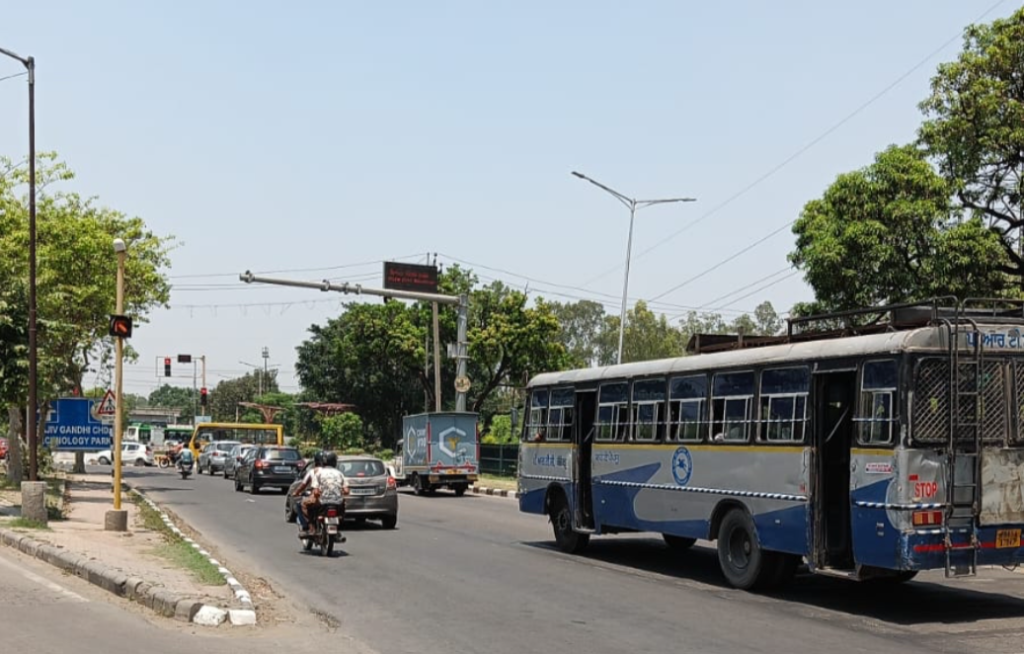
But if experience is indeed a clue, then one should spend ten minutes at any traffic intersection in Chandigarh.
A rider without a helmet cuts across lanes. A car inches over the stop line. Someone accelerates through a yellow signal. Another driver parks casually beneath a “No Parking” sign.
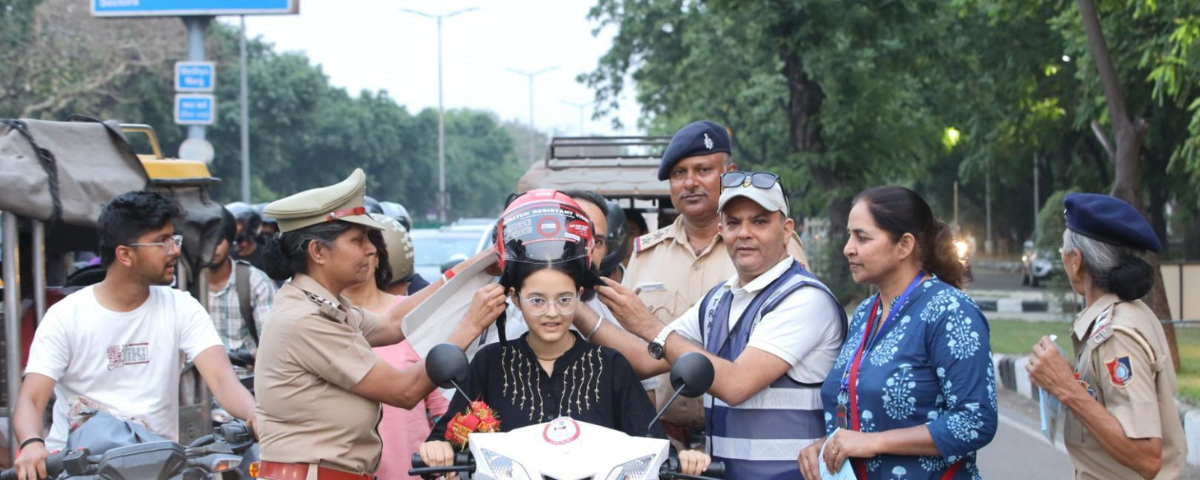
Data from Chandigarh Traffic Police shows that red-light jumping was by far the most common offence last year. A total of 4,97,297 challans were issued for signal violations alone, accounting for almost half of all challans generated in 2024. Overspeeding came next with 146,000 challans, followed by more than 110,000 challans for zebra crossing violations. Helmet enforcement has intensified dramatically. Authorities issued over 84,000 challans for riding without helmets, including more than 52,000 involving women riders. Wrong parking added another 26,000-plus challans.
Mapping Chandigarh’s Traffic at the Integrated Command and Control Centre
For decades, traffic enforcement depended largely on human presence, policemen standing at intersections under the harsh summer sun, manually noting violations or stopping offenders on the spot.
That system still exists in Chandigarh, but it is no longer the main force driving enforcement.
Today, the city’s roads and traffic movement are monitored at the Integrated Command and Control Centre at sector 17 in Chandigarh, where operators work in shifts monitoring live feeds and reviewing AI-generated alerts from intersections across the city.
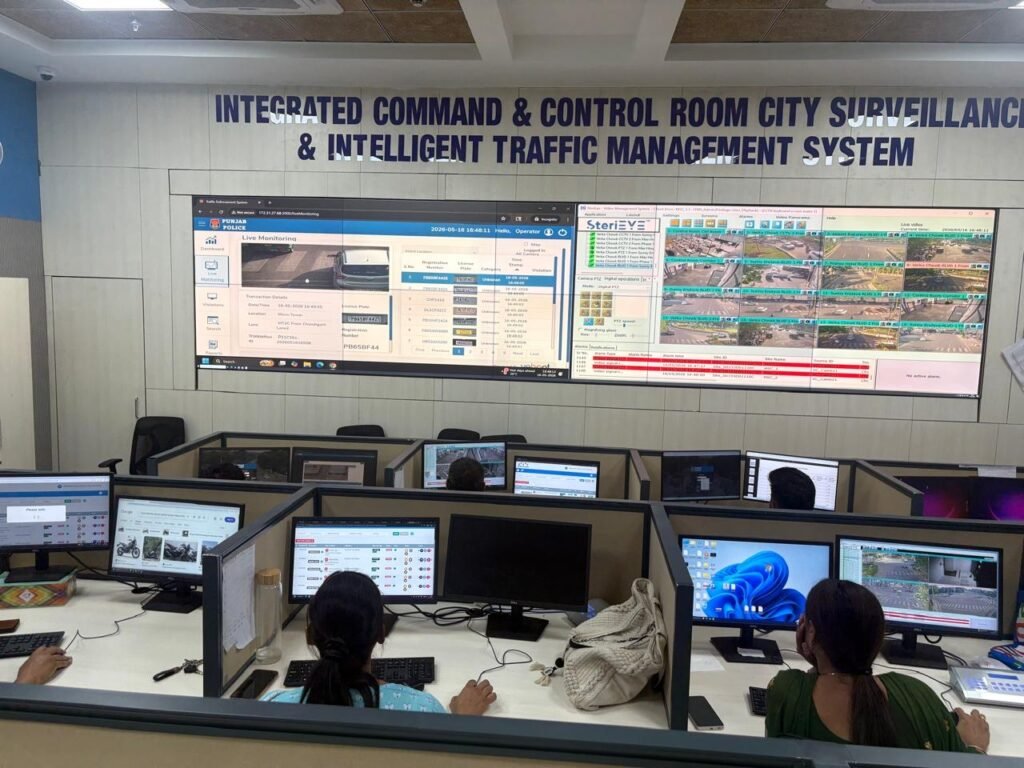
Cameras track speeding vehicles, read number plates and automatically flag violations.
It is policing driven not by instinct, but by algorithms.
Officials say that is what makes Chandigarh different from many other Indian cities where CCTV systems still rely heavily on manual observation.
According to government data, AI cameras generated 846,000 challans in 2024 alone. By comparison, traffic personnel issued just 148,000 challans manually during the same period.
In 2023, the gap was even more striking—891,000 challans were generated through automated systems, while barely 100,000 were issued manually.
“IMTS also allows human intervention during emergency situations such as ambulance movement. Moreover, if a person involved in repeated suspicious activity moves from one location to another, the system can trace movement patterns within 24 hours,” said Inspector Surinder Kumar, Chandigarh Traffic Police.
Voices From the Road: What People Say
Many Chandigarh residents acknowledge that the technology has changed driving behavior. Kulwinder Singh, a regular commuter, said the biggest difference is the disappearance of frequent police checkpoints.
“Earlier, there used to be naka-bandi and a lot of time was wasted. Now there is no need for roadblocks because people know they can be challaned without being stopped anywhere,” he said.
At the same time, he pointed to a common frustration.
“Sometimes incorrect challans are issued, and then people have to make repeated visits to government offices to get them cancelled.”
Taranpreet Singh said AI-based enforcement has also reduced opportunities for bribery.
“Corruption and bribery have come down. It saves time, and people are avoiding illegal parking and red-light jumping,” he said.
However, he warned that the technology is not infallible.
“Sometimes AI reads the wrong number on Vehicle’s Number plate and the challan reaches an innocent person. There is also not enough public awareness. For elderly people coming from other states, dealing with online challans can be a major headache.”
As enforcement becomes stricter, public frustration is also growing. Residents frequently complain that the system leaves little room for human judgement. A tyre crossing the zebra line by a few inches, stopping slightly ahead of the marker or making a split-second mistake at a crowded junction can trigger a challan.
The issue had even reached Parliament.
Responding to concerns raised by Manish Tewari, Union Minister of State for Home Affairs Nityanand Rai acknowledged that the government regularly receives representations regarding AI-based traffic enforcement. Many complaints, he noted, involve minor transgressions being penalized through automated systems.
The government, however, maintains that the process is fair. According to officials, every AI-generated challan is manually reviewed at the Police Command and Control Centre before final approval.
Chandigarh’s AI Traffic Model Is Spreading
What began in Chandigarh is now rapidly spreading across the Tricity region. In neighboring Mohali, authorities launched their own AI-enabled traffic management system earlier this year. Within just four days, Automatic Number Plate Recognition (ANPR) cameras generated nearly 7,000 e-challans.
But another statistic drew attention: barely 110 offenders paid the fines immediately. Within a single week, Mohali’s automated system reportedly generated penalties worth Rs 1.40 crore, fuelling debate over whether traffic enforcement is becoming a significant source of municipal revenue.
Mohali MLA Kulwant Singh has suggested that all revenue collected through e-challans should be reinvested in roads, signals and traffic infrastructure.
Meanwhile, Panchkula has intensified its own crackdown. In the first six months of 2025, Panchkula issued more than 45,000 challans. Helmetless riding topped the list, followed by expired pollution certificates, wrong parking and tampered number plates.
Beyond the Tricity, several Indian cities are adopting similar systems, including Bengaluru, which uses an Adaptive Traffic Control System, and Pune, where the expressway is monitored through an Intelligent Traffic Management System. Punjab Police is also integrating AI tools to identify accident-prone zones and improve enforcement.
Big Brother at the Traffic Signal
For traffic authorities, the technology represents a breakthrough. Chandigarh was originally designed for around 500,000 residents. Today, the city handles traffic from its own citizens along with neighboring Punjab and Haryana states..
Officials say traditional enforcement simply cannot keep pace. Yet the rapid rise of automated challans has raised an uncomfortable question: where does efficient enforcement end and excessive surveillance begin? Privacy and data-security experts caution that continuous collection of surveillance data could lead to misuse or leaks if robust safeguards are not implemented.
Despite these concerns, AI-driven traffic systems are expected to play a major role in creating safer, smarter and more efficient roads in the future. And unlike a human constable, the AI camera never looks away.
Also Read: Punjab Police Ropes in AI to Tackle Organized Crime Through Surveillance