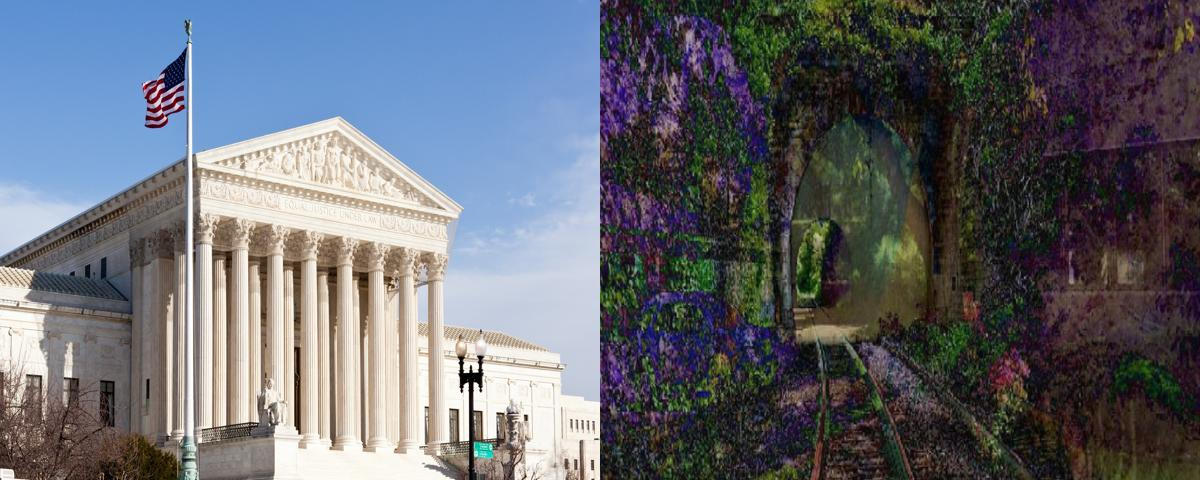
The Supreme Court of the United States on March 2, 2026 declined to hear a case about whether artwork created by artificial intelligence can be protected by copyright under U.S. law, leaving in place lower court rulings that require human authorship.
The Supreme court turned away the case involving a Missouri computer scientist who was refused a copyright for an artwork generated by his AI system. The denial appears in the Court’s official Orders List (607 U.S., March 2, 2026), which lists: “25-449 THALER, STEPHEN V. PERLMUTTER, SHIRA, ET AL.” under the heading “CERTIORARI DENIED.” This decision means the lower court’s ruling rejecting the copyright claim remains in effect.
The dispute began in 2018, when Stephen Thaler applied to the U.S. Copyright Office to register a visual artwork titled A Recent Entrance to Paradise, listing his computer system (AI system) “DABUS” as the author and explaining that the copyright should transfer to him as the owner of the machine. In 2019, the Copyright Office denied the application, saying copyright protection requires human authorship, a prerequisite for a valid copyright to issue, in the view of the Register of Copyrights.
After Thaler sought reconsideration, the agency’s Review Board issued a final refusal in 2022, concluding that the work was not eligible because it lacked human authorship. Thaler then filed a lawsuit in the United States District Court for the District of Columbia.
On August 18, 2023, Judge Beryl A. Howell ruled in favor of the Copyright Office, writing that human authorship is a “bedrock requirement of copyright.” The court also wrote “Plaintiff Stephen Thaler owns a computer system he calls the ‘Creativity Machine,’ which he claims generated a piece of visual art of its own accord.”
He appealed, but in 2025 the United States Court of Appeals for the District of Columbia Circuit affirmed the decision.
Thaler then filed a petition for a writ of certiorari with the Supreme Court to review the case, which on March 2, 2026, declined to hear.