US AI powers are turning to South Korea to secure the chips powering America’s AI buildout, as a global shortage of high-bandwidth memory (HBM) and advanced semiconductors pushes companies to lock in supply years in advance.
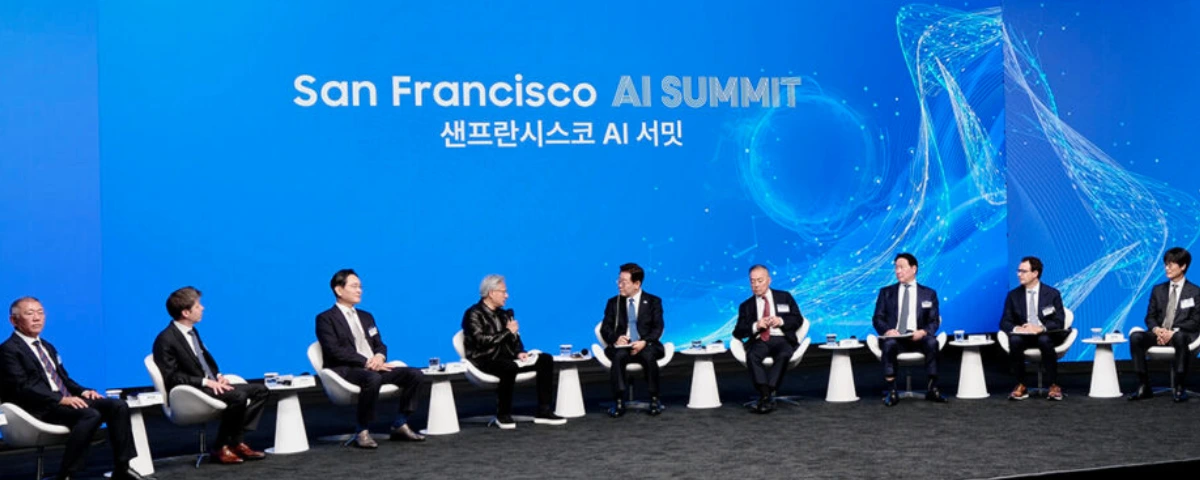
President Lee Jae Myung hosted the San Francisco AI Summit, bringing together the world’s top AI executives and South Korea’s largest conglomerates to strike a wave of chip and AI infrastructure partnerships.
Speaking at the summit, Lee said South Korea would lead the next phase of AI development in collaboration with global technology companies, using its “dynamic AI ecosystem” to expand the global market for both industrial and personal AI use.
The HBM market is effectively a duopoly, with South Korea’s Samsung Electronics and SK Hynix controlling roughly 80% of global supply, making them central to NVIDIA, Anthropic, and Broadcom’s plans to scale AI infrastructure.
At the summit, Lee met with the chiefs of NVIDIA’s Jensen Huang, OpenAI’s Sam Altman, Broadcom’s Hock Tan and Anthropic’s Dario Amodei. The event was also attended by Samsung Electronics Chairman Jay Y. Lee, SK Group Chairman Chey Tae-won, Hyundai Motor Group Executive Chair Euisun Chung and Naver founder Lee Hae-jin.
세계 AI 산업을 이끌어 가고 계신 네 분과 마주 앉았습니다. 혁신의 도시 샌프란시스코에서 다리오 아모데이 앤트로픽 대표, 샘 알트만 오픈AI 대표, 젠슨 황 엔비디아 대표, 혹 탄 브로드컴 대표를 차례로 만나 AI 시대의 협력과 미래를 함께 이야기했습니다.
AI 시대는 어느 한 나라나 한 기업의… pic.twitter.com/mqKQZWx32H
— 이재명 (@Jaemyung_Lee) July 25, 2026
South Korea announced $950 billion worth of new AI deals involving Samsung Electronics, SK Group and US technology companies.
Organized by South Korea’s Ministry of Science and ICT, the summit was held at The Midway venue in San Francisco on July 24-25. About 150 executives, investors, researchers, and startup founders attended, according to South Korean officials.
The ‘San Francisco AI Declaration’, unveiled by Lee at the summit, serves as a national roadmap to leverage South Korea’s world-leading memory chip competitiveness and production capacity, positioning the country as a AI chip production base and core supply chain partner for the world.
Also Read: Why HBM (High Bandwidth Memory) is Becoming Real Bottleneck in the AI Industry